• Happy U.S. Paper Money Day (1862)! 🟩🔙 💵

Solo on the Light Side

For this build, glassing is the area I have spent quite a bit of time researching, pondering and generally trying to get a good handle on the whole process. The point of taking another long look at how it works, is simply the goal of reducing weight and understanding the where and why of weight in the canoe.

Probably the biggest single influence for the overhaul of my glassing procedure and process came from Laughing Loon Custom Canoe and Kayaks (Rob Macks) Shop Tips video: https://laughingloon.com/epoxy.html

If you ever read this Rob, I really appreciate the article, it quite literally changed the way I see glassing.

To be able to wrap my head around the process, I broke it down to 3 layers ...

1) the part that absorbs into the hull
2) the layer of glass and epoxy
3) the fill coats on the top.

If you make the assumption that in any given application, if the glass layer and fill coats are done well, these become more or less constant weights, based solely on the depth of the glass/epoxy and fill coat layers. It follows that the only variable weight becomes the part that absorbs into the wood ... that will be a function of excess epoxy on the wood being available for absorption into the wood substrate.

In a typical wet layup, the wood is allowed to absorb as much epoxy as it can hold, that is simply a byproduct of keeping the glass wet to prevent the glass being starved of epoxy. In a dry layup, the wood is precoated/sealed prior to glassing and offers the opportunity to control the amount of epoxy used for the process. There are limits to this as well, manufactures suggested application rates seem a little scattered for seal coats used with composite layups.

That is the thinking, now for an example of how I see this working.

I decide that I need to save weight on a canoe build and opt to move from 6 oz to 4 oz glass,with a wet layup, what can I expect?

The epoxy will still absorb into the wood unchanged, so no change in Layer 1 weight, the fill coats still get aded so no change in layer 3 weight. So that leaves the glass/epoxy layer, obviously the glass will be lighter, but it will also have less depth, typical 6 oz cloth is 8 mil thick and 4 oz is 6 mil, so less epoxy will be required. The model I created gives a estimated weight for a 47 square foot hull (this build) at 2.5 pounds for 4 oz cloth and 3.4 pounds for 6 oz, a savings of ~.9 pounds. The estimated weights for fill coat is .9 pounds and the wet layup wood layer at ~ 1.7 pounds.

This suggests that half of the composite coating weight is from the fill coat (Layer 3) and epoxy absorbing into wood (Layer 1), which explains why reducing the cloth weight never achieves the type of weight savings you might expect.

In the past I have been of the opinion that precoating is a waste of effort, it requires allowing the epoxy to set before the glass can be laid out, which means sanding would be required and the loss of the chemical bond portion of the epoxy adhesion to the hull. Unfortunately, after reading the above post, something became quite clear ..... I started with a 5:1 epoxy and stayed with that epoxy because it worked and I was comfortable using it ... 5:1 epoxy requires sanding between coats, if you miss the tack stage and you pretty much need to do that, because trying to wrestle cloth on a tacky surface isn't going to pretty. This is the experience I had in my toolkit, so a seal coat meant more sanding, cleanup and a bond reduction ... clear cut reasons not to do a precoat.

The Laughing Loon link uses a System 3 Epoxy, which has a 72 hour recoat regime, which is a very big departure from what I thought I knew and reminded me that there is always new stuff to learn. This makes a precoat quite easy, put it on in the morning, then do the glass later in the day ... stay up later for a fill coat or just do it the next day, the reduction in stress for the whole operation was remarkable compared to the strict regime my previous epoxy required.

So, in short, I am going to use a precoat on this build, to hopefully save further weight.

On to the glassing, I am using 4 oz S glass and System 3 SilverTip Epoxy with both fast and slow hardeners, all new to me.

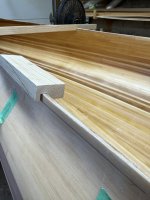
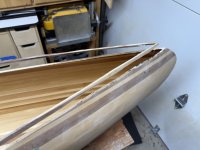
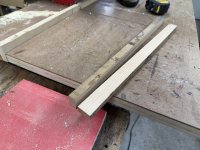
Since I intend to add 2 rub strips at bow/stern I get them cut on the bias before I start
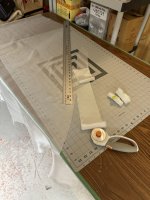
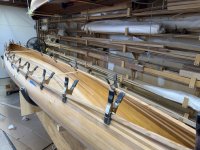
IMG_6878.JPG

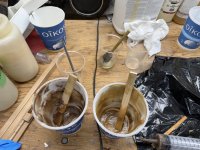
The mix station is setup to weigh each epoxy batch, the precoat will use the fast hardener. System 3 suggests using .5 fluid ounces per square foot of hull, this looks like too much for the hull to absorb, so I am defaulting to putting on just a solid coat like I was painting and not going back for any dry spots.
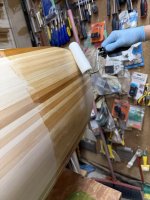
IMG_6898.JPG

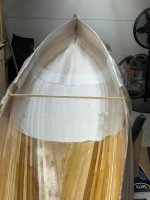
The precoat went on so easy and dried with a light sheen, fairly certain enough was applied, the good news is that the applications ended up weighing in at ~.85 pounds, meaning that about .9 pounds of weight was saved using the precoat.

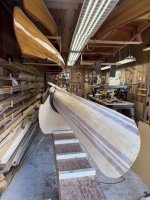
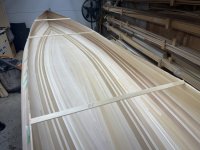
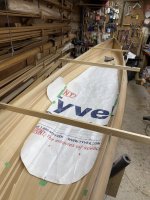
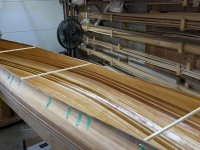
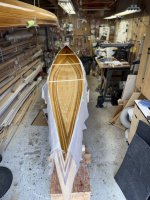
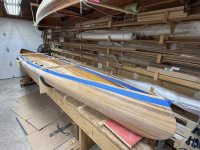
The glass was draped with a few extra inches of cloth at each end. I am using the slow hardener to get a water clear finish and give me max time for working, about an hour. The wetout was quite straight forward, using a 7" 1/8" foam roller, I did middle to end one half, other half, then repeat on far side, trimmed ends back about 1/2: shorter than the ends and applied the rub strips. Went back over quarters with squeegee and called it a night.

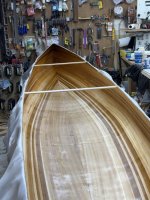
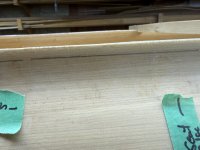
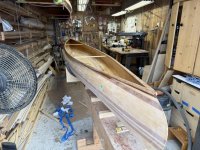
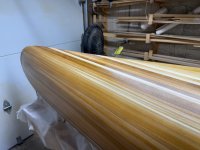
This is next morning, I am pretty happy with the initial coat

IMG_6910.JPG

IMG_6912.JPG

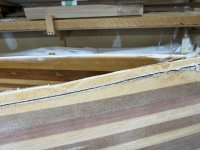
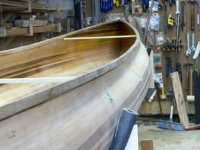
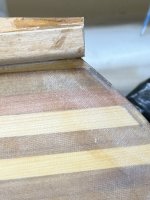
you can see the rub strips in this shot
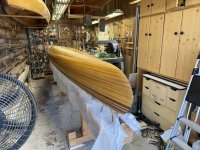
IMG_6922.JPG

the leftover epoxy in the tray released quite easily and looks to be glass clear, my regular epoxy has a haze to it, but this is just crystal clear.
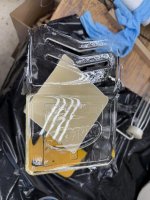
IMG_6918.JPG

the rub strips next morning

IMG_6925.JPG

and after feathering and a light sanding to blend
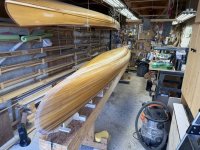
IMG_6928.JPG

then it was on to 2 fill coats, using fast hardener and the 7" roller. I find this epoxy tends to form a bit more, the bubbles break quickly, but I adopted a do 2 feet, tip off with a foam brush, 2 more feet, tip off ....

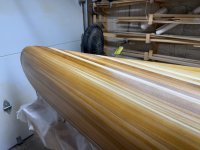
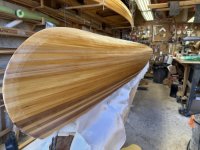
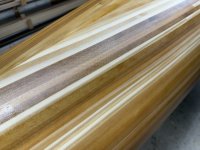
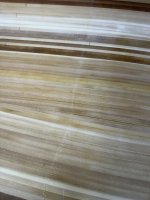
You never know exactly how the wood will look until you get that full wetout done, the white cedar got a lot darker than I thought it would, but I really like the shading,
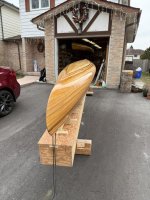
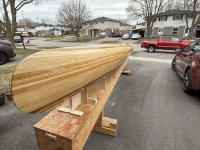
IMG_6933.JPG

IMG_6938.JPG

IMG_6940.JPG

I figure that swapping to 4 oz S glass and using the precoat have saved me almost 1.8 pounds, compared to a 6 oz wet layup ... on paper it looks like the 4 oz S glass should be fairly close in performance compared to the 6 oz E glass, albeit, their is a price to be paid for that performance ($$$).

The glass on this 17' hull is about .75 pounds less than the glass on the last 15' hull ... so it looks promising that the goal of not increasing the boat weight from last time, is potentially on track, but it is early days yet, but I am still optimistic.


Brian
 

Attachments
  • IMG_6912.JPG
    IMG_6912.JPG
    108.9 KB · Views: 7
  • IMG_6910.JPG
    IMG_6910.JPG
    146.6 KB · Views: 9
  • IMG_6910.JPG
    IMG_6910.JPG
    146.6 KB · Views: 5
Last edited:
Great work Brian !
I used to seal coat, many to facilitate filling gaps and holes. Shortly after applying the seal, I'd come back and go over the staples holes, with another coat, worked fine.
The main problem with seal coating, was be sure there are no dust particles in the seal coat. If not removed ? They will lift the cloth away from the hull. Theses are a pain to sand down and patch. Some try and inject resin. Doesn't work well.
Looks Great !

Jim
 
How did the rest of this turn out, Brian? The hull looks great, and there is so much valuable information to pick out of your thread! Thanks for sharing all the little details. Your shock cord system is very interesting, and it looks like it worked really well. Between that and the Jimmy Clamps (tm) it makes staple-less almost look like fun!
Cheers!
 
TPG ... it hasn't actually "turned out yet" . Around spring time I ran into a couple of issues that needed my time. It is sanded inside and almost ready for glassing, I am projecting to restart in about 5 days. Just finishing putting handles on some Damascus steel knife blanks for Christmas presents, then I can finally get back to the canoe .... stay tuned
 
Thank you for taking the time to put all this together. Your brain is clearly wired for writing instructions. I always appreciated the Stuff Rob Macks posted on the Kayak forum. This thread makes me feel a little guilty not including more details in my thread. I'm also going to try stemless on the next one.

Your boat looks beautiful.
 
Time to get moving on the rest of this build ... left off with sanding the exterior to 120.

Given all the curving, the hull cannot be simply lifted off the forms. The individual forms need to be released from the strong back and angled out.

At this time I like to add markings for the form locations on the hull, I label and attach painters tape labels before I release and flip the hull.

IMG_7126.JPG

New cradles will be required when the hull is released and flipped over. Both the #3 stern and #3 bow molds will be removed and at this point de-fanged, so happy to be rid of those steel teeth.

The forms are laid out on 1/2" ply and given a 1/2" margin around the form, cut out, smoothed, the strong back attachment cleat, for the form, is then added..

IMG_7125.JPG

IMG_7129.JPG

IMG_7130.JPG

When the hull is flipped, I had to leave the bow and stern assembly in place ... they are tight and it is much easier to remove them after rotation.

IMG_7134.JPG

Final step for the new cradles is to add 1/2" pipe insulation foam to snug up the fit and protect the hull. A note here, the 1/2" margin was to accommodate the foam I used.

Measure the base width of the #3 bow/stern and centre forms, then cut a hull separator stick for each.

IMG_7142.JPG

All the stations are removed, at this point, new cradles installed at the correct bow and stern stations. With the foam in place, the canoe is placed in the cradles. These cradles are snug, so it is required to line them up with the appropriate makers on the hull to make it settle in well.

IMG_7133.JPG

To work on the inside I need to tilt the canoe a bit for easier access .... so I just cut a couple pieces of ply to angle the cradles. And Jim, before you say just angle the strong back, I agree that is a great solution ... it just isn't going to work with this strong back, in the area I have. I have been delayed in this build and we have a "crap ton" of snow, so outside is not viable. I also added some shock cord holders to keep the hull spacers in place.

IMG_7145.JPG

IMG_7146.JPG


I have covered the sanding regime before, so I won't get too detailed here, first a light scraping to level, then 80 grit on an ROS for the bottom, hand sanding for bilge turn and tumblehome section ... this curvy type of hull is the "Prince of PITAs" for sanding IMO. The final step is to lightly pencil the entire hull and do a light 120 grit sanding .... by hand.

Ending up with this

IMG_7536.JPG


At this point it is time to plan the glass application. I knew I wanted to reinforce the seat area and laying that out, I started thinking that I could also add in a "trimmed" football section. I put quite a bit of thought and effort into making up the design and template.

IMG_7488.JPG

The estimated weight cost was going to be 12 oz. ... then reality crashed in on me, I was falling down the "reinforcement" hole. In another post, Allan mused about how ppl had generally started adding extra glass when it likely wasn't needed ... what started as a simple seat area strengthen had morphed into a full insert, which arguably wasn't required. Alan at that time had also pointed me to his Barracuda build, also 17', also relatively narrow, also just using 1 layer of 4 oz cloth and the world didn't end, the boat didn't sink. BTW Allan TY for the reality check.
This build is "weight conscious" using S glass, so I revised the plan ... breaking the glass into 3 sections, overlapping at the seat area for 14" to provide the "extra" and at the bow thwart for 4" ... estimated weight cost is about 4.5 oz, which I can live with.


This will be the first time I have ever used sections of glass, instead of a solid piece. The plan is to make templates of each of the end pieces and precut the rounded sections, hopefully making the fitting process easier, when the glass is settled on the hull.
A quick trip to the local Dollarama yielded template material

IMG_7506.JPG


For $1.25, this was likely the least expensive item on the build, it got cut in 2 pieces .... then draped over the bow/stern

IMG_7513.JPG

Carefully draw in the shape

IMG_7515.JPG

Draw in a line about 1/2" in from the tracing to give some clearance

IMG_7516.JPG

Carefully cut on the clearance line to give a completed template for each end


IMG_7517.JPG


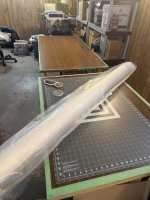
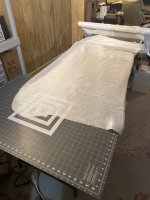
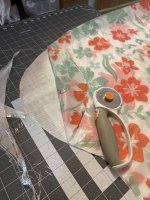
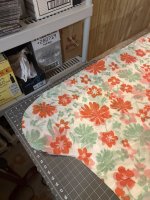
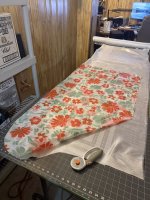
Glass cutting station (actually my sewing area), note the rotary fabric cutter, which IMO is the best way to cut FG if you have the work surface.

IMG_7524.JPG

I am cutting 3 pieces of glass, so unroll and cut the 3 lengths required ..

IMG_7529.JPG

Two of the FG pieces will be cut to fit the round fronts, take the stern piece and carefully fold it length wise without creasing, lay the stern template on top, then carefully cut the shape with the rotary cutter

IMG_7528.JPG

IMG_7531.JPG

IMG_7533.JPG

Repeat for bow Section, the FG sections are all cut and shaped for installation.

The night before glassing:
- I warmed the shop up to 72F
- planned the day without interruptions
- did a final vacuum of the hull
- setup my epoxy station
- checked my organic vapour respirator (closed shop, it's winter, this step is pretty important PSE IMO)

Glassing day, I got up and straight to the shop to do the precoat. This took about an hour, used 3 x 240 ml batches System 3 with fast hardener (details at the end of this section). While this was curing, I went in for coffee and breakfast.

IMG_7538.JPG

Around noon the epoxy was pretty much ready.

One small step I usually do at this point is mix up a small batch of epoxy and go around wetting any areas that need some fill. Thicken the rest of the epoxy and colour as required and fill each area, a light rub down to flatten and remove any excess.
I don't wait for this to setup, just install the FG and go ... it just sort of melds in and doesn't show.


The centre piece is placed first, then the stern and bow. Here the centre is down and the stern piece has been laid in on top, the fit at the stern nose is not too bad. The overlap area is ~14" and is where the seat will be installed, so that is the re enforcement I wanted. The bow section isn't shown, but it is basically the same with a 6" overlap.

IMG_7543.JPG

This time I will be using System3 with slow hardener, 5 x 240 gram batches were used. First pic is shows completed application, the second one shows one of the overlaps.

IMG_E7549.JPG

IMG_7545.JPG

The coat was left to cure overnight and in the morning, the excess glass gets trimmed and the two overlaps need to be feathered a bit.

The closeup of the overlap looks like this

IMG_7553.JPG

and what was a bit surprising is the buried side of the overlap, it is really hard to see, even when you know where it is, virtually no bump or visual clue.

IMG_7554.JPG


and just a light standard feathering, I am just knocking down the high edges and will try and leave some texture.

IMG_7551.JPG

A look from a little bit back after feathering

IMG_7555.JPG

and after a light epoxy coat to seal the feather back up

IMG_7561.JPG

For those of you interested in the weights, the precoat came in at .73 pounds and the glass application weighed in at 3.5 pounds ... this a total of 4.3 pounds for the inner glass.

The hull now weighs 22.4 pounds ... I am on track .... now on to the gunnels.

And mem ... this time I took your advice from last build and am not using the fill coat ... I am reasonably careful with the boat and I don't think I would ever damage the interior FG enough to matter.


Brian
 
Although our building styles are very different, your's being careful and analytical, mine belonging to the wood butchers school, you have just replicated my last 20 or so builds with your interior glassing. Except for the careful pattern making and cutting, lol. I just unroll the glass sideways and cut it off the roll when I reach the other side of the hull. I can't remember the last time I used a full sheet on the inner hull. Your overlaps were about the same as mine as well. I will be doing the same in a few weeks to the modified Pal we are building for the school club.
 
Interesting about the overlaps not being visible.
So maybe when you apply Bias strips to the stems, you might want to bury them as well ?

In my experience, feathering overlaps makes them totally invisible. I defy anyone to find the edges of my extra layer over the football.
I have on just a couple of occasions, done a two piece interior. I was careful to make the overlap, under where the seat, so as to Hide them. They are still visible.
To me the single layer is faster, and not that much harder to do. One and done.
I realize it's just a canoe, and small things like overlaps, and screws on the gunnels are not a big thing !
If you can make something a little pretty ? Why not ?
Just my $.02 worth.

Oh ! now would be a great time to make a Kevlar copy ! Hint ! Ha.


Jim
 
Interesting about the overlaps not being visible.
So maybe when you apply Bias strips to the stems, you might want to bury them as well ?

In my experience, feathering overlaps makes them totally invisible. I defy anyone to find the edges of my extra layer over the football.
I have on just a couple of occasions, done a two piece interior. I was careful to make the overlap, under where the seat, so as to Hide them. They are still visible.
To me the single layer is faster, and not that much harder to do. One and done.
I realize it's just a canoe, and small things like overlaps, and screws on the gunnels are not a big thing !
If you can make something a little pretty ? Why not ?
Just my $.02 worth.

Oh ! now would be a great time to make a Kevlar copy ! Hint ! Ha.


Jim

You may have missed the point of the overlaps ... it was to beef up that area, the one overlap at the seat was 14", but the other point was I believe it made fitting the ends a lot easier
 
It also makes working wrinkles or bubbles out a heck of a lot easier. Just push it toward the overlap and get rid of it. I usually keep the top overlap of the next piece folded back until the previous piece is completely wetted out and then fold it back down and roll it on.
 
Nice looking build. Thanks for sharing!

Especially thanks for showing your uniwale design. I'm going to keep it in mind with my own current build. I've always done scuppers in the past, including one with the 3/4" x 3/4" overbuild. I honestly think that those come from the fact that it's an easy dimension to cut out of 1x stock, rather than any real thought about how much strength is required.
 
So it's gunnel time in the shop, I had to go back and review the earlier posts on cutting the gunnels, to make sure I didn't miss anything.

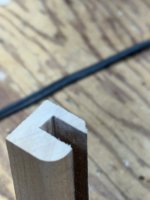
One of the things not covered yet is the current shape of the gunnels, the round over and chamfer have been added, so the profile now looks like this

IMG_7604.JPG

I mentioned I like to bob off a bit of the sheer to get a clean working edge, so I made up a block with a measured slot ~3/8" deep, this will be used to draw a reference cut line

IMG_7560.JPG

Nice dark line to cut along

IMG_7559.JPG

I stewed a bit about how to cut this, it's a bit more than i usually take off, so sanding and planing isn't as viable. I settled on my oscillating saw and that worked very well

IMG_7557.JPG

going around the end

IMG_7571.JPG

and a look at the new working top edge

IMG_7573.JPG

Just to explain the increase in the bit taken off, the Uniwale actually has a top portion that makes the sheer higher than plans. I've lengthened the boat, so it will ride higher, I can afford to take off enough to keep it closer to the design height, the extra is just dead weight IMO, so I can save a bit here (about 200 grams).

Next I need to mark the depth of the Uniwale slot on the inside and outside of the hull. To do this I just lopped off 5" hunk of Uniwale and used it as a guide

IMG_7595.JPG

Next, I fitted the gunnels onto sheer and cut one end to match the centre of the canoe

IMG_7587.JPG

IMG_7576.JPG

This one is the angle cutoff and it also shows cutting the little bit on the inner gunnel cut out. I do this to allow a better fit on the inside of the canoe

IMG_7584.JPG

Cut the second gunnel angle so it sits nicely, I don't worry about the ends at all, I will be taking the end portion off and recapping the end.

IMG_7585.JPG

If you read this and are considering trying Uniwales, you should plan according to how you intend to finish the ends. If they will show you need to carefully fit the ends, in this build I will be capping the ends and there will also be decks, so most of the gunnel end stuff doesn't show.

Next, tape along the gunnel line, inside and out ... everything above the line gets sanded

IMG_7594.JPG

IMG_7600.JPG

I made up a 80 gram batch of epoxy (fast hardener) wetout everything above the painters tape and saturated the inside slot of each gunnel.

IMG_7607.JPG

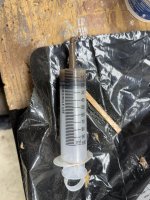
Prepared a 120 gram batch of epoxy, thickened and tinted with woodflour and cabosil (fumed silica), this got loaded into a 100 ml syringe from Amazon, they are inexpensive and really work well for squeezing a bead of thickened epoxy into the gunnel slot

IMG_7608.JPG

IMG_7609.JPG

That pic of the syringe is after use, pics during epoxy work are tricky and I like my phone (not so much like, more it is costly) too much to risk it.

The gunnels are installed one at a time, but in the same session. The one just filled gets inverted starting at one end and working your way along till it is seated. Hopefully if you try this, you will have already done the fitting a few times and will have the hang of how to slowly work the gunnel onto the sheer.

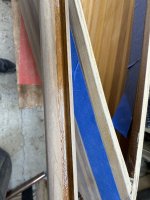
Clamp in place using the larger "Jimmi Clamps" ... this picture shows the clamps, but it is actually later in the process. Once both gunnels are in place, the excess epoxy is scraped/wiped to remove as much as possible. Any epoxy left at this point will need to be cleaned up later, and hard epoxy is a pita to remove. Once you have gone around the boat once, I go back to the first clamp, remove it, rewipe inside and out and peel off the tape inside and out, replace the clamp, repeating down the gunnel until all the tape has been removed (pic is from this point). The last step just keeps the tape from being epoxied to the canoe, which is also a pain to cleanup after it sets.

IMG_7611.JPG

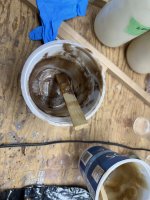
Leftover wetout epoxy cup (back), thickened batches to seat the gunnels and the used syringe ... I keep the leftovers till the next day to check that the epoxy setup properly.

IMG_7612.JPG

The next day the clamps come off and we have

IMG_7619.JPG

IMG_7617.JPG

The uniwale joint looks like this

IMG_7621.JPG

and a couple of voids needed a little extra

IMG_7622.JPG

The ends aren't fancy or well fitting at this point, but it was never intended they would be

IMG_7627.JPG

You will notice they are longer than required and that is intended, we are going to cut the end and install a cap across the end

IMG_7628.JPG

The excess gunnels are cut back to the hull edge, keeping the cut perpendicular to the line of the gunnel

IMG_7636.JPG

Bit of a side bar ... this is a pic from the gunnel cutting, the larger fifth piece on the right here, is leftover, but intended to provide matching cherry to the gunnels for the various pieces like thwarts/gunnels/seat cleats etc.

IMG_6207.JPG

I cut a chunk off the cherry extra and ripped it in half to provide the various pieces, such as endcaps, that match the gunnels.

IMG_7631.JPG

A couple smaller chunks were made to serve as endcaps and then a clamping solution was figured out. This is the dry fit and test

IMG_7640.JPG

That worked well, so the piece were saturated with unthickened epoxy and the end buttered with tinted, thickened epoxy and clamped in place

IMG_7649.JPG

Next day the clamp is removed

IMG_7651.JPG

and the endcap piece is cut to the same angle as the gunnel side

IMG_7658.JPG

A small shaping rasp is used to finish the job of matching the endcap to the gunnel shape

IMG_7663.JPG

IMG_7664.JPG

The gunnels are installed and the endcaps are shaped to fit into the flow of the gunnels. The gunnels will be finished once the thwarts/seat/handholds and yoke have been installed, if you sand or round the edges, it will be much harder to add fitting and other pieces to the gunnels, I did that once ... now I leave them untouched and square (for now). The endcap finishing will be finalized with the installation of the decks.

For those interested in weights, the removed portion was 195 gram ( ~7 oz), the gunnels when installed added 3.70 lbs and lastly the hull now weighs in at 26.2 lbs

Brian
 
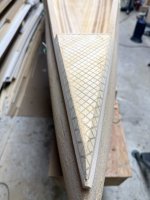
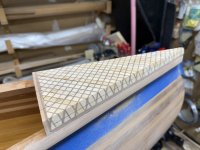
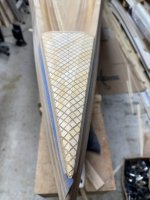
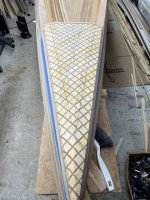
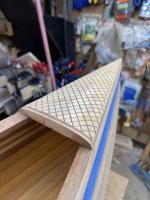
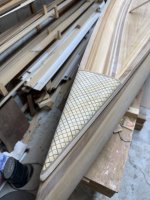
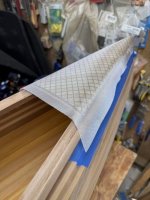
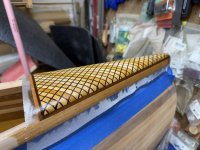
Time to get some decks done ... I know some folks don't do or like decks on a canoe, but since I tend not to make the canoe stripping fancy, the decks are the only place I get to personalize things, so I do.

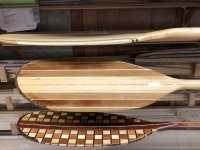
The history of this deck design has it's roots in the last paddle set I made, the checker pattern was a "Tartan" of sorts for a Scottish friend. In my head I wanted to use a finer pattern, but the method/skills, at the time, just won't allow that.

IMG_5381.JPG

A year later I figured out what and how I was going to use that pattern for the decks ... first step was getting a few materials ... I paid an unholy amount of money for this western red cedar board (2" x 6" x 10'), but you just don't find the chocolate coloured ones very often, I will stretch it's use over several projects and tell myself it wasn't that bad.

IMG_7026.JPG

Next I milled up a portion of that board and some white cedar I had laying around into standard 3/4" thick pieces

IMG_7027.JPG

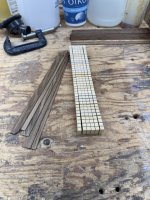
A 24" piece of the dark WRC got cut into 20 mil strips, that was a fun challenge, but a bit of researching and you can come up with a jig to do just about anything

IMG_7031.JPG

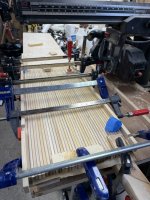
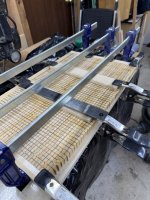
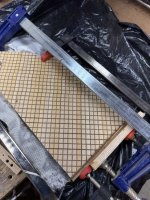
The white cedar was converted into .25" strips, which was somewhat faster and easier to do. In this pic you see the white cedar strips and the dark strips ... in the back ground you can see the them separated into groups of 4 white strips with dark between, those are the "glue up" sets. This is done simply because I wanted to use spring clamps for the gluing and ~1.25" is a good width for them and it makes a convenient "chunk" of material.

IMG_7672.JPG

For a glue up like this, picking the right glue can be the difference between getting it done, getting it done poorly or just giving up the idea. The stuff available to me in the shop is LePage Express Glue, TB II Pro, TB III and 2 kinds of epoxy with fast and slow hardeners.

The basics of this task:
1) is that there is a lot of real estate to be glued for this
2) it is all cedar
3) weight matters
4) time matters

We are gluing cedar, so the bond strength for all products is overkill. There is a high contrast in the woods already, so tinting to make the joints pop a bit isn't required (epoxy feature). The weights of the various products (yes, glues add weight) are in about the order listed, I think epoxy for example would almost double the final weight compared to the express glue ... this is largely due to the solids content of the products. Learned this from the paddle, it used epoxy and was measurably heavier.

Doing the glue up is straight forward,but there are a lot of pieces getting put together and taken apart, so that is the main requirement of the job. I am using the LePages Express glue for this, the main reason is for the 10 minute clamping.

IMG_7675.JPG

Now you are probably thinking it will take forever (it did take some time), but with that short clamping time, it is pretty much a continual process, with several "chunks" on the go

IMG_7674.JPG

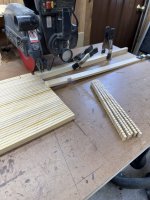
Then the chunks are glued together, to form a big striped slab ... I was amazed that it only took just over an hour to get the assembly this far

IMG_7683.JPG

Now that I put all those pieces together, it is of course time to take it all apart again. I set up my radial saw to cross cut exactly .25" strips, even made a fancy hold down to keep the cut strip from flying away

IMG_7736.JPG

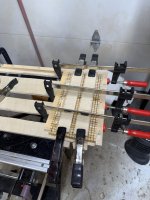
For this gluing session, 6 crosscut strips and 5 dark strips are going to be glued up for each chunk

IMG_7741.JPG

a new gluing jig for this purpose was assembled, pictured here is 3 chunks being glued together. In practice, each chunk is done separately, then when 3 are completed, the 3 are joined, then set aside.

IMG_7737.JPG

When all strips are cut, then all the triple sets are then glued up. The clamp time here is just 10 minutes, so it moves almost continually.

IMG_7744.JPG

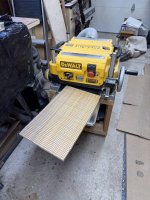
next day it is ready for a quick plane and I am wondering what I have got myself into with this idea

IMG_7746.JPG

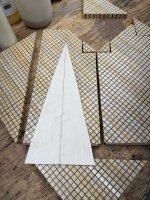
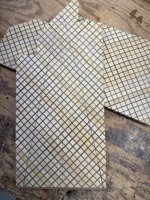
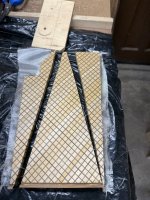
The pics get a little scattered at this point, I got excited and started cutting before doing the clicking, so bear with me. The idea wasn't for checker or squares, it was diamonds ... so the deck forms I made get placed on the "bias" to draw in the cut shapes

IMG_7752.JPG

IMG_7754.JPG

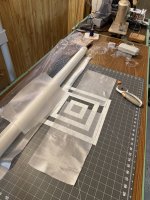
The decks will be fiber glassed, so a couple rectangles of 2 oz cloth were cut ... I have said it before, if you can cut your glass with a rotary cloth cutter, it is the best way IMO

IMG_7756.JPG

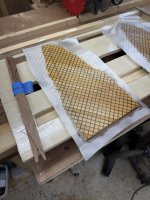
The shape lines are drawn on the bottom of the deck and this is where the first cloth get added, on the left side you will notice a couple of dark cedar strips that are already cut and shaped, there is a set for each deck

IMG_7760.JPG

When looking at the deck blanks, I realized that the decks where light and dark , while the cherry gunnels where somewhat of a middle colour. The extra dark strips are to provide a dark outline of the deck where it meets the gunnels

A dark strip and a cherry strip are added to the deck base to complete the effect

IMG_7766.JPG

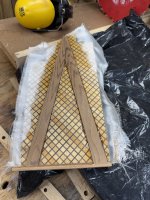
and then a set are added to the side, coming to a forward point, all are epoxied in with dark tinted epoxy, I want the joint to make a clean, sharp line to create high contrast for the decks. Carrying the dark cedar around the bottom perimeter, just seemed like the appropriate aesthetic

IMG_7767.JPG


Once the epoxy has set, the shape is cut out on the band saw. This cleans up the glass and the blank is ready to be installed

IMG_7764.JPG

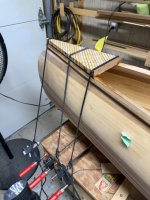
A few bar clamps and shock cord provided an easy clamping solution with more dark tinted epoxy, holding it all together

IMG_7769.JPG

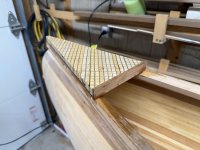
Next day, we have more of a lump than deck at the end of the canoe

IMG_7787.JPG

The gunnels at the bow/stern are angled in, so the angle of the gunnel is extended through the deck side. I use mostly shaping rasps, the set I got is from Lee Valley https://www.leevalley.com/en-ca/sho...V95YICHILrLImqPBcl21kgwUQAdh_D6oaApgUEALw_wcB

This isn't an advert, just trying to give an idea of what works for this task. I have several different flavours of rasps and sometimes you have to go back and forth to figure out what is working best (at least that is how it is for me), in this case I put away the larger rasps and went strictly with the smaller ones.

Just take your time if you try and install decks like this, this is getting started

IMG_7789.JPG

This is now ready to be shaped

IMG_7798.JPG

There are any number of ways to do the shaping, I take a page from paddle shaping. First draw in a center reference line, next line on the gunnel face of the deck ( .25" in this case), then measure from the deck top over (.75" in this case) and draw a line, repeat other side

IMG_7825.JPG

remove everything between the 2 lines, create a flat area from line to reference line

IMG_7833.JPG

Draw another set of cut lines, I think these where .375" on the face and .75" on the top

IMG_7834.JPG

remove everything between the 2 lines, create a flat area from line to reference line

Now we have this shape, not round, but very much closer to what we want

IMG_7836.JPG

At this point I load some 80 grit in a small flat sander and just knock off any corners and get rid of any rasp marks. Hand sand through 120/150/220 with a foam block until you are happy you cleaned it all up. In this pic, you can see a gap at the nose and there is another small one on the other side ... I put tape on either side of the gap, filled with tinted epoxy and cleaned it up after it set.

I believe it was RickR who quoted his carpenter friend " It is only a mistake if you refuse to fix it"

IMG_7816.JPG

Add some tape to protect the hull, drape the outside fiber glass

IMG_7837.JPG

And on goes the first coat ...

IMG_7845.JPG

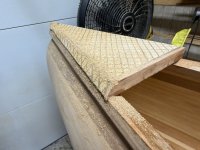
And 3 coats later and the extra glass trimmed off, the decks are complete

IMG_7876.JPG

The deck weights are about 1.5 oz each, so not too much of a hit on the weight budget and I am pretty happy with how they turned out.

This much gluing and cutting is not for everyone, but I learned a bit and have a new (to me) experience for the "bag o tricks" ... on to the thwarts


Brian
 
Last edited:
Back
Top Bottom