• Happy Birthday, Simon Fraser (1776-1862)! 🧭🏞 4️⃣9️⃣

Alan's Bloodvein II

I can add a couple off observations to the innie-outtie debate, lol. I have always put a football on the outside (football first, under the full sheet). However, the only major destructive events that have happened with my canoes have been inside hull separations, which lends credibility to the inside football idea.

There is another however, however.

I had an 18 foot J. Winters Quetico that I had built early in my canoe building experience, and I only used a single layer on the outside hull. It held up fine, however, on one port clearing trip down the Steel river, a particularly difficult log jam made for some interesting acrobatics at the end of the port. There was about a six foot cliff that one had to negotiate, and once the canoe was in the water, I simply jumped off the cliff into it. Unknown to me, there was a large tree underwater, and when I landed, the glass on the inside hull split for almost 2 feet in a line running up the centre of the canoe. We were still several ports and around 40 miles from an extraction point, and it was a very hairy trip, with the big split winking at me with every paddle stroke. I was sure the exterior glass was going to separate at some point and we would end up Titanic-ing.

I know that if I had a second layer of fibreglass inside the canoe, the catastrophic failure would most likely not occurred. However, I also believe that of I had a football on the outside, it mightn't have occurred. Or, even if the results were still the same, I would have at least had 12 ounces of glass holding the winking gap together for the final push.

The other similar event happened in my first Raven. On that one, I used 4 once cloth for the football, covered with 6 ounce for the whole sheet. I had a single layer of six inside. I was on a trip with the school, paddling at full speed, when I ran up hard on the point of a rock. The contact was right under my feet, impact was severe. Again, the glass inside the canoe fractured, but only for about 3 inches. I was able to conduct a repair in the field, as I usually took a small resin/glass repair kit.

If weight were not an issue, I would say do the inside and outside. On my 20 foot freighter, due to the size and use of a motor and the unimportance of weight, I did multiple layers of 10 and 6 ounce cloth, inside and out.

For some unknown reason, despite evidence to the contrary, I still continue to put the football on the outside, perhaps because I treat my canoes so rough, lots of dragging, etc.

I did stretch that Quetico out to a 20 foot canoe, and on that one I used a single sheet of 10 ounce cloth on the outside and the inside. That was a bomb proof layup, and after 20 years of hard use, that canoe is still going strong. On the Quetico the students are currently building, we will be using the standard exterior football (under the glass). The Under-over football is a discussion where I think everyone should just do what they like best. I haven't experienced any adverse effects from doing it my way, and our canoes probably get beat up a lot more than the average stripper, so I'm going to speculate that the under/over debate is more a matter of personal preference than one of structural integrity.
 
No need for apology, Jim. I intentionally do things that are unconventional (my wood choices, using 4 oz glass instead of the standard 6, thinner strips, gel stains under the glass, lighter gunwales, installing float tanks, etc) and I expect that some of those will be unpopular. Some may even result in shortened hull life and, possibly, a catastrophic failure (perhaps even mid-trip).

I do wish I'd looked at the Freedom lay-up prior to glassing the exterior of this one- I didn't realize that the football was s-glass and the extra abrasion resistance of s-glass might be helpful (even though I've only gouged all the way to the cloth once).

S-glass is more expensive (like double the cost), and the abrasion resistance of an "innie" layer is irrelevant, so an "outtie" football layer (30 inch width) would be in order with an s-glass football layer IMO. I can still do that on this hull (and may before 2027) although I'd much rather have it as part of the original lamination.

As for punctures causing the wood core to separate, I'm sure a puncture would allow the wood to start soaking up water but I usually beach & inspect the hull after severe impacts so it wouldn't get very wet before I could slap some Gorilla tape on it (I haven't been carrying epoxy & glass in the bush). Even if it continues to soak, I'd think the surrounding glass should be sufficient to maintain hull integrity for a little while. Plans, at that point, might be "paddle faster, stop taking thousands of pictures, and know that the clock is ticking".

If the boat hits the burn pile upon my return home, I'll build another (I'd have an open slot in storage lol)

I'll admit that I may want to rethink my in-field repair kit. It sounds like Mem has broken more boats than I've built and if he's toting epoxy, perhaps I should too.

Then again, he's portaged full coolers of beer while I opt for the weight savings of hard liquor and, having seen the 6 foot drops on the Steel River ports, I'm not launching myself from the top rope and hoping to hit the boat (besides, my right ankle would kill me for that)

As always, I appreciate the insight of other builders here, even if they're sure that I'm nuts (they're not entirely wrong, you know) and I'd encourage anyone thinking of building to post detailed threads like this. They may get an occasional "yeah... I'm not so sure about that" comment but they'll also get honest discussion and the reasons for any skepticism.

Back to the build... Interior glass has been delayed until (probably) Tuesday due to family members who need some help. I'll be pushing the "72 hours to get chemical bond" on the fillet but I can scuff it if I need to, the adhesion to the surrounding wood should (I think) provide adequate strength and the fillet will still strengthen that joint and help to eliminate voids under the glass in that area.

Happy Sunday to all.
 
Last edited:
Gamma, a suggestion for you to try next build. If you do something like the knuckle and maybe crack fill here and there again, let it sit for 15 minutes and then go ahead with glassing. You obviously need to be careful laying the glass at the sticky parts, but it will still move and sit in place well. When you continue with the epoxy, the wet areas just blend and settle perfectly. No sanding or fussing.
When I do the hull touchups now, I just plan an extra 40 minutes on glass day ... the technique has it's limits, but is a useful time saver.

Brian
 
Wow, some days are better than others and today was a tough day at the boat shop. I've often wondered about those who've built one boat and swear they'll never do another and, I suppose that, if this were my first, I might join them.

It has absolutely nothing to do with the hull design or, really anything that I can put my finger on but I finally got a chance to glass the inside and it just wanted to fight me.

I was a little worried that I would run short of epoxy so that didn't help the stress level but then I kept dragging the glass so that it was pulling loose from the sides. I tried a foam roller but that didn't seem to be working so I finally went back to the plastic squeegee. It worked much better for forcing the epoxy through the cloth, especially in the overlap areas where I was wetting out 3 layers at once.

I did need to be very careful to keep the cloth pressed against the hull after it was wetted-out and there were several instances where I had to fuss over it but, by using my free hand to hold it, I managed to get it done.

I used a small paint brush to wet out the stem areas and tuck the wet cloth into the ends then placed the float tank panels in place, covered them with cloth and wet them out.

This was more difficult with epoxy all over my hands (actually, my gloves, of course) and I might have some loose strands to clean up tomorrow. We'll see.

DSCN4382.JPG

Overall, I'm pleased with the result although it took almost 4 hours to get it done.

I'm not sure how much epoxy I'll need to attach the gunwales but I'll probably order another 3 gallon kit. I was really expecting to suck air on one of the pumps tonight and that might have put me over the edge. If I don't order, I suspect that I'll regret not mixing a 1/2 batch to finish up.

DSCN4384.JPG

As it is, I'll probably have the phone on "do not disturb" from now on when I'm in the shop. I have a job interview in the morning and they sent me 2 e-mails, 2 text messages and the recruiter even called once (I answered none of them since I was covered in epoxy).

That's probably for the best because, if I had, I'd have probably told them that their persistence today makes me think that they've been hiring too many irresponsible people and I really have little desire to work with people who need those kind of reminders.

Thanks for letting me vent. I should be calmed down by morning.
 
You are not alone gamma we have all had those kind of days. I was almost done after finishing my first boat but a strangers words propelled me to try again and again and ultimately all I wanted to do was boat work and had my own shop for 30 years.
Jim
 
Glad you got through it. I had a similar experience on the interior of the last hull I glassed. It took forever and felt like I was working with two left hands.

Alan
 
Thanks guys. All better this morning.

I usually walk away when the frustration level gets that high (it keeps me from breaking things). I seriously considered taking advantage of the "you have 72 hours to finish" thing... anybody ever stopped mid-operation & come back to it later?
 
Interview went well, thanks. She may have even convinced me that they'd be a good fit.

I stopped over today to see what kind of disaster I made yesterday and was very pleasantly surprised. Despite everything, the final result is probably the cleanest I've done so far. There were a few places where some sawdust "crumbs" were embedded (from doing the fillet and not removing the football layer to clean afterward) and 2 minor places where I managed to get an air pocket under the cloth.

Both are superficial IMO, neither will, in any way, affect performance and I'm doing nothing to correct them.

If all goes really well, I might throw it in the water Sunday (thwarts clamped in place and outer gunwales left off) to see where I place the seat. Speaking of which... I think I've solved the issue of wiggling it in there and still having it become a lateral support structure.
 
Well, Sunday came & went (maybe I meant next Sunday) but I'm back to making some progress.

I got the inner gunwales fitted this afternoon & I probably do them a little differently than most.

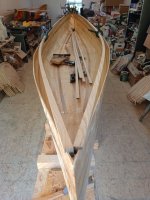
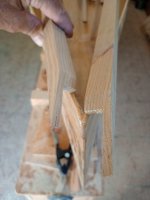
First, I loosely clamp them near the center of the hull so that they overlap (I've never tried one-piece and I'm not sure I could do them this way. Also, please excuse the growing disorder in the canoe shop. It needs a good cleaning but will not get it before June 8th if I'm going to finish these 2 boats before WPASCR)

IMG_20260518_172928988.jpg

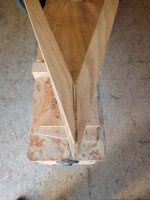
I then eyeball the first cut to align with the centerline of the boat

IMG_20260518_173100867.jpg

Cut out the underside to provide clearance

IMG_20260518_173646096.jpg

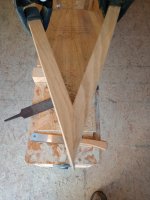
and then adjust the angle as needed to make them even(ish)

IMG_20260518_173900629.jpg

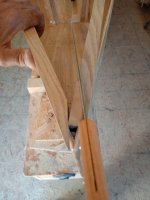
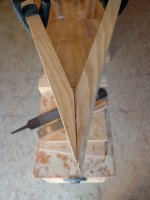
Once they're reasonably close, I squeeze them together and cut between them with the pull saw, pulling them tighter into the bow or stern as needed.

IMG_20260518_174056299.jpg

By cutting both gunwales together, I soon have a nice, tight fit.

IMG_20260518_174212186.jpg

Once both ends are fitted, I arbitrarily pick a point near one end of either side and (somewhat arbitrarily and almost certainly controversially) cut an angle. Pretty much any angle, I don't really get fussy.

IMG_20260518_174629966.jpg

I then mark the other half of the gunwale, leaving it intentionally longer than I think it should be.

IMG_20260518_174920369.jpg

and start trimming it a little at a time (yes, I sometimes cut the top of the sheer but it'll soon be buried in epoxy)

IMG_20260518_180757766.jpg

until both pieces come together nicely on the inside of the hull.

IMG_20260518_181304596.jpg

I don't worry at all about the outside of the hull at this point since I'll be trimming all of that off before installing the outer gunwales.

I've ordered more epoxy because I was worried about running short. Hopefully, I can glue & screw these on Wednesday evening.
 
Hi Gamma,
I will throw in my 2 cents here ... gunnel is structural. Nothing wrong with gluing them, but it needs something like a 10:1 to maintain integrity. The angle you have is almost all end gran and will break with very little force. The angle isn't important, but the ratio is, that is not going to give you the strength required for the gunnel iMO.
If it is not too late, make the ratio high enough to provide the structural strength the gunnel needs.

Brian
 
Hmm... I'm epoxying the full length of the hull and screwing through the hull into the inner gunwale every 18 inches or so. I also epoxy the outer in place (no screws) making sure that I overlap the inner scarfs by several feet.

I know the gunwales are structural but (glued, screwed and overlapped), I've thought that they had sufficient strength (actually, I sure hope so, the Freedom that's made 2 trips to Canada and the Raven which should go this Fall are both done that way)

Epoxy came today so I'm hoping to get them on tomorrow. I'll take a look at what material remains & the possibilities of extending the scarfs.
 
I suppose if you are gluing the entire length to the hull, there will be an added strength factor, but even with that, the short scarf will be an area of weakness. I'm thinking of a catastrophic event, such as a pin, particularly if you have a short scarf on both the inwale and the outwale. Of course the beauty of building your own canoes is that you are free to experiment with structural dynamics and perhaps set a new trend as the "short scarfer".
 
Thanks Mem. I don't really want to buck every bit of conventional building wisdom but I do try to understand the physics involved and it does seem that full-length glue-up on both sides would make it difficult to get enough pressure on the weak point to cause damage. (though I've been wrong before)

At the same time, I'll agree that a longer scarf is stronger, I'm already reducing the gunwale material by about 50% (inners and outers are both 3/8 inch plus the thin strip that caps the top) and this hull is expected to go places where extraction becomes problematic so a healthy amount of overkill may be wise.

I've got a few hours of work to do and then I'll head over to the shop (my epoxy came yesterday). I'll see if I can devise a (boat-mounted?) jig of some sort to cut a long scarf consistently (might save time fitting everything on future hulls anyway) and try it.

I just can't screw up too many times. My wood-working buddy had cataract surgery yesterday so it'll be a few days before he's able to help and I have about 8 feet (two 4 foot pieces) of cut-off gunwale with which to work. Margin of error is pretty low if I'm to make the deadline.

PS: I don't worry too much about catastrophic events like pins. The way I've figured it, I'm building too light to withstand something like that, if I screw up that bad in the bush, my boat will fold like a cheap suit and quickly become woodland detritus. I'll try to cleanup the mess as much as I can (probably by burning it) but I'll then be finding my way out on foot. The end result is that I'm a bit of a whitewater coward and I'm almost certain to portage anything sketchy.

To be perfectly honest, the "few km of continuous whitewater" downstream of Stewart Lake on the Kap has me a little concerned for the 2027 trip. I think it'll be OK going in August though... Maybe water levels will be low enough that I can drag Alan's boat over the rocks like I did the Freedom Solo on the Steel River. Come to think of it, maybe I should add an s-glass football outside after all 🤷‍♂️
 
You could glue a splice over your scarf. I've seen that done.
That would solve the strength issue.
Jim
 
Another opting is cut a slot on the inboard face and insert a spline. I have a slotting bit for a router so I would use that but it could be done with a straight bit in a router with a fence. Might look nice with a contrasting wood or make it blend in with the same species.
Jim
 
I generally think of the gunnel as providing continuous structural support and stiffness along the entire canoe. Compromising the support in an area simply means that area is not as supported as the rest of the structure. With that shallow of an angle, it is essentially a butt joint ... no amount of hull fastening is going to restore the lost structure.

This isn't something that is going to send the craft to the bottom the minute you get in, it is just built in weakness that may or may not cause an issue. It's that darn saying someone mentioned in my last build " it is only a mistake if you refuse to fix it".

If you have already applied the gunnel and are thinking of how much effort it would be to remove and redo (and whether there is material to even try) then Jim's suggestion is likely best, just add a piece to the inner over the joint. Taper both ends, epoxy it in place and it looks like a feature and it won;t even be noticeable.

Brian
 
Back
Top Bottom