• Happy National Viet Nam War Veterans Day! 🇺🇸 🪖

Alan's Bloodvein II

Sure was. I'm still a little freaked out by it and I can now see why you throw a filet inside in that area.

Honestly, I was going to round them off hard but the bow is pretty high, the chine runs out pretty far and I'm wondering if that was part of the problem I ran into on the Merlin. I know for sure that 3rd strip laid in there much more easily than the 2nd did (now that it wasn't forced to twist radically)
 
If I'm understanding both what you did, and the directions in the Kite plans, I think you handled the hard chine the same way they describe to do it there. Run past, and than butt up to it. Looks like it worked, and it's something I'll be dealing with in a bit as well.
 
I think I've built six or seven solo's with the hard chine, and I never once did it that way. I've done it a few ways, but one of the most effective was to just start the first strip right at the chine, so that the strip above it would still fit in the bead and cove. Then I planked down to the gunwale, sometimes adjusting the width of the gunwale strip on the fly, sometimes when it was off the stations.
 
I'm up for trying new things... might try that on the next one.

The only thing I'd bet I WON'T be doing is like I did on my Freedom (1st strip right at the chine, 2nd along the sheer and tapered every strip between the two)
 
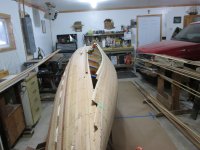
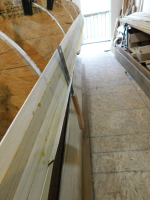
I cut the extra from the chine today.

I decided to do it before doing much more stripping so that, if I made huge, gaping holes in the side, at least I wasn't completely stripped and ready to sand.
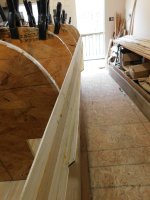
DSCN4279.JPG

I know that one typically uses a plane to remove the excess and I have planes and spokeshaves at the shop. At the same time, we tend to use the tools with which we have the most confidence and, for me, that's usually a rasp.

(If you really love to hammer, everything looks like a nail?)

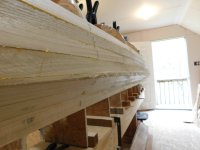
Anyway... I started by cutting the majority off with the pull saw
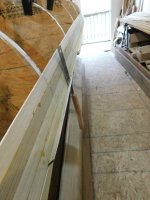
DSCN4280.JPG

and then used the rasp to clean it up. I'm pleased with the result and extremely pleased that there were no gaping holes resulting in an impromptu weanie roast this afternoon.
DSCN4282.JPG

Speaking of holes, I did make a couple and, for anyone considering building, remember that these are just wood and wood can be cut apart and glued back together if you need to.

In my case, I needed to a couple of places:

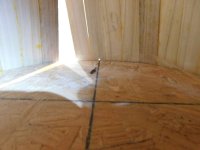
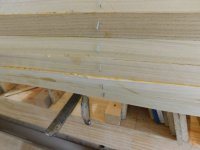
The first was where the 2nd strip (from the sheer) twisted from the stern into the tumblehome section. I knew that I'd lose alignment of the bead & cove by stripping the chine the way that I did but I wasn't careful enough and the strip pulled away from the forms so much that I was worried it would be paper thin by the time it was sanded.
DSCN4283.JPG

Again, it's just wood, I've got glue and can clamp creatively...

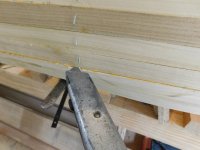
I took a utility knife, cut between the strips to break the glue joint,
DSCN4284.JPG

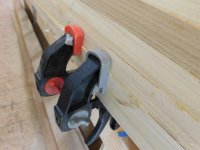
added a generous amount of glue to the opened joint and clamped it securely. I was able to pull the strip into alignment pretty well and I left it clamped that way to dry overnight.
DSCN4286.JPG

The other area was where I didn't get adequate adhesion when I glued on the strip above the chine and the lack of glue caused part of a strip to pull away while I was rasping.
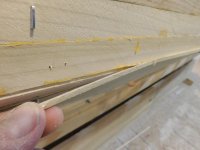
DSCN4291.JPG

this too was generously coated in glue and clamped into place.

In this case, the squeeze bar clamp thingy (sorry, I have no idea what it's actually called) didn't have enough grip range so I used a large(ish) c-clamp and added some scrap wood to the inside so that it could pull straight
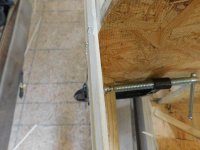
DSCN4287.JPG

At that point I started stripping the rest of the hull and got a fair amount done.

Tulip Poplar is notorious for pulling minerals from the soil, and the minerals typically stain the wood purple. Although it is considered a defect in grade lumber, I used a few of the mineral-stained strips in the hull simply because it's characteristic of the species.
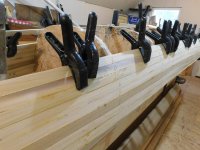
DSCN4293.JPG

Hopefully, it will look OK when finished.
Let me know if it really bothers anyone as I still have lots of Unicorn Spit and could tie-dye this one like I did the last.

 
Looking great so far...I do like those purplish strips.
Don't remember if you're planning on decks and/or bulkheads, but strategically placed colored poplar could be very unique and attractive as decks and bulkheads.
 
the purple likely won't stay purple for long, it'll fade to a dark brown or gray unless adding fiberglass and epoxy into the mix changes something (seems doubtful, but i've only witnessed what happens to it with typical furniture type finishes).
 
I don't use decks (extra weight IMO and I'm already disadvantaging myself by using heavier woods) but I suppose the purple could find its way into a float tank panel...)

I'm ok with it whether it stays purple or not. I'm curious about the effect of the spar varnish on both the purple and the Sassafras (I put a Sassafras strip 2 strips up from the chine; adds some color and might draw your eye away from any ugliness I create while trimming / shaping).

I've noticed that the Sassafras strips in the Raven are staying green (colored) much longer than the gunwales, seats, etc and much, much longer than the paddles which are oiled. The UV blockers in the spar might keep the purple tones and, possibly, even the green shading of the Poplar. I might even try to make that happen by varnishing ASAP after glassing.

Interestingly, I always thought that UV light was what drove the color change in wood. It certainly seems to play a role in Sassafras turning brown but the Cherry in the Freedom solo seems to be darkening the same under the glass as in the gunwales & paddles.
 
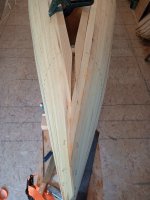
One thing that I'm really not sure how to do is keep overlapping the strips as I close the football. I know I've seen people do it but I've never been able to keep it going past the bow & stern.

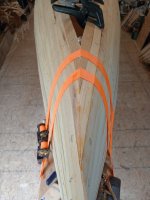
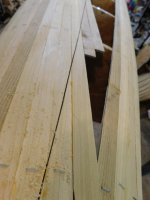
On this build, I did remember to lower the bow & stern forms for stemless building, so I had clearance when I reached the top of those forms. The extra clearance did not, however, help to transition from the bow / stern to the bottom of the hull, so I did as I have in the past and tapered the strips individually

IMG_20260326_121310309.jpg

glued them down and used ratchet straps to hold them in position until the glue dried. (I'm a fan of brute force when finesse fails)

IMG_20260326_124914894.jpg

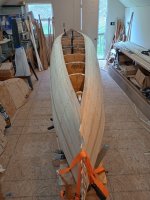
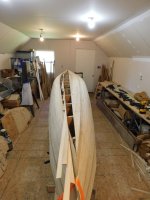
In this case, I allowed the glue to dry overnight and returned today to start stripping the football (1/2 at a time)

IMG_20260326_163003475_HDR.jpg

Because I'm only working one side at a time now, I'd glue a strip on and head outside for awhile to enjoy the warm day and clean up some dead pines that fell into my friend's yard. The end result was that we cleaned up a couple acres of yard and I still got a lot done.

IMG_20260326_195151594.jpg

Tomorrow I need to see how much Sassafras I have as I'm considering doing the remaining strips with Sassafras. It's quickly become my favorite wood to work with and, if it didn't make such outstanding paddles, I'd consider building an entire canoe from it (it's getting harder to find lately. Many of the larger trees have died off and I'm starting to be more careful with my stash)
 
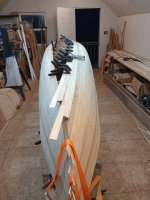
As planned, I looked closely at my Sassafras strips and decided that I had enough to close the football. I switched to Sassafras and set aside an equal length of strips for every strip that I installed. As it turned out, I'd missed seeing a bug-eaten section in the one long strip so I needed to return to Poplar for the last strip (it will result in a very thin Poplar center which might even look like I planned it that way).

I rewired some lighting downstairs while the glue set up and then grabbed a small drill bit.

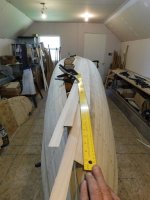
I reached under the canoe and drilled upward on the center line of every station that I could reach.

DSCN4295.JPG

I then grabbed a straight edge and connected the holes with a pencil line, extended that line to the bow and stern from the top

DSCN4297.JPG

and cut along the line with the pull saw

DSCN4300.JPGDSCN4301.JPG

(Note that I only removed the staples that were in the way of the saw. That helps keep the waste pieces from flapping around while I'm cutting.)

I got a few more strips on after this but it's pretty slow going now since every strip has to be tapered at both ends. On the bright side, the strips are lining up pretty well so my center line must be cut pretty close to being true.
 
I've considered chalk lines but it seems problematic to stretch one by myself, how to attach it to the hull, etc. Does the extra chalk come off pretty easily? (I sometimes feel like a contortionist getting the drill lined up in some of those pockets)

I'm actually glad that you find something of interest in these details. I often think that I might bore the snot out of experienced builders but I include those types of details for the benefit of anyone considering a first build.
 
The chalk line can be somewhat problematic with a lot of rocker, but if handled properly, it usually works. First, remove all the staples along the path of the chalk line so that there is nowhere for the string to get caught. Also, I usually knock down any high ridges or spots that might catch the string. I drill a screw into the inner stem, or in your case, the stem-ish area, on both ends and then stretch the chalk line very tight between the two screws. I try to make the screws high enough to avoid the first bit of rocker. Once it's really good and tight, give it a snap and then remove. I will use a straight edge often to pencil in a permanent line and to extend it if some of the stem are has been missed.
 
I tilt my strongback, to make it easier to cut the center line, and then fit the strips.
Helps in the sanding process too.

1774794168891.jpeg

Jim
 
Last edited:
Hey Jim, I thought you only built at the community woodshop. That looks like a home build...

I'll probably get the jackstands upstairs again (or buy a dedicated pair) so I can spin it on the rotisserie again for sanding & adding fellets in the chines. Otherwise, I'll be sanding the tumblehome upside down.
 
Back
Top Bottom