• Happy National Rocky Road Day! 🪨 🇪 🛣️🍨

Alan's Bloodvein II Canoe Strip Build

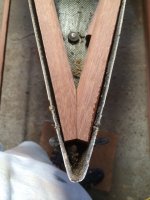
You cut these off the boat, epoxy them together and then fit them as one piece? I could do that but then fitting both ends to have nice, tight joints at the ends would become much more difficult.

I usually have to make the last cut (where I'm running the pull saw between both sides) 2-3 times to get it tight and, of course, every pass shortens them just a little. That's why I do the mid-ship scarf last. The shape of the hull makes getting an accurate measurement difficult (every time I tried to measure on the first one, I cut it short), so I've gone to cutting them in place.

I think I know how to make a jig that will allow me to cut a consistent, shallow angle on the hull and can be used on any hull shape. I should be able to get one made this afternoon & we'll know if it works in real life like it does in my head.
 
You cut these off the boat, epoxy them together and then fit them as one piece? I could do that but then fitting both ends to have nice, tight joints at the ends would become much more difficult.

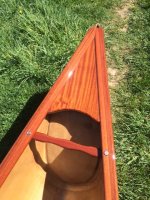
I just don't worry about tight joints at the ends. If there are float tanks I make them flush with the gunwales so the inwales die into them. If there are no float tanks then I "intentionally" leave a gap where the inwales meet and claim it's for water drainage. The outwales are trimmed flush with the stem and then the tips are rounded off until I think they look right.

Alan
 
Admin interruption:

This is a very popular and informative thread about strip building a canoe, and is still ongoing, but the title ("Alan's Bloodvein II") is very ambiguous for search engine word "grab-ability". So, I added the words "canoe" and "strip build" to the title to improve the SEO for future searchers and researchers.
 
If it is up to me I intentionally leave a gap to let water drain out.
Interesting. I wonder how that would look if I left the inwale short & wrapped the outwale as I've been... might try it that way when finishing the "Extra Trippy Merlin... (wood strip... canoe build)"

Just kidding, Glenn. Edit as you wish... whatever grabs your search engine.
 
My ends are seldom perfect, and like Alan I see it as a drainage hole, lol. I have a process for installing inwales, it doesn't involve math, measuring tapes or common sense. My inwales are intentionally long, I clamp them as far as I can, starting from the center, with the ends riding high over the stems. Then I eyeball the inwale where it crosses the end of the stem, draw a line and cut it to fit. 6 times out of 10 it doesn't look very good, but it's fast and dirty, just the way I like things. I'm actually going to be doing this tomorrow if everything works out, I'll include a picture for the "fine art of wood butchery" scrapbook.
 
My ends are seldom perfect, and like Alan I see it as a drainage hole, lol. I have a process for installing inwales, it doesn't involve math, measuring tapes or common sense. My inwales are intentionally long, I clamp them as far as I can, starting from the center, with the ends riding high over the stems. Then I eyeball the inwale where it crosses the end of the stem, draw a line and cut it to fit. 6 times out of 10 it doesn't look very good, but it's fast and dirty, just the way I like things. I'm actually going to be doing this tomorrow if everything works out, I'll include a picture for the "fine art of wood butchery" scrapbook.

That's exactly how I do it as well.

On the last couple I haven't even drawn a line. I just eyeball it with the pull saw as my sight line and then cut when it looks close.

I've tried other methods that involve more measuring, clamping, marking, and fancier cutting but they all end up with the same homely looking ends.

Alan
 
You guys are awesome. There are SO many times that I think I should aspire to be more craftsman-like... thanks for keeping me grounded.

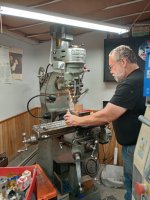
I spent 3 or 4 hours in my friend's gun shop tonight and went through a couple of variations before landing on what I think is going to work great. Dave's an awesome machinist and I'm often surprised that his love of precision and my embodiment of "meh, that'll (probably) work" don't have us choking the crap outta one another.

IMG_20260521_192344855_HDR.jpg

He also loves to talk and is usually incapable of working & talking at the same time. By the time we were done, I was itching to give it a test run but I knew that would lead to mixing epoxy, installing the gunwales and spending 1/2 the night in the shop... There's always tomorrow, right?
 
Sign of a true craftsman.
Definitely describes him. I often tell him that he "tasks" better than just about anybody I've ever met but doesn't "multi- task" worth crap.

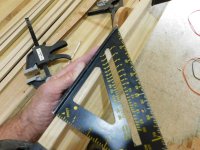
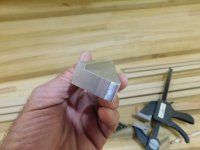
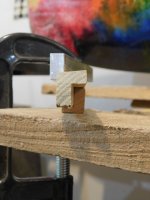
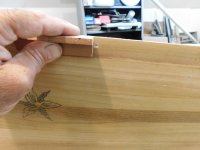
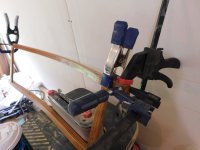
I got to test drive the jig today and I'm pretty pleased. Drawing inspiration from a small combination square (you might notice my short scarf at the top of the square... I was really close to 45°)
DSCN4385.JPG

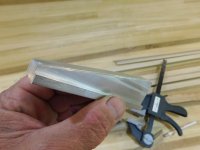
The jig started out as a 2" x 5" piece of 3/4 inch thick aluminum. We (again, somewhat arbitrarily) chose 12 1/2 degrees as a suitable angle and Dave machined a small lip onto the block

DSCN4386.JPG

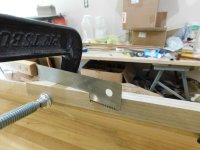
With aluminum flying everywhere (notice the cardboard containment shield in yesterday's photo), he then cut the 12 1/2° angle and added a slight undercut to allow for the kerf on the pull saw blade

DSCN4387.JPG

The hope was that the remaining width (above the kerf cut-out) would be sufficient to guide the saw and it actually works well.

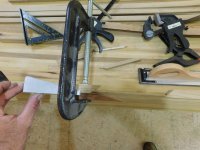
First step was to clamp the gunwale securely and I used a large c-clamp and added a piece of Cherry gunwale scrap to the outside in order to account for the overhang

DSCN4388.JPG

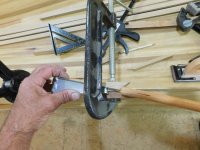
The large c-clamp allowed the pull saw to pass through it and I held the saw against the jig as I (using light pressure to help prevent distortion) eye-balled my end point and sawed off the shallow scarf

DSCN4390.JPG

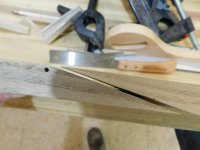
By the time the saw was making contact with the sheer, the blade was deep enough that the gunwale could act as the guide and I removed both clamp and jig and finished sawing through without hull contact.

DSCN4391.JPG

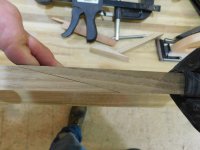
I repeated the process to remove the other shallow scarf and then grabbed one of the discard pieces from the other day.

This was clamped differently as I decided to cut it off of the boat.

I added a piece of Cherry gunwale scrap to square it up, placed the jig on top and clamped the whole mess to one of the boards of the off-loading table

DSCN4398.JPG

This was, in my opinion, the test for the jig; to see if the angles were consistent and repeatable. I am very pleased to say that it works well even if it's a little wonky getting used to holding the saw against it.

DSCN4395.JPG

I then marked the other end of the repair piece and thought I cut it a little long but, it seems that I'll need more practice.

DSCN4397.JPG

I used that too-short piece as a guide for another and then cut it too short also.

By this time, I was running out of inwale stock so I shortened one of the too-short pieces a bit further and used the other as donor material until I got it close enough. It puts 2 scarfs very close together but it's (I think) probably as strong as the original 45(ish) angle would have been so I'll live with it.

DSCN4403.JPG

Being hungry, I decided against mixing the epoxy and headed home feeling reasonably good about myself... That lasted until a few hours after supper.

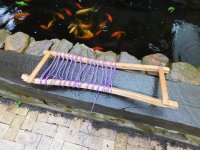
I'd taken the seat frame home to finish sealing it so I marked the locations of the paracord & started weaving. I've always worried about the paracord stretching & becoming loose so I try to remove all of the stretch by pulling it as tightly as I can every time I cross the seat.

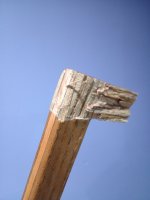
It seems that, at least today, I was stronger than my Sassafras / Oak lamination and I wound up breaking the seat.

DSCN4405.JPG

Now I'll need to soak, bend & dry, epoxy, mill, assemble and weave another seat asap. I guess I know what I'm doing tomorrow after horses.
 
Last edited:
:oops::oops::unsure:

That takes me back... I ran into something similar when I was working on the seats for my tandem (I also use tightly strung paracord). I think there are photos around...

The upshot is that the greatest load on this kind of frame is inward along the lacing, especially when you're sitting on it. Those curved front and rear frame pieces then translate that force into a significant amount of torque. While it looks like you're trying to stay light, I suspect that you'll get better results if the joint geometry provides full support to the inner edge of those front and rear rails.
 
True and that's been mentioned before in my other builds. I'm not crazy about the time crunch but I typically don't mind taking things all the way to failure because you can learn alot.

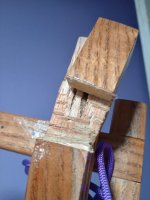
In this case, I think I needed more clearance in the dado joints since the sides of my cross rails show little sign of damage which, to me, would indicate very little (if any) epoxy was holding those surfaces. Only one of those 4 joints held well enough to tear out the surrounding wood and I'd think that the epoxy should be much stronger than the wood.

IMG_20260523_063254014.jpgIMG_20260523_063401975_HDR.jpg

My conclusion is that either I had insufficient clearance to allow epoxy penetration or the wood was impervious to epoxy. (I'm going with door #1 and, regardless of which direction I run the dado in the future, it will have a loose fit.

As you said, the way it failed also indicates some serious downward / inward pressure as both sides failed on the front rail. I'm not too terribly worried about my Raven seat at this point (made exactly the same way) because it's now bolted to tabs that are epoxied to the hull. I think that will provide adequate support to the underside and prevent the twisting forces required to break the joints but I could be wrong.

Note: Anyone taking it for a spin at WPASCR might want to paddle it early and wear fast-drying clothes.

Options at this point are: 1) weave the seat after installation so that the hull provides extra support. No way that's happening

2) Increase clearances slightly and trust that better epoxy penetration provides enough strength to hold it.

I'd be more comfortable with that if not for the areas where the wood itself failed. To me, that indicates a need for more material in general and I may still be too close to the edge for comfort.

3) Completely revise my dado to provide enough support to prevent the twist even before the seat is installed. On any trail, ounces are pounds and pounds are pain but I think this is one place I can suck it up. (I carry a perk coffee pot for goodness sake because I can't stand instant... I can tough it out so I don't have to kneel for weeks when the seat breaks)

I'm pretty sure that I thought of a way to repair this frame without rebending fresh wood (which I don't currently have unless I change species). Might not be pretty, but if it works, it will make the WPASCR deadline much more feasible.
 
We did cover this a build or so ago, that lap joint over the top IMO, is part of the problem ...I would suggest making a simple dado on the side of the front and rear rails. I usually run a screw in to act as a clamp, then replace with a dowel (helps with that torque from that bend) after the epoxy sets up. If you have interest, this is the link to the seat stuff;

https://www.canoetripping.net/threads/light-weight-solo-tripper-build.105054/post-111763

When I add the epoxy, to the joint, I like to saturate the area with unthickened epoxy and leave sit for a few minutes to soak in well, then use thickened to butter the area. Don't over clamp the joint, an epoxy joint requires significantly less pressure than glue ... there needs to be epoxy left in the joint for full strength.

You likely already know this, but when there is a failure, likely best to go over everything again to be sure.

Suggestions:
1. lose the top dado/lap in favor of a side dado
2. add a dowel or screw to add support for side rail torque
3. don't over clamp the epoxy joint, think spring clamp pressure or run a screw in the provide the clamping pressure


Brian
 
Last edited:
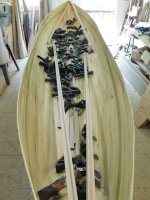
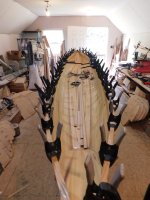
I'm trying to keep after this one and ran over to the boat shop today to install the inwales. First order of business was to dump my box of clamps into the boat.

DSCN4410.JPG

I then used a piece of gunwale scrap to guage screw locations and drilled 7/32 Inch holes thru the fiberglass and an 1/8 inch drill the rest of the way through the hull

DSCN4406.JPG

Next, I mixed up a batch of epoxy and, as Cruiser suggested, I used a small brush to paint epoxy onto the inwales, then thickened the epoxy and slathered it generously onto the inwales which were then reinstalled and clamped in place

DSCN4412.JPG

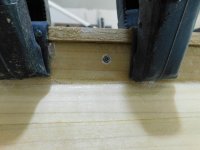
screws were then installed (since I like mechanical as well as chemical fasteners) and they were tightened until the screw was pulled flush with the glass

DSCN4414.JPG

I found that putting my hip against the bottom of the hull and pushing down with my left hand really helped to keep the inwale tight to the sheer.

I'd previously used a rasp and some 40 grit to clean up the broken seat parts (removing any loose pieces of wood that might keep it from fitting tightly again, removing any old epoxy and adding a little clearance to the dado joints).

I used the remaining epoxy to glue the seat back together

DSCN4411.JPG

At that point, I was waiting for epoxy to set up so I moved the Bloodvein off to the side and switched boats.

DSCN4417.JPG
 
In an effort to button this up by Friday, I spent a couple of decent days in the shop.

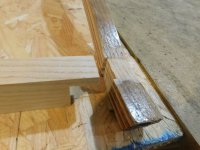
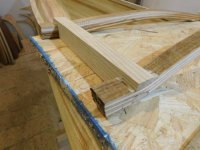
I'd stopped over at my buddy's woodshop last week and we re-did the seat. Now that the cross pieces were glued in again, we cut them off, ran the dado up & down while sizing it to fit some Sassafras scraps Dewey had laying around. We left a support tab underneath (primarily to compensate for the cut-out area on top) and sanded the finish off the old seat parts.

I made sure that the dadoes had a loose fit this time despite Dewey's objections. (Machinists are funny... apparently, "loose" is not a specification and we had to determine an appropriate amount of "clearance" before the dadoes could be cut. I can't recall what number we settled on but it fits loosely so we should be fine)
DSCN4429.JPGDSCN4430.JPG

I then thickened some epoxy and glued it together, clamping it lightly and making sure that it was square.
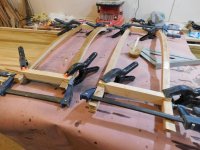
DSCN4433.JPG

I had intended to test paddle in order to find the ideal seat placement but I didn't. I think Alan said that it was designed to be similar to the Raven so I placed the seat similarly to where I put my Raven seat but cheated it an inch forward as a compromise to those who like the seat more centralized. (IIRC, I wound up 11 inches behind center.)

I used a contour gauge to match the hull shape and will mount the seat directly under the gunwales (I like the seat 9 inches off the floor but, with the drop I have on the seat, I'll be closer to 8. Should still be OK... one way to find out...)
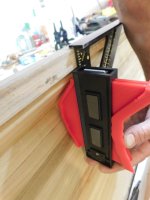
DSCN4435.JPG

I had quite a few Sassafras & Catalpa scraps from making paddles (I cannot visually tell the difference between those woods), so I transferred the contour to some scrap & started fitting.
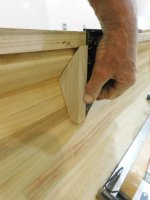
DSCN4438.JPG

With the failures piling up on the floor of the boat, I eventually stopped sanding the sides until I'd gotten the fit that I wanted.
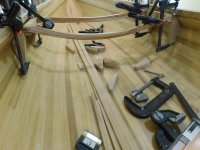
DSCN4452.JPG

I cut the thwart to fit (I'll only have one since the seat will serve as the rearward... should be enough... sure hope so lol)
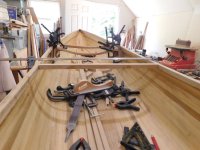
DSCN4455.JPG

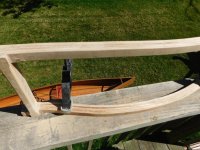
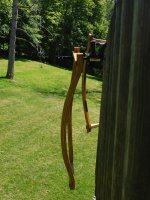
and I cut up an earlier seat failure to make grab handles. (I like the slight upward arch but it wasn't the best idea)
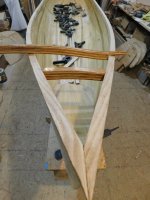
DSCN4427.JPG

I then drilled 1/8 inch pilot holes through the gunwales and into the thwart and handles, then used a 1/4 inch drill to make divots in all mating surfaces so that they'd have a little more contact area, increase the grip and eliminate twisting.
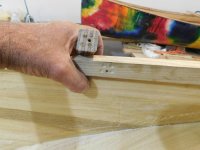
DSCN4460.JPG

I mixed up some thickened epoxy, put some tape on the bottom of the seat cross rails and glued everything into place.
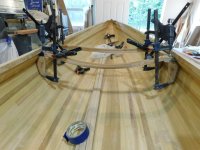
DSCN4465.JPG

I installed a 1 3/4 inch deck screw into each end of the thwart and both ends of the grab handles, drawing the screw tight below the surface of the hull's exterior. (note: I'd opened up the pilot hole on the exterior with a 1/4 inch drill bit so that the screw would sit below the level of the glass. In the future, I'll have to remember to drill the 1/4 inch "divot" first so that it doesn't try to catch when it gets through the glass. With the pilot hole already there, the bit tried to follow the pilot the whole way through the hull)
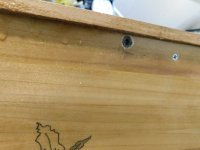
DSCN4463.JPG

This morning, I removed the seat & grabbed my jigged trim router.
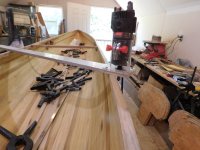
DSCN4471.JPG

Remember those sexy-looking, arched grab handles? They threw off the jigged router and wreaked havoc on the cut but I carefully removed the overhanging inwale material, smoothed the rough areas with a rasp and then the long board (40 grit). (have I mentioned that I love working with Sassafras... not only does it sand well but it smells terrific!)
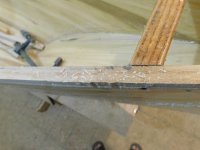
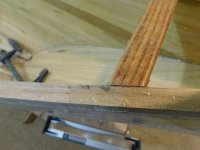
DSCN4469.JPGDSCN4473.JPG

After that, I started fitting the outer gunwales. I do this by cutting opposite corners flush with the hull and allowing the other side to run past the end.
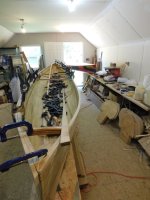
DSCN4477.JPG

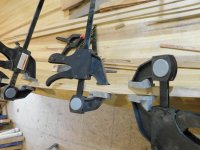
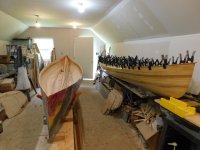
Once done with that, I thicked up some epoxy, generously buttered the backside of the outwale and clamped them in place (you'll see why the Merlin is sticking out the door in a minute... Looks really weird from outside...)
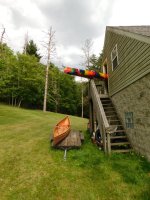
DSCN4483.JPG

Once all pieces were clamped in place, I slid the Bloodvein to the off-loading table to dry and brought the Merlin inside on the cradle. (I'll update that thread tomorrow... probably... gotta bale hay, trim a few horses and build boats too... too many irons & not enough hours...)
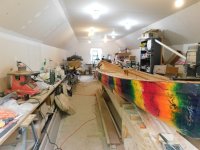

DSCN4485.JPG
 
Last edited:
Back
Top Bottom