• Happy International Cat Day! 🐈😻🐈‍⬛

First Canoe

Joined
Jul 2, 2026
Messages
28
Reaction score
121
Location
Downeast Maine, USA
Really. I've paddled many canoes but never owned one.

Chesapeake Light Craft makes cedar-strip kits for several canoe and kayak designs by Nick Schade. CLC is known for plywood boat kits: kayaks, rowing craft, sailing, other.

This kit is the "Mystic River Tandem".

Length17' 2"
WL length17'
Beam34"
WL beam33"
Weight42 Lbs
Max payload450 Lbs
Draft4.5"
Surface area60 sq ft
Wetted area31.7 sq ft


Not a lot of rocker; about 2.25" difference between center and the last form.
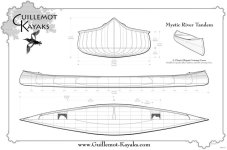
Mystic.jpg
Weight was one big reason for choosing this design. Many designs and kits for 16' and longer canoes are heavier by 10 or 15 pounds. This kit uses 1/4" strips and 6-oz cloth so the weight savings aren't ultralight materials.

I opted for the "complete" kit. CNC-cut forms, CNC-cut strongback, strips, glass, epoxy, decks, seats and a piece of ash for a yoke.

I see zero mentions of this design on canoetripping.net. Zero mentions of cedar-strip kits from CLC. Of course CLC could look around and see zero mentions of me or my abilities so we could be even.
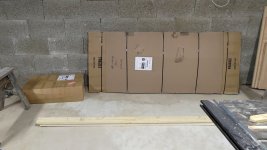

Boxes.jpg

To the basement!
 
An interesting hull. It has a shallow-vee bottom, much like a Mad River Malecite. I think it has more rocker than a Malecite and I like that. The shallow-vee will give a little twitchy feel that you will get used to in the first few minutes of paddling. It gives it excellent secondary stability. It will track well, too.

I would be absolutely amazed if you end up with a 42# boat. Maybe 52# would be more realistic. I can't believe that CLC advertises that at 42#. I think it is misleading.
 
Thanks, @Sedges , for those details. Since ordering the kit on July 2, I've been wondering if this design is the right choice. Your comments on the design are reassuring.

Your comment about weight seems reasonable but less reassuring. My weight goal has been 44#. That's 2/3 the weight of my only current boat, a 17' ocean k*y*k. Fifty-two would be a disappointment but still better than 66#.
 
You won't regret building your own canoe, it is a vastly illuminating, terrifying, exhilarating and satisfying endeavor ... try to enjoy every step.

Building lighter has sort of become "my thing" in the last few builds. IMO a lighter boat is not one decision, it is every decision you make, at every step. Obviously, going with a kit means a lot of those decisions have been made for you already, but not all of them, there are still some ways to try and build lighter IMO.

Things to consider:
- check your epoxy instructions carefully, understand how it can be used, if you can use a precoat (seal coat) and maintain a chemical bond, you will save a nice chunk of weight.
- look at the gunnel sizing, if it is standard 3/4" x 3/4" ash (or similar) you can reasonably halve that to 3/8" x 3/8" and save quite a few pounds
- check the deck weights, they don't need to weigh over a few ounces each, it is a small project to redo them and save weight
- laminate that "chunk of ash" and minimize the yoke design, it needs to work, but anytime you use hardwood, it is easy to pack on weight
- unless you do a lot of scraping on the inside, you can forego the flood coats and save a pound or two on the inside
- you can also safely trim ~3/4" from the sheer, gives a better finish to the edge and saves a pound or so as well

Each of these areas are still available to you for weight considerations and you may be surprised by how much weight you can save doing them.

IMO, you should be able to make 42#s by not adding unnecessary weight during the build, however, if you just follow the directions, I suspect 55+ would be the likely result.

Brian
 
WoodsNWaters

A great kit. to start with. A Big Plus, is the strips are Bead and Coved. Makes assembly a lot easier.
Will you build in the Basement ? Dust will be your biggest enemy.

Does the kit include stems ?

As others have said 42# is light.

I'm repairing a tandem stripper right now. Two big cracks down the middle.
Had the original builder, double layered the bottom ? I doubt I'd be fixing it !
Yes, extra weight. but worth the durability in my view.

Keep us posted on your progress, and don't be afraid to ask questions !

Jim
 
Thanks, @Cruiser. I will be referring to your "Solo on the light side" posts to review ways to reduce weight and maintain strength. There are a lot of talented builders here and I'll read many threads. That one is just too impressive.


I will replace several pieces of wood supplied by CLC. I won't post details until I hear back from them. The cedar looks good so the project will continue. I should have no trouble making replacements for the parts I don't like. Each of these is an opportunity to shave weight and have a higher-quality canoe.
 
Last edited:
@Jim Dodd -- I believe you when you say that dust will be my enemy. I plan to divide the basement with plastic so the canoe is in it's own room. Even canoe parts will be outside the canoe room. The divider will go up before sanding and needs to stay up to help keep the boat warmer during fiberglassing. There will be dust, but it won't be on, in, and under everything. Just on in and under the canoe which is more manageable.

The kit does include stems, 16 strips of 2" by 3/32" spruce to laminate all 4 stems at one time. I don't like the idea of common spruce for the outer stems. Then again I'm considering a layer of Dynel so maybe softwood is OK. Or no outer stem. The whole question of stems is up in the air.

Double layers? I'll have to track my weights. My budget should allow swapping out the E-glass for S-glass and double layers on the bottom. But is that worth it for a first canoe build?

A boat that's difficult to use just doesn't get used. It has to be light enough to be convenient or it'll last a long time and never be in water. Durability is important too. Trade-offs.

Thank you for your interest, and I willl ask questions.
 
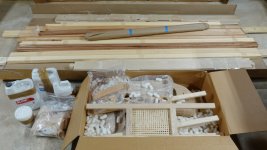
The whole kit and canoedle:

Kit.JPG

From the top:
  • CNC-cut side pieces for the strongback. Twelve millimeters or 0.475". Five plies of softwood plus two thin plies of . . . birch?
  • Alaska yellow cedar strips bundle 1, cove & bead, 1/4" thick by 11/16" effective height.
  • Western red cedar strips, 4 bundles. Most strips are 96" (8') long. Some of the Alaska yellow cedar is shorter.
  • On top of red cedar to the left is a piece of sapele for a thwart.
  • On red cedar to right is the roll of 50" wide 6 oz glass.
  • Alaska yellow cedar strips, bundle 2: short pieces for football.
  • Cherry gunwales, 3/4" square, with scarfs pre-cut. The scuppers have not been cut.
  • Alaska yellow cedar strips, bundles 3 and 4.
  • CNC-cut top and bottom pieces for the strongback.
  • On floor are 1.5 gallons of MAS low-viscosity resin, 1 gallon of MAS slow, clear, non-blushing hardener, plus wood flour and cellulose.
  • To the left inside the box are coamings, seat bolts and spacers, etc.
  • Below to the right are a stem mold on top then CNC-cut molds below. The molds are "hollow" with reference line grooves for center and waterline. Some sort of fine-grained fiberboard 0.485" thick.
  • Two seats, caned but somewhat rough.
Farther down in the (compostable starch) peanuts are:
  • A bundle of 16 spruce strips, 2" wide by 3/32" thick for laminating inner and outer stems.
  • The forms for the curved decks with reference line grooves for center and edges.
Also not shown are the 81-page instruction book by CLC and the 3 pages of plans, 24" by 36".

Such a lot of posts and I haven't DONE anything yet. I'll correct that soon.
 
Back
Top Bottom