• Happy National Paranormal Day! 🔮👻👽

Alan's Bloodvein II

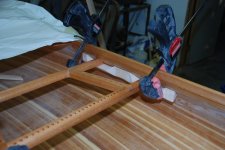
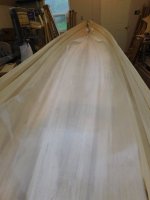
I had gone over to the shop the day after glassing and used a utility knife to cut away the cloth that hung past the sheer and Monday I pulled it off the forms
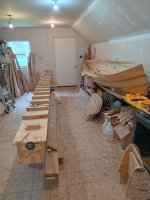
IMG_20260419_150640604_HDR.jpg

The first order of business, at that point was to smooth the sharp edges of the glass at the sheer line so I installed the cradles on the strongback, gently moved the canoe onto them and rasped the sharp edge level with the sheer strip
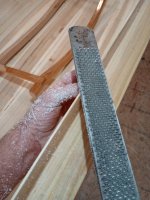
IMG_20260419_152618678.jpg

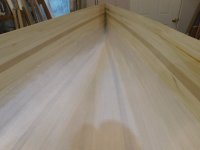
That done, I could work on the inside without worrying about getting cut and I removed all of the tape strips then used the surform rasp to knock off the glue drops and level any high spots. I rasped in a cross-hatch pattern and it took about an hour to do the whole canoe.
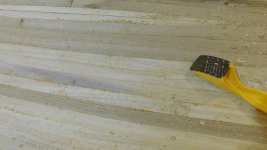
DSCN4351.JPG

I also did the face of the float tank panel the same way, then sanded it with the orbital and 40 grit paper. Honestly; feeling the float tank after the 40 grit, I'm wondering if I need to go any finer.

I mean, I openly detest sanding and the inside is the worst but... the epoxy will self-level so it should have a decent ability to cover scratches, I only do a wet-out coat on the inside as I want some texture on the glass for better grip and it seems that there would be more "tooth" with 40 grit.

Do you think I could get away with making sure the strip edges are level but not sanding beyond 40 grit?

Another decision that will need to be made is the seat:

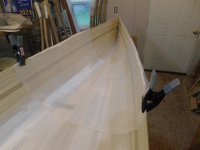
I have been hoping to use the first one that I made for the Raven (then cut too short) and I have been mounting seats to tabs epoxied to the hull so that the seat acts as lateral support. I've been able to eliminate some thwarts but doing that and figured that I'd do the same here. The only issue is that the tumblehome moves the sheer inboard enough that I can't wiggle the seat in without flexing the hull quite a bit.
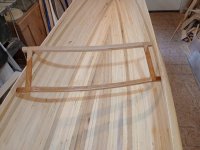
IMG_20260419_151908199.jpg

To be sure, I could flex it, drop the seat in and leave it loose in there while I finish the trim but I like the seat removable in case it needs repaired or replaced and my gunwales, as well as the thwart will be both glued and screwed so flexing the hull to remove the seat will not be possible once the boat is complete.

Alan had done a pedestal seat but I'm not a fan of pedestals or buckets. I guess I could hang from the gunwales but that would mean a second thwart since the seat will not provide any support.

I could also bring something up from the floor, attach it to the sides at the appropriate height and mount the seat to those (like brackets on each side) and I may gain the advantage of an adjustable seat that way. I'd also be likely to add a couple of pounds (not a deal-breaker if not overdone, I guess)

My granddaughter's first birthday party is on Sat and my daughter needs help baking & getting ready so I'll have a few days to consider options. Opinions are appreciated.

(opinions about the canoe, not my baking ability or the wisdom of asking my help for party prep. Maybe I shouldn't have to be specific but I've been around here long enough that I've come to expect some of you to misbehave.) 😁
 
Gamma,
I faced a similar hull flex seat install dilemma when I built my DY Special...
On that hull, my seat support cleats were positioned well below the severe tumblehome, the only way to install the seat was to flex the shear line outward.
I had already epoxied on my gunwales, between the gunwales and the compound curves of the hull, the hull was quite stiff. Even so, I could (with some effort) flex the sides out by a total of nearly 4 inches, all elastic deformations...no yielding.
You should have no problems flexing your hull for seat install.

Below are a couple pics, only ones I can find, showing seat cleat install, hopefully you can decipher how much that hull needed to flex to remove/install the seat frame.

DSC_1399.JPG


DSC_1400.JPG
 
I install the seat (with cleats) back 7-10" from CoB, which is usually a few inches from the actual boat center. I measure the width required at the install location, which means I get the seat to wide to fit every time.

You need some wiggle room with the seat width anyway, so I go 1/4" under and move to the centre (widest point), place the opposite side on the max tunblehome width and usually only require a modest flex to get the seat past the sheer.

At that point it is just a slide into position.

Brian
 
(opinions about the canoe, not my baking ability or the wisdom of asking my help for party prep. Maybe I shouldn't have to be specific but I've been around here long enough that I've come to expect some of you to misbehave.) 😁
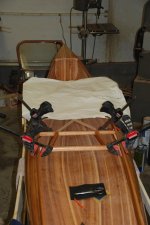
Probably wise to be specific around here. I expect a full build report on the baking.
 
I think you would be fine stopping at 40 grit as long as strip edges were smooth and there were no other large dips, humps, deformities that might cause the fiberglass to bridge. I think the aesthetics would suffer (ROS scratches would be "filled" with epoxy but likely still show) but that may or may not be very important to you (based on your previous tie-dyed canoe I'd say likely not so important).

I think I've stopped at 80 grit on a few hulls. From a few feet away they look fine but when looking close you can see the swirly scratches from the RO.

Alan
 
I've also become a fan of hanging seats from the gunwales. It's just so quick and easy with no fiddly-fartin' around. Raising or lowering is just a matter of making a different set of drops. Swapping out seats is easy. Adding an extra thwart on account of it is very little work or weight.

Alan
 
I expect a full build report on the baking.
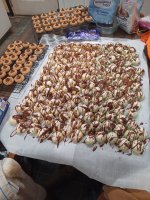
This is as close as you'll get. I'm not sure about other parts of the world but, around here, cookie tables aren't just for weddings anymore

IMG_20260422_214218889.jpg

I need more practice drizzling chocolate but round 1 is done. I'll make 2 more kinds tomorrow & call it good.

As for the boat. no, I'm not nearly hung up on aesthetics enough to ever see sanding scratches but I'm trying to become more aware of what others notice so I'll probably go over it with 80 as a compromise.

Even with the extra thwart, hanging the seat might be less weight than building supports from below although I think I'll need to beef up the gunwales too (at least where the seat will be). I think my inners have been less than 3/8 inch in the past.

I could (with some effort) flex the sides out by a total of nearly 4 inches, all elastic deformations...no yielding.
You should have no problems flexing your hull for seat install.
Was that with thwarts installed? I glue & screw mine to the inner gunwale instead of attaching underneath so they are a permanent part of the boat & I doubt I'll gain enough (I think I'll need about 3 inches)

DSCN4355.JPG

I suppose the smart move might be to figure I'll be hanging from the gunwales and then try to flex the hull enough to wiggle the seat in after thwarts, gunwales, etc are all done. I'll either be able to get it in there and need to install cleats or I won't and I'll need to beef up the gunwales where I want the seat.

I install the seat (with cleats) back 7-10" from CoB, which is usually a few inches from the actual boat center.
That would be another advantage of finishing the trim before deciding how to mount the seat.

I'm figuring on going a little more conventional with seat location and the CoB might be further forward than it appears. The stern narrows more quickly than the bow which probably makes this hull ideal for tripping with a pup but I suspect that extra room for Sadie moved the CoB forward.

@Alan Gage , I can check your build thread but do you know offhand how you placed your seat?
 
I'm figuring on going a little more conventional with seat location and the CoB might be further forward than it appears. The stern narrows more quickly than the bow which probably makes this hull ideal for tripping with a pup but I suspect that extra room for Sadie moved the CoB forward.

@Alan Gage , I can check your build thread but do you know offhand how you placed your seat?

The shape of the sheer and shape of the waterline are radically different so while it looks like a weight forward fat little piggy from above it is much more normal at the water line.

Since I used a sliding seat placement wasn't quite so important. If I remember correctly when slid full forward it was a couple inches behind the center line. Normal seat position is most of the way back. I don't know if I've ever paddled the boat without Sadie in it so without her (27 pounds) it would come forward a little more.

I always like to be able to paddle a new hull before seat placement if possible. This lets me play with not only fore/aft but also height. I've done it with gunwales installed and thwarts clamped in place.

On a couple hulls with narrow inwales I've glued 1/4" strips to the locations where the seat and thwarts will attach. This works well but requires pre-planning. On the last one I just gave in and made the entire inwale a 1/4" thicker rather than messing with it.

Alan
 
Gamma,
I installed and removed the seat in that DY several times...
The short thwarts at each end always stayed in place, the center thwart had to be removed to allow the hull to flex.
It was fairly stiff, but again, there was no permanent deformation.
 
the center thwart had to be removed to allow the hull to flex.
Thanks, that's what I was afraid of. I'll have to revise how I attach the thwarts or the seat... maybe both. Thwart placement is typically 28 inches forward of the seat since I use the paddles for portaging instead of losing yokes in the woods.

I wonder if it would be stiff enough to leave the outwales off while I paddle it in my buddy's pond? Then I could play around with seat location and figure out where to put the thwart based on the seat. I'll probably try that... what could possibly go wrong, eh?
 
OK, I've sanded the interior with 40 grit and then again with 80. I will (somewhat grudgingly) admit that I could still see the scratches (if I looked from a couple of inches) after the 40 grit and the 80 looks more finished.

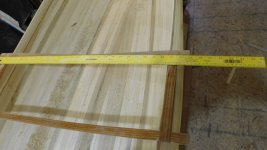
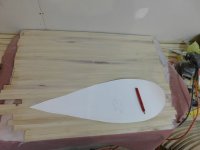
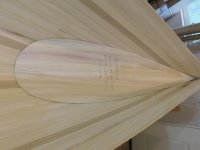
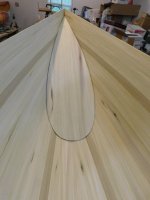
Moving on, I fitted a float tank pattern from thin cardboard. I don't trim all the way to a tight fit, I just get it close, transfer the shape to the wood panel and then rasp / sand each panel to their final shape and I was really surprised that the roughed-out pattern that I made for the bow would also work for the stern.

DSCN4363.JPG

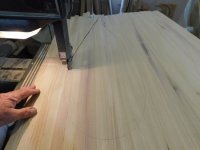
I traced the pattern onto the float tank panel that I'd made when glassing the exterior, cut out both panels with the bandsaw and then (as stated), rasped and sanded until I had a nice fit

DSCN4364.JPGDSCN4367.JPGDSCN4368.JPG

That done, I removed both panels, swept the interior and then swept it again from the center toward the stems. The second sweeping is calculated to push anything that I missed the first time into the bow & stern so that any remaining sawdust or other debris will be hidden inside the float tanks. I didn't actually see anything getting pushed ahead of the broom but it can't hurt.

Once that was done, I was ready for glass and I anticipate that this hull will be used for wilderness tripping so I wanted 2 layers of glass on the interior for increased impact resistance (Let's face it, I'm going to hit rocks and I don't want to breach a hull somewhere off-grid)

I unrolled some 4 oz e-glass (30 inch width) the length of the hull and smoothed it out with a soft-bristled paint brush (prevents rough hands from snagging the fibers), tucking it in to the stems.

DSCN4369.JPG

I then took the scissors and trimmed it off a little above where I suspect the waterline will be (approx 3 inches or so above the floor)

DSCN4372.JPG

Next, I'll run the same 4 oz, 30 inch wide e-glass across the hull overlapping a couple of inches on each section. I got the first done tonight (the bow and stern will get individual pieces on each side with generous overlaps under the float tank and tucked into the stems)

DSCN4373.JPG

I'm really hoping to get this wet-out over the weekend. I've only got 4 weeks to finish 2 boats if I'm taking them all to WPASCR
 
Adding the extra layer of cloth to the inside is wrong.
Sorry, but I feel the need to express this.

Take a look at Alan's Bloodvein pics, after his trip. See how much wear there is to the outside of the hull.

Adding extra layers to the inside, only adds stiffness, that could have been accomplished with thicker hull material.

I hope the single layer on the outside gets you by.

I've chewed up enough bottoms of canoes. I'll add extra layers to the outside. They will not only add stiffness, but abrasion resistance.

Jim
 
I just watched an "instructional" video from a build series and I cringe every time I see people smoothing glass with bare hands ... unfortunately it happens often. IMO using something like a soft brush is pretty much the only way to handle FG cloth and that is even more important for lighter cloth like this. Really enjoying the build.

Brian
 
Adding the extra layer of cloth to the inside is wrong.
Sorry, but I feel the need to express this.

Take a look at Alan's Bloodvein pics, after his trip. See how much wear there is to the outside of the hull.

Adding extra layers to the inside, only adds stiffness, that could have been accomplished with thicker hull material.

I hope the single layer on the outside gets you by.

I've chewed up enough bottoms of canoes. I'll add extra layers to the outside. They will not only add stiffness, but abrasion resistance.

Jim

I feel compelled to respond.

"Wrong" is a pretty definitive word to be used here, it is really about the context for Gamma's needs IMO.

If the need is for impact strength, he is doing the exact right thing, cloth inside. As far as inside layers only adding stiffness, that is incorrect. If you are considering impacts, then additional inside cloth adds strength/ImpactResistance, and in that case the exterior layer adds mostly stiffness, but no real strength/ImpactResistance gain.

If he is looking for abrasion resistance, you are correct, it should be on the outside. The extra glass will be a sacrificial surface to scrape away and it will add some stiffness to the hull, but little useful strength in the field.


Brian
 
My understanding has always been that fiberglass has more strength in tension than in compression so impact resistance is best achieved by adding the layer to the inside.

I've treated a couple of strippers rather poorly on trips (dragging through portages, scraping over rocks, beaching to dry-foot entry/exit) and I've only gotten into the weave on one scrape.

On the other hand, I cracked a strip in my Freedom Solo when I high-centered & got hung up in a rapid during my Marshall Lake trip and that incident is the primary reason that I want better impact resistance. The Freedom Solo has 2 layers on the outside, 4 oz e-glass on the whole exterior and 6 oz s-glass on the football.

I may very well be adding some exterior s-glass to the football on this one but we'll see. Current plans are to take the Tamarack Raven to Wabakimi this Fall and this boat on my return to Marshall Lake in 2027 so I've got some time to scratch, repair and strengthen if needed.

Where I am wrong is putting the football layer under the full layer. As Jim has pointed out before, that leaves a void that has to be filled with epoxy. It's arguably better to put the football layer on top of the layup and feather it in but I'm going the lazy, hacker route and sticking it under.
 
Gamma, the void issue is valid, but as the fiberglass thickness goes down (i.e. lighter cloth) I really wonder if it is even a consideration at 4 oz. which is somewhere around 5 mil thick wetted out.
When I overlapped my 4 oz, I had a heck of a time finding the overlap line, in that case while I recognize the issue, I really wonder if it has much real world impact with the 4 oz cloth.

And as you point out, it saves you some steps.

Brian
 
it saves you some steps.
Speaking of saving (or forgetting) steps... It turns out that I wasn't as ready for glass as I'd thought.

This morning, I realized that I'd forgotten to fillet the sharp knuckle of that tumblehome. Not wanting to rely solely on whatever glue I'd gotten in the joint, I stopped over this afternoon and corrected that issue.

IMG_20260502_155145298.jpg

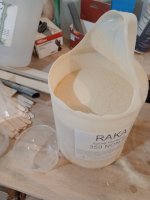
I'd collected almost a gallon of sawdust while sanding the interior so I mixed up a small batch of epoxy, mixed sawdust in (a few fingerfuls at a time) until the thickness was somewhere between yogurt & oatmeal, poured (and scraped) the mixture into a plastic baggie, cut the tip off so it could work like a piping bag then squeezed a line onto the inside of the knuckle and smoothed it out with my finger (Alan's idea, actually).

Much like drizzling chocolate on the cookies a couple of weeks ago (in fact, the only differences are that I was drizzling horizontally this time and the contents of the baggie were not edible) I need a lot more practice.

One word of caution: If you try this at home, cut the tip of the bag much smaller than you think it should be. You can always cut it larger but it's pretty hard to control the flow once you're laying it on way too heavily.

In the end, I think I got it under control, but it took a lot of wiping with gloved fingers.

IMG_20260502_161444012.jpg

I'll stop by tomorrow morning and check but I think I got it smooth enough to just right glass over it.
 
I apologize !
It's Gamma's canoe, and he can put paper machay on it, if he wants to !

As for real world results, A puncture through the outer layer, will leave a strip built canoe, in worse shape.
If that hull flexes over a rock it will survive.
If you rip a hole in the outer layer, the hull will need major repair, as the glued wood strips will soon delaminate.
Again, Abrasion resistance is more important than Stiffness, in a canoe hull.

If you ever paddle a Royalex canoe? You will note how they flex. They go over a rock with no damage. Royalex is far stronger than any strip built hull, even after adding extra layers to the inside !

I'll take a double layered outside bottom anytime, over adding an extra layer to the inside !

Sorry Gamma for my straight forward response. I only speak from personal experience !

Jim
 
Last edited:
Back
Top Bottom