• Happy 1st Demo of Polaroid Land Camera (1947)! 📸⏩🖼️

What's changed for better or worse over your canoeing lifetime?

Glenn MacGrady

Administrator
Staff member
Joined
Oct 24, 2012
Messages
6,666
Reaction score
12,872
Location
Connecticut
This is an interesting question.

Here is what Cliff Jacobson, now 84, says about his 72-year canoe career, about the same as mine.
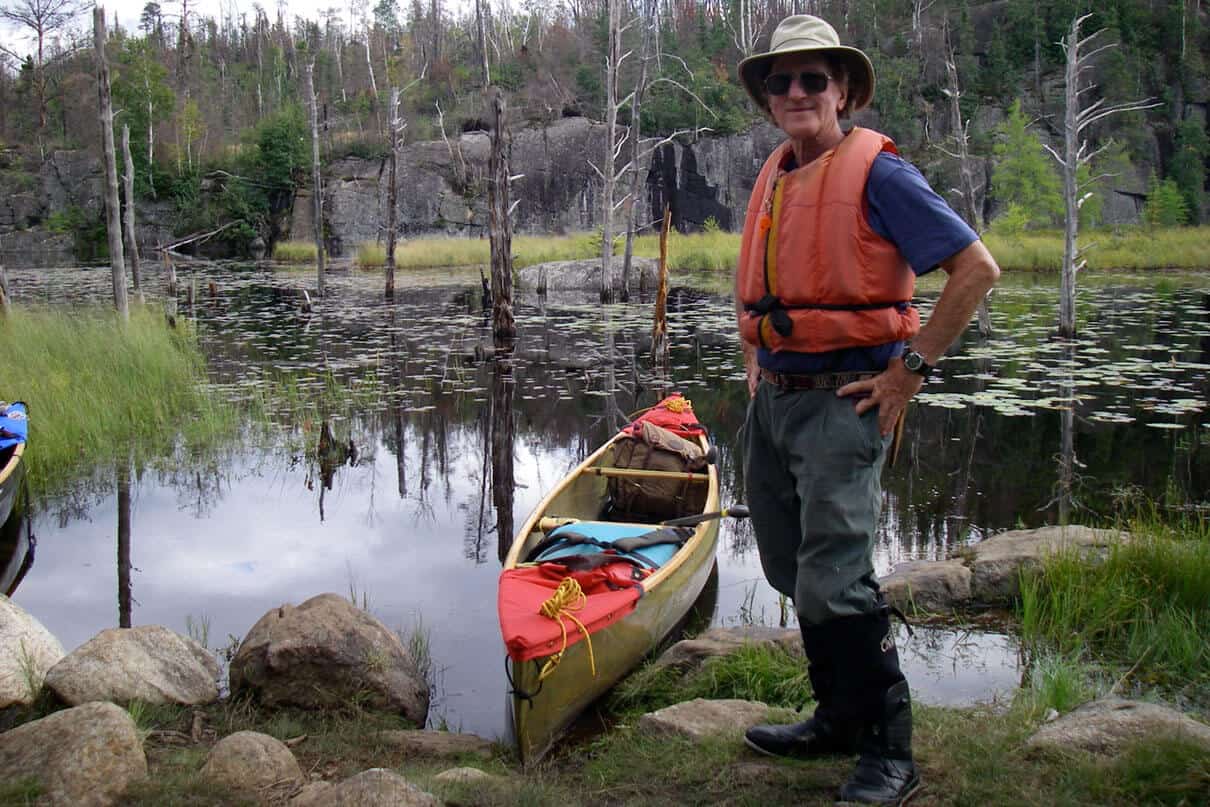

I'd say what what's changed for the better in my lifetime is the improvement in composite materials technology to make lightweight canoes and paddles. And, in general, I agree with this observation by Cliff:

DURABILITY: “Overrated. If you wrap the heaviest, most durable canoe, it’s a goner. It may fold back into shape and be ‘paddleable,’ but when you get home, you won’t want it. Better to buy a light canoe and take some lessons. Very good paddlers seldom seriously damage their canoes.”
 
Clothing progressed.
Pfd comfort progressed.
Boat shapes seem to go in a to me wrong route.
Most interetations of the same boat get more stable. I wish stability kept the same , and boats get faster or easier to manouvre or both.

Finding good paddles seems getting more difficult. At least in europe.
 
What's gotten better? Having money and time. I bought my first solo canoe in 1983--even as a dealer getting it wholesale, I couldn't afford Kevlar. However, at 51 pounds, it's still useable and is a delight to paddle. I'd rather carry my current 36 pound Kevlar boat. Wood bent shaft paddles were replaced with carbon, but the wood still feels good. I've replaced my 73 pound glass tandem with a 51 pound Kevlar (which stays in the rafters--no partners). On the water, there's not much difference. I've spent a lot of time in the 73 pounder (which my daughter owns now). Being retired I can now take long trips in the middle of nowhere, which is what I've wanted to do since my first trip in 1977 (and probably before that as a Boy Scout getting my Canoeing merit badge). I've had outdoor gear since the 70s, and as I don't try to have the latest and greatest, gear evolution has had little effect (though I did replace wool with synthetics).

What's gotten worse? Getting older, and wondering how long my current lifestyle will last.
 
I agree with Cliff on the cookware. The new stoves are well built, but aluminum foil for windscreens? I still use a Sigg Tourist cookset with a Svea 123 stove. I haven’t found anything that is as stable, versatile, and windproof as a Svea 123 Stove with a Sigg Tourist cookset.
 
My urge to cover ground has flipped. Taking the eighth day in camp worked well. Them changing lakes after eight days felt comfortable. The last few years 4-6 weeks on a remote lake with great views is just right.
 
What has gotten better - my skill set and my attitude as well as my goals. I have turned into the guy who paddles hard to get to base camp ( 1 to 5 days ) - then explores every rock outcropping, every near by lake etc. With a base camp established I enjoy camp chores - processing fire wood, cleaning camp, tending to my gear - as well as enjoying daily adventures with my dogs. We hike, fish, shore lunch .... I have learned to truly cherish times with them in the timber on a canoe trip.

What has gotten worse - my stamina. I am pretty active and in good shape but my long slog 12 plus hour travel days are over. Also, I can deal with cold temps, and very hot temps ... but high humidity and high heat sap me more than ever as I age. As far as canoe kit goes ... I use the same stuff I have for the past 20 plus years so I have no idea how to compare it plus or minus.
 
Better:
Carbon Kevlar - tough, stiff, and light. For perspective, when I first paddled good fiberglass canoes were in production but rare.
Good plastic kayaks - my creek boat is light enough to carry on my shoulder, tough enough to seal launch off granite rocks, and doesn't need to be any stronger.

Cars - Cars have gotten more reliable, more capable, and more fuel efficient. Getting to the water is less drama now.

The internet:
-Online classifieds: In the 1980s i could only look for used canoes in the Sunday paper, and it was mainly Colmans and aluminum.
-Online gear: new gear is cheaper and easier to get. It used to be gear came from outfitters which were crazy expensive or Campmor.
-Online guages and weather: ever tried to tell the gauge height based on a series of beeps over the phone?
-Online maps: I miss map rooms, like the ones at major universities. But I sure don't miss planning to be in one of those cities, when the library was open, just so I could copy a few topos.

Pollution:
- less garbage in most places
- better water quality in most places
- more birds. I'm old enough to remember when there were fewer large birds, as DDT had only been banned a few years before.

Bad:
polypropylene canoes
Cheap plastic kayaks and SOT everywhere

Still the same:
- people still drown too much, mostly cause they don't wear life jackets
- people still drink too much around the water.
 
Last edited:
I definitely enjoy having lightweight canoes at this point in my life. Numerous knee surgeries (the first reconstruction at the ripe old age of 17) led to an eventual replacement so having less to carry on a carry is a joy. It's funny to me how I started out with traditional gear (I.e. wool, canvas, etc.), caught the bug with modern materials and have now moved into a blend of the two. Still enjoy my Bean boots and wearing lots of wool but love my nylon tarps and other lightweight camp gear. I do enjoy my one graphite bent shaft paddle but still find myself grabbing my old Al Camp wooden bent shafts just as often. At this point, old vs. new isn't as important to me as being able to get out. Turning 73 this April is a reminder that I need to keep active and enjoy life as I'm able.

That's all for now. Take care and until next time...be well.

snapper
 
I haven't been avidly paddling canoes as long as most of you. But what's changed for me personally is the availability of good used canoes - especially solo canoes. When I first decided to buy a canoe but didn't have the cash to buy new, it was hard to find anything in my area better than a Coleman or a Grumman.

That was before everyone decided they want to move to Idaho. Now we have a pretty good supply of decent canoes being brought in from other states appearing on the used market. Some of the sellers are aging out (lots of folks retiring here), and others are simply mistaken in their perception that we have no good place to use them (well, compared to BWCA or the Adirondacks...yeah).

I never used to think I would be able to buy a Wildfire I could justify the expense without driving two days both ways. Of course, that still wouldn't have been as likely if there were others here looking for same.

The bad? Used to be, before I got serious about canoes, there was a good selection of new canoes from Wenonah, Old Town, and Mad River. Good luck now with buying a new canoe other than the heavy plastic found at Dick's. No one locally is stocking much of anything I would consider buying new. The only real paddle shop in Boise now usually only has a couple of tandems, if that. They no longer have demo canoes at all. Closest dealer with stock of anything I consider desirable is in Bend, and that's only one brand (Northstar).
 
Although I have canoed since I was a Boy Scout, my adult time in the military kept it at a moderate level camping with a Grumman mainly only when I visited home, some with wife, 2 kids and a dog. Until work colleagues invited me at age 46 to partner in a woodstrip voyageur canoe project built by a home town friend. We began racing the Adirondack 90 miler for several years, which I have continued to my 30th annual 90 miler in 2026. That eventually also got me to do five Yukon River races, such wonderful experiences those have been. Love of wilderness got me to get my state wilderness guide's license, and to volunteer as a mentor and BSA high adventure trek leader instructor for 30 years. It was not a big step to become a Wilderness Search and Rescue crew boss certified by my state.

After militeary, I had an enjoyable long and fruitful government engineering career and advanced well with good pay, resulting in a decently comfortable retirement. That allowed me to expand and continue my canoe pursuits of recreational paddling and racing lightweight canoes, thankfully in good health even as I entered my 70's. And to build a nice camp on a small no-motors Adirondack lake located a short distance from many of the larger canoe waters and backcountry hiking and remote land and canoe camping opportunities.
 
over the last 6 decades I've seen a ton of changes in the paddling world,some good, some bad, and some fleeting. The best changes were in materials- I grew up with "ultralight" aluminium that was, in reality, just slightly lighter than a battleship with a standard build running in the 90lb range and an "ultralight" pushing 60lbs for a 16 footer, while many people were still using W/C 100lb behemoths, in my teens You started seeing fiberglass boats come on scene with weights ranging from 50+ lbs to over 100, and a myriad of styles and shapes not possible in older materials- who can forget the "reverse cambered hulls" that were intentionally hogged by anywhere from 1/2 to 3" (My woodstream had a very minor one to supposedly make it harder to hit the hull anywhere but in the reinforced stems), then as a young adult I was introduced to KEVLAR!!! 50 lbs for an expedition, or 40 for an ultralight, and CAD and computer simulations where you could design a boat using actual math and test the design without even cracking a mold- the new standards for an entire generation. around the same time Royalex and Royalite came on scene (who can forget watching some big, burly guy slamming a sledgehammer on one, only to watch it bounce right back) strippers became popular among traditionalists around the same time.
But soon there was another set of innovations- the idea of using vacuum bagging to remove excess resin while infusing it far more evenly, adding "footballs" for rigidity instead of ribs, and the appearance of more exotic materials for both hulls and trim like graphite, boron composites, borosilicates, and even volcanic rock (basalt), then there were also the outliers that never formed any more than a small niche following like geodesic, polycarbonate (clear), or some strange combination of other materials and designs.
As boats changed so did attitudes- we went from paddling Dad's old boat or doing it at summer camp, to owning our own boat, to having stables of purpose- built canoes, from a basic maple, ash, or popular paddle in 2-3 different designs to poly bladed monstrosities, bent shaft paddles, more shapes than you can shake a stick at, and as with boats, a move to lighter, stiffer, and stronger materials to the point that buying a car is less complicated. Along with that has come more popularity and the ability of a newbie hopping in a boat, grabbing a paddle, and setting off on either an adventure or a disaster, plus all the problems lack of knowledge causes like access point overuse, campsite destruction, environmental damage, and a litany of other sins.
In the end it's falls on us to give proper advice, and lead the younger generations in a direction that preserves both the sport and the environment in a sustainable way to protect it for the next ones...
 
Royalex and Royalite came on scene (who can forget watching some big, burly guy slamming a sledgehammer on one, only to watch it bounce right back)

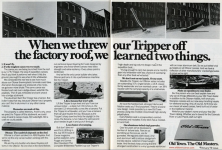
Or Old Town throwing a Tripper off their factory roof in 1973 to demonstrate the durability of "Oltonar," which was their name for Royalex. There was a picture of that in Canoe Magazine ads, but I can't find one. Maybe @Benson Gray can.
 
Let's see, for better or worse?
I've been exclusively paddling canoes that I have built since 1978, using only my own bent shaft paddles since 1982. Not much change.
Hull designs are somewhat improved, but I mostly paddled racing hulls for tripping...not much changed.
Tents, sleeping pads, sleeping bags have all gotten betterr and more comfortable, same for switching from fuel stoves to a Kelly Kettle.
Foods much better since I started dehydrating all my own meals and snacks. Used to be canned food and a two burner Coleman.
Paddling and camping with MDB and the kids was wonderful, nothing better than shared family memories.
Big positive changes in the access to new waters within the ADK's. Lows Lake, Lake Lila, Henderson Lake and the Prestons, Essex Chain, parts of the Boreas as well as Boreas Ponds, Moose River plains, just to name a few.
Oh, and the environment (in the ADK's) is generally much improved. Acid rain much diminished, Brook Trout and Bald Eagles making a comeback, elimination of tent platforms. I can still remember paddling by a tent platform site when I was maybe 8 or 10 years old, seeing LP tanks and fridges discarded in the water. Much later in life I realized that filth was on Little Long Pond in the St Regis canoe area. Hugely better now!!

About the only thing worse is me! I used to be a 165 lb Brawnyman, all muscle, now I'm a 145 lb Scrawnyman, trying to keep the little muscle that I have left.
 
Or Old Town throwing a Tripper off their factory roof in 1973 to demonstrate the durability of "Oltonar," which was their name for Royalex. There was a picture of that in Canoe Magazine ads, but I can't find one. Maybe @Benson Gray can.

The first advertisement below is probably the one you are seeking. They spent all afternoon throwing it off the roof because it is not easy to get a canoe to land on end from four stories up. Most of the time it just bounced without buckling. There were lots of pictures available so they picked the best throwing, falling, and bouncing ones in addition to the buckle one. You can see that the shadow lines on the windows are slightly different in each image.

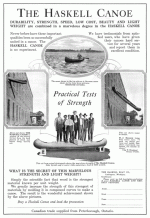
This was not the first time that the durability of a canoe was advertised by throwing it from a factory. Haskell did it in the early 1900s with their cold molded plywood canoe as shown in the second image below but they only dropped it from a second story window.

Benson


1771707675484.png


BACK.GIF
 
Last edited:
Back
Top Bottom