• Happy Birthday, Dr. Seuss (1904-91)! 🐱🎩

Questions and requests for advice as I'm starting out

Joined
Feb 9, 2026
Messages
4
Reaction score
22
Location
Central Wisconsin
Hello all. I'm new around here, but have been trying to catch up on reading some of the wonderful builds folks have and are doing. This will be my first build. But the idea of building a cedar strip canoe is something I've been thinking about off and on since I first read Canoecraft about 30 years ago. Over the last 5-10 years I've watched a lot of Nick Schade's Youtube videos, as well as others, and read several build articles and forum posts online. So I have some background, but there is only so much you can learn without getting your hands dirty. While I'm excited to get going on building this canoe, I'm also hoping it will not be my last, but we will see how this first one goes first.

I'm looking at building a 15-16' solo. I've bought both the plans for a Northwest Passage Solo, and a Kite. The digital Solo plans were very inexpensive, but did not have much detail, so I thought I'd get the Kite ones as well, to get some of the extra details from that, even if I don't build it. I know the Kite may not be an ideal first canoe, but it is just so sexy, I thought it was at least worth looking into. The physical plans for that are supposed to arrive tomorrow. I plan to use this on both inland lakes and non whitewater rivers. I actually live on a smaller river, that I would love to take it down at some point. Both these designs seem to be decent all around'rs for these tasks, but would take feedback if others know differently.

As of now I'm thinking about trying to go stapleless, with 3/16" white cedar beed and cove strips I'll mill up my self. I do have a decent source of that locally, but he typically only has 8' lengths, and as we all know finding CVG will be difficult as well. Picking out the wood is something I plan to do tomorrow. Looks like a lot of scarfing will be in my future. And of course I will be staggering those joints as well. When using that much shorter wood, does it make sense to try and pastern the scarf joints, or try and make them look more random? I also am planing on using at least an outer stem (still debating on inner), I'm not looking for super light weight, and I figure in the river I could use the extra ding protection. Also looks like it might be easier to hide some of the sins on a first build.

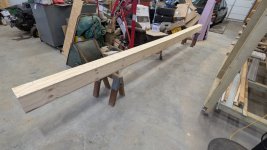
So far I have my strongback itself a good way along, and will start working on forms when I decide on a design. I used some leftover 3/4" ply I had to build a two part 16" one. Since I'm going stapleless, I guess the form material shouldn't matter as much, so will probably go with 1/2 construction plywood from menards, unless others think I should upgrade a bit. I also had just done an amazon order of a bunch of parts to build Jimmy clamps, but I think I may have screwed up the size of one thing or the other. The inner tubes I got seem way wider (about 1 5/8" wide) than the spring clamps (about 1 1/8" wide), So not sure how that is going to work out. I also ordered a bunch of small C clamps to possibly use the strip hold down method I've seen Nick S. use in his videos with a chunk of a hook shaped piece of wood clamped to the form. And for good measure I even bought some bungee materiel to possibly try that method as well. PXL_20260227_212313936.jpgPXL_20260227_212401708.jpgPXL_20260227_213616272.jpg
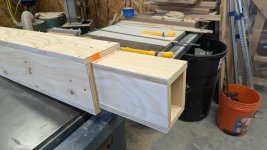
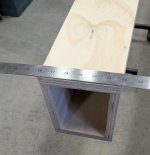
The one section of outer strong back box is not screwed down to the other yet, so not fully level, but will be. I'm also probably going to increase the height of the saw horses, but they were at this height, so I put it on there. Actually that is another good question, what is a good height for the top of the strongback?

Thanks in advance for any suggestions and help. I'm really looking forward to getting going on this, but also a bit nervous as well.
 
Strongback looks like it'll be solid. You may need to temporarily brace it level when screwing it together.

The most time-urgent, since it might affect your wood shopping tomorrow:

  • It might be un-intuitive, but you usually don't want vertical grain planks for your strip stock. (Assuming 1x nominal stock, which is what most of us start with.) Instead, you want the flattest flatsawn available. Then, when you rip your strips out of the plank, the strips will have vertical grain. Draw out the annular rings on the end of a plank if you need to visualize it.
  • Are you thinking of scarfing in the plank before ripping your strips? If so, you'll lose about 9" of length to the scarf. What does your supplier mean by 8'? Is it "Exactly 96 inches" or is it "8-ish, probably a little bit over"? If the first, scarfing them will leave you with 15'3", which might be just enough to run full-length for a 15' canoe. No extra space here. If you intend to scarf/joint per-strip: you won't loose near as much, since the scarf will run the other way.
  • If you can't get 100% clear stock, you will end up breaking the strips at semi-random lengths. Not necessarily an issue, it just affects whether trying for matching/patterning joints is at all practical.

Other stuff:

  • Staple-less construction: If you haven't found it already, you might want to look at how @gfraizer13 handled the forms over on this build thread. I think it was brilliant.
  • Form materials: Are you intending multiple builds on the same forms? If not, go for what is most cost-effective for you. Would not recommend any utility plywood less than 3/8". One of the advantages of the MDF that I often see used is that it stays flat. Most utility plywoods tend to warp or bow a bit, and may need some flattening cleats.
  • Work height: I like the section that I'm working on to be just a few inches lower than chest height. That strongback will be able to take some moving about, so there's no reason not to lift or lower the build as you progress. If I had to leave it all at one height, I'd suggest that the bottom of the canoe be around 48" from the ground, give or take. YMMV.
 
Strongback looks like it'll be solid. You may need to temporarily brace it level when screwing it together.

The most time-urgent, since it might affect your wood shopping tomorrow:

  • It might be un-intuitive, but you usually don't want vertical grain planks for your strip stock. (Assuming 1x nominal stock, which is what most of us start with.) Instead, you want the flattest flatsawn available. Then, when you rip your strips out of the plank, the strips will have vertical grain. Draw out the annular rings on the end of a plank if you need to visualize it.
  • Are you thinking of scarfing in the plank before ripping your strips? If so, you'll lose about 9" of length to the scarf. What does your supplier mean by 8'? Is it "Exactly 96 inches" or is it "8-ish, probably a little bit over"? If the first, scarfing them will leave you with 15'3", which might be just enough to run full-length for a 15' canoe. No extra space here. If you intend to scarf/joint per-strip: you won't loose near as much, since the scarf will run the other way.
  • If you can't get 100% clear stock, you will end up breaking the strips at semi-random lengths. Not necessarily an issue, it just affects whether trying for matching/patterning joints is at all practical.

Other stuff:

  • Staple-less construction: If you haven't found it already, you might want to look at how @gfraizer13 handled the forms over on this build thread. I think it was brilliant.
  • Form materials: Are you intending multiple builds on the same forms? If not, go for what is most cost-effective for you. Would not recommend any utility plywood less than 3/8". One of the advantages of the MDF that I often see used is that it stays flat. Most utility plywoods tend to warp or bow a bit, and may need some flattening cleats.
  • Work height: I like the section that I'm working on to be just a few inches lower than chest height. That strongback will be able to take some moving about, so there's no reason not to lift or lower the build as you progress. If I had to leave it all at one height, I'd suggest that the bottom of the canoe be around 48" from the ground, give or take. YMMV.
Thank you for the quick response and good points.

I did misspeak and meant just clear grain, not clear vertical grain. I've been to the fellow I'm buying from's yard once before. He mills, and kiln drys a wide variety of material, and I bought some maple and walnut when I was there last. But just looked at the cedar. I'm assuming like you it is a bit long, but not absolutely sure, will check tomorrow. I remember thinking to get the lumber as knot free as I could get, i would probably need to go with some wider boards, and than not strip all of it. While gluing up and scarfing before stripping sounds like something that would save time, I was worried both about the waste, and the joint holding up at that point. I have a bit more confidence in getting good glue coverage on the individual strips, or am I mistaken on that? I believe both of these designs would take about 50 or so board ft, but I plan to buy extra.

I believe I had seen that build before, but thank you for bringing it up again, it is an interesting technique that I don't know if I fully understood the first time I saw it. I get it more now.

I also appreciate the reality check on the form material. I was already planning on using 1/2" at minimum material. And I wasn't thrilled with how much MDF was going for a sheet. And I could have sworn my local Menards was out of particle board at the time I looked a few months ago. But checking today they have plenty of both 1/2" and 5/8" so I think I might go with that instead. I believe 2 sheets should be enough even if doing the extra edge technique. I don't have plans to make another of the same right now, and I think I may not even be supposed to of the Kite, without buying new plans, but they also don't take up much room to store. The strongback on the other hand, I could see being used on other builds, so I did intentionally build it fairly strong, but also so I could split it in 1/2. And the plan was to brace it while screwing it down, but thank you for the reminder on that as well. And like you said, it should be able to handle some shifting even with the canoe and forms on it. I may have a way of doing that fairly easily, at least at the start. May go down to the saw horses when I get to the bottom.
 
I think it's important to remember that lots of people build cedar strip canoes and, assuming they actually finish what they started, they always seem to turn out fine. Not making mistakes certainly makes it easier but it's pretty hard to mess it up to the point it can't be fixed.

And there are many ways to skin this cat. I remember being frustrated with my first build because I just wanted a step by step "do this and do that" but it seemed like everyone had a slightly different way of doing each step and it was so hard decided which method to use. Eventually I realized they all work and quit sweating it as much.

If you plan on this being your only cedar strip canoe and you tend to be a perfectionist then knock yourself out and make it as pretty as you want. Just realize it's going to take a lot longer. A lot of people are fine with that. Some people enjoy the process just as much or more than the paddling.

If you think you're going to build more of these, or if you're not that much of a perfectionist, I recommend using staples and knocking out a basic cedar strip without getting bogged down in the details. This will make you familiar with every step of the process and will make it easier on your subsequent builds to shoot for high quality because you'll know what areas to focus on and which aren't that important.

Have fun!

Alan
 
Alan is right about the tradeoff between "perfect" and "good enough". Don't let the former be the enemy of the later, but only you can decide where that line is for your build(s).

While gluing up and scarfing before stripping sounds like something that would save time, I was worried both about the waste, and the joint holding up at that point. I have a bit more confidence in getting good glue coverage on the individual strips, or am I mistaken on that?

I have done the "Scarf each strip as I go" method. Once. I had a little jig to sand the scarfs on a disk sander, and scarfed each one as I was ready to lay it. I found it fussy, messy, time-consuming, and in the end the joints didn't look all that great. (Think about what happens when you round off the outside of the strips when fairing it before glass. Each of those knife-edge joints sands back in an irregular parabolic curve.)

All for a stronger joint that doesn't matter:

The structural strength here isn't actually relevant to any real degree. I've said it before, but I will repeat here: The core of a strip canoe is not really structural. It needs to have some compressive/crush strength to keep the two glass panels properly separated, but beyond that it could be balsa, or even styrofoam for all its strength matters. (indeed, there are some builders here that have built more advanced composite canoes that do use foam to separate the composite layers when they need more stiffness without much weight.) All it really needs to do is look pretty, and hold together until we get the glass applied.

What I, and many other builders, have done is to simply butt-joint the strips. This means make sure that the end has a nice, clean, straight cut, and just butt it up to the previous strip. You can clamp a scrap of strip stock behind the joint until the glue in the bead sets, but otherwise it's properly supported by the strips above and below.

Scarfing in the plank, before ripping your strip, is entirely about convenience and aesthetics:
  • You get the convenience of having full-length strips to lay in
  • You get a neat, crisp joint for relatively little effort. (Honestly, since this isn't really structural, you can get away with a shorter scarf here. 4:1 or 5:1 scarf will work fine, and look good.)
  • You have the inconvenience of needing to machine and handle full-length strips. These things are long, thin, and flexible. You know your shop layout, and your ability to arrange for infeed and outfeed support, both for your strip-ripping, whatever that might be, and for your router setup for the bead and cove.
 
I've never built with full-length strips and I scarf as I go with a simple miter box (45 degree scarfs). I lay both pieces in the box overlapping them, cut them both at the same time and then glue them on as you would laminate flooring: whatever is left over from the last strip becomes the beginning of the next strip. It assures a completely random pattern to the scarfs.

Personally, I wouldn't worry too much about finding clear lumber either since small knots are common to that wood species. As long as the knots are tight you'll be fine and you can always put a few drops of CA glue on the knots just to be sure they don't move when you cut the strips.

For station forms, I use 1/2 inch (or whatever it is now) OSB and haven't had issues. Building the strongback bulletproof is always a good idea.

I've found that Harbor Freight is a great source for cheap, decent spring clamps and any local bike shop will have used inner tubes. They'll probably give you far more than you want just for asking.

I'm not sure how high my strongback is but I can check tomorrow if you're really interested. I'd say the top is about mid-thigh. I have to bend over or kneel to place the sheer strips and I use a small (2 step) step ladder to close the football.

I agree with Alan: don't overthink the first. Relax, have fun with it and know that almost anything can be fixed. Besides, if you buy 50 board feet of Cedar, you'll probably have enough to build the second one anyway.

Looking forward to watching.
 
Back
Top Bottom