• Happy Birthday, Charles Lindbergh (1902-74)! 🛩️🗽🗼

Pack canoeists, do you use portage thwarts or yokes?

Glenn MacGrady

Administrator
Staff member
Joined
Oct 24, 2012
Messages
6,626
Reaction score
12,695
Location
Connecticut
A portage thwart can't be permanently installed because it would interfere with the central seat. Many pack canoes have thin or no inwales, so there is nothing or nothing much for a clamp-on portage yoke to clamp onto.

So, how do you pack canoeists carry your canoes? With some sort of attachable portage yoke—what kind? Or do you just not bother because of the canoe's light weight?
 
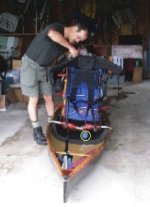
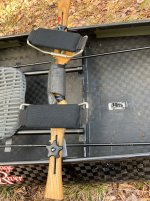
i have posted the photo of me carying my Hornbeck with a Knupak many times and will not repeat tha here. But i do have a photo of the knupak breing mounted on a custom bent yoke temporarily held at the canoe's CG by with bolts and finger tight nuts through the wood gunwales. Time to transition from paddling to carry mode and vice-versa is less than 4 minutes.

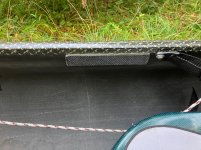
The lack of an inwale on my Blackwaer is overcome by having Ben Diller at SR glue in short blocks at the CG to acept the clamp on yoke.
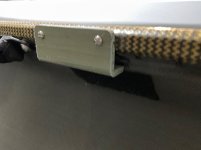
Bill Swift installed threaded recepticles into the gunwale of my Cruiser to accept nob mounted bolts that work with the same yoke that I use on the BW. Joe Moore did the same on my PB Shadow, while my Gen1 Rapidfire has wood gunwales with an inner inwale to accepthornbeck knupac mount.jpegBW yoke.jpegBW gunwale block.jpeg the clamp.
 
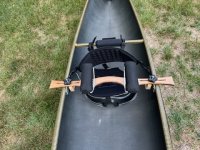
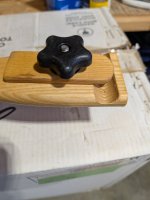
You might be able to use a fairly conventional yoke, especially if the boat is very light. PakCanoes have 3/4" or so aluminum tubing inside fabric as the gunwales, providing very little room for purchase. However their yoke works fine for carrying the 60 pound boat. The yoke is routed with a channel for the gunwale, and opposite is a wooden clamp that rotates under the rounded gunwale, tightened by a screwed knob. I'll provide a photo after a while a (still having my morning coffee).
 
For short distances I just throw it over a shoulder. The Trillium is 27 lbs so I can manage that. For longer distances it digs into the shoulder and gets uncomfortable. That’s when I use a detachable yoke, I got a wood one from Northstar. I initially got the yoke with foam on it; it was not comfortable at all so I picked up shoulder pads similiar to what ykn shows in his picture. I have aluminum gunwales on my canoe and have no trouble clamping the yoke to them.
 
Now in my mid 70’s we started using portage yokes. My Northstar Trillium is easy but my wife’s Placidboat Oseetah was a challenge until I came up with this solution.
 

Attachments

  • IMG_0161.jpeg
    IMG_0161.jpeg
    212.4 KB · Views: 17
  • IMG_2089.jpeg
    IMG_2089.jpeg
    90.3 KB · Views: 17
So this only just occurred to me today after writing my response earlier. I got my Trillium converted from a pack seat to a standard canoe seat with 4" seated drops, so I'm not sure my current yoke setup is going to work. I guess I'll have to figure that out.
 
I use the Swift carbon fiber yoke on my Prospector 14 Pack. They didn't have it worked out the first year or so, and the clamp slipped. The add a piece of tape on the gunwale and it usually works. Tighten the clamp really good.

They have since incorporated a threaded insert in the gunwales. I haven't used it. Bill Swift said they would add it to mine for a reasonable price. Would like to plan an Algonquin PP trip and drop it off while I trip in my other solo.
 
This is something I wrack my brain over constantly. There's got to be a better way.
In my home-built canoes, I can run paddles across the two thwarts situated on either side of the central third of the canoe length. This sucks when the bugs are bad, and doesn't offer much padding. If I want a dedicated yoke I can just build one and screw it into blocks glued to the gunwales; that works, but then you've got a bulky extra thing to tuck away or forget or lose somewhere.

Plastic boats are a different animal. I bought a clamp-on yoke for my OT Pack but it so clutzy and clunky that I returned it.

I bought a Dagger Solo 13 last summer with an interesting feature- a webbing strap that rolls up and tucks away on one side, with a corresponding buckle on the other; out of the way paddling, easy to click on when portaging, impossible to lose. There's a huge flaw in the design, though, in that the weight of the cane on your shoulders is enough to bend the gunwales in and create enough slack that you're bopping your head on the hull every step.
So in my next boat, I'm going to build on that concept and add a webbing strap with a buckle, just like the Dagger, but thread a thin quartersawn plank that runs maybe an inch less than the width between gunwales. This will tuck out of the way along the hull with a buckle, velcro, or snap when paddling, but shift the weight of the canoe onto the gunwales themselves during portage, rather than the mid-point between them, and reduce that tendency to sag inwards and reduce the distance between strap and hull.
 
My question was aimed at very lightweight (15-25 lb.), composite "pack canoes" from manufacturers such as Hormbeck, Slipstream, Placid, Savage River, Swift, Northstar and Wenonah. These pack canoes typically have no central thwart at all because that's where the seat is, and hence no factory-installed central portage yoke/thwart. Often they are made either with no inwales or with very slim composite inwales or perhaps aluminum—such that standard clamp-on, removable yokes have insufficient inwale surface for solid clamping purchase.

I know that such lightweight canoes can easily be carried short distances on the shoulder, from and to a vehicle for example. But I'm wondering what kind of yoke is available to carry the canoe for long distances on both shoulders. (Forget the custom Swift yokes that screw into factory threaded insets in the infused gunwales.) What solutions have pack canoeists used for this situation: no inwale to clamp onto and no factory thread holes?

@yknpdlr mentions that Savage River glued clampable carbon blocks on the inside of the his no-inwale Blackwater hull so that he could use his standard clamp-on yoke, but I recall that that didn't work out perfectly. @yknpdlr, perhaps you could elaborate on what improvments you would have made re that solution.
 
Since the scenario is with no inwales I wonder if you could strap the yoke around the bottom of the canoe?
Jim

That reminds me that there there used to be, and maybe still are, fabric yokes that wrap around the entire hull. They were offered by the Bag Lady, Placid and maybe still are by Swift.


I recall @yellowcanoe not being particularly enthused about hers for a Rapidfire.
 
One of the problems with the fabric yokes is that they lay on your neck and your head is up inside the boat. The nice thing about the yokes that yknpdlr and I use is that the weight is carried on our shoulders and your head isn’t up inside the boat. Easy on easy off.
 
My question was aimed at very lightweight (15-25 lb.), composite "pack canoes" from manufacturers such as Hormbeck, Slipstream, Placid, Savage River, Swift, Northstar and Wenonah. These pack canoes typically have no central thwart at all because that's where the seat is, and hence no factory-installed central portage yoke/thwart. Often they are made either with no inwales or with very slim composite inwales or perhaps aluminum—such that standard clamp-on, removable yokes have insufficient inwale surface for solid clamping purchase.
My point about the (much heavier) PakCanoe is that it has no inwale/outwale (and no central thwart) and that a modified conventional yoke may work, mostly to give you an idea of what might work with a little ingenuity. Apparently my point was missed.
 
Back
Top Bottom