• Happy Birthday, Lou Gehrig (1903-41)! ⚾🎠4️⃣

Light weight vs strong laminate

Joined
Mar 17, 2015
Messages
112
Reaction score
290
Location
Louisiana
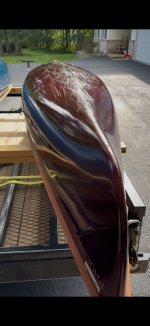
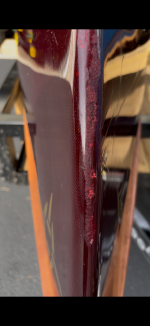
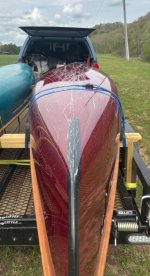
There have been discussions about moving to lighter weight canoes as we age but that tends to mean more fragile construction. I want a canoe that is both light weight and robust! The Flashfire is one of my favorite canoes. I had a Bell Flashfire that weighed about 36 pounds and then when a Placid Flashfire came up for sale some time ago I sold the Bell and bought the Placid Flashfire which weighs 29-30 lbs. It is such a delightful canoe to use for maneuvering around obstacles such as trees in a swamp or snags in a stream. Last week on Magees creek, a shallow stream that flows into the Bogue Chitto, I got over confident and made a last minute poor decision to take a less straight-forward route when approaching a snag. I hit the snag broadside and along with the thud there was a sickening cracking sound. The fabric doesn’t look torn, but the resin matrix is cracked in the chine and also at the shouldered tumblehome, along with gelcoat cracking on the outside. I usually try to baby that canoe but it is such a fun canoe to play with I got tempted to try a move I shouldn’t have. Back when Placid was making the DY fire models Charlie Wilson was touting Placid’s resin infusion technology and saying the Placid versions had greater strength compared to the Bell ones. I’m not sure about that now. I hit the snag with more than a gentle tap but I wouldn’t have thought it would cause cracking like it did.

What trade-offs do you make? Do you struggle with a sturdier but heavier canoe, paddle a light weight canoe but avoid trips or maneuvers that risk damage, or paddle a light weight canoe, take the risks and keep doing repairs? With the back problems I’ve been having, loading a canoe much over 30-33 lbs on the car has become quite a challenge so a heavier lay-up wouldn’t be a great option but neither do I want to keep having to patch my Flashfire nor am I ready to give up fun maneuvering in flat but flowing water that has obstacles that may at times push the limits of my ability to avoid them.
 
I have a similar conundrum, except mine isn't about weight or fragility. It's about cost and ease of repair between two boats. My w/c canvas canoes are the ones I prefer to paddle, but a mishap on moving water or dragging over shallows could cause damage that would be harder and more expensive to fix then on my composite boat. I could also take a royalex boat and have no worries at all, but life is too short for that.

The conclusion I came to is paddle the boat that I prefer or the one that would work the best for the trip, and hope for the best. Within reason of course. Knowing your skill level and the conditions you may encounter are a big consideration. Take whatever boat you think will be the most enjoyable with a reasonable chance to come out unscathed.
 
paddle a light weight canoe, take the risks and keep doing repairs
That's me. It helps that most of my canoes have been bought used, with pre-existing scratches and dings - even cracks or worse. So far, at least, my repairs haven't added significant weight. I only have one canoe that is so pretty I baby it ......a little.

I'm a man, so I'm always shopping for an upgrade. One of the things that keeps me from buying a brand new canoe right this minute (besides price and lack of test paddle access) is this indecision over layups. 28 lb ultralight, or expedition weight? Yeah, that's a tough one when you're talking about $4k US. But time for spending the money and wearing one out grows short.....
 
Pika, as an aside, the area you describe is likely the most vulnerable area on the entire canoe, had you impacted anywhere else, we probably wouldn't be having this discussion.
Choosing "Ultralight" versus "Expedition" layups (and the few in between) is largely an exercise is figuring out how you plan to use the canoe and what are your needs/wants. If you want the weight reduction, then you have to slide towards the UltraLight layups and that will also require you to respect the capabilities of those craft. They are just not going to be as impact resistant as the heavier layups, but if you hit them hard enough, they will also crack.
I think Lowangle summed it it up nicely:
The conclusion I came to is paddle the boat that I prefer or the one that would work the best for the trip, and hope for the best
 
Pika, as an aside, the area you describe is likely the most vulnerable area on the entire canoe, had you impacted anywhere else, we probably wouldn't be having this discussion.
That is an interesting point. The cracks are not directly at the point of impact (at least I don't think so), they are in areas of greater hull curvature above and below the impact.
 
I'm in the "patch it, paddle it, enjoy it" camp but it depends on the extent of the damage whether I'd bother patching it.

If the glass is intact on both inside & out and the cracking appears to be limited to the core (does a fingernail or ball point pen catch in any of the cracks?), I'd probably just paddle it, figuring the odds of hitting the same spot might be pretty slim.

Of course, your destination may impact the level to which you repair also... If you're headed to Crown Land for a 3 week, off grid, solo I'd be more likely to repair than for a day paddle on local waters with easy road access.
 
I have been struggling with the same problem. I tweaked my back playing pickleball recently (second time in three years). I am still able to lift my 65 pound Royalex OT Camper but I turn 68 soon and at some point in my future the weight will probably be a problem. The lighter more fragile layups would be nice to lift and paddle but I know that I will not be able to avoid exploring the water here where an unexpected oyster bed or really narrow mangrove tunnel is sure to turn up. I have decided to give up pickleball keep going with the “bulletproof” Camper and hope that my strength holds up for a few more years.
 
A lot of the modern “tough” composites are a decent compromise. Most can take a decent impact without too much issue, and are still lighter than royalex. A Flashfire made by Swift in their Expedition Kevlar, or a firebird in IXP would still be fairly light and able to take more of an impact. I try to avoid major obstacles but the Ozarks are just super hard on the bottom of boats. No manufacturer I’ve found makes a boat abrasion resistant enough for years of regular use in the Ozarks without a rough looking underside, unless you only go when the water is fairly high. My IXP Phoenix takes impacts just fine but still scratches badly on the bottom. Same with my Swift Starfire. I’ve spider cracked my gel coated Bell Starfire but it handles the abrasion a little better than the others (plus the ivory color helps hide scratches). I had a T formex boat and the vinyl wore very fast in my opinion. Faster than older stiffer Royalex. But the old Royalex wears fairly fast too around here. Obviously they take an impact pretty well though. I go for durability over lightweight because we don’t portage here and it’s shallow rivers full of gravel, rocks, and strainers.

Keep in mind I wet foot entry/exit, and try my best to avoid shallows, but they’re just pretty unavoidable on these rivers sometimes.

Phoenix after less than a year:
IMG_3871.png

Phoenix stem after taking a very hard impact on a truck sized rock on the upper Buffalo (no structural damage at all):
IMG_3873.png

Swift after second paddle (very rocky river, low water):
IMG_3633.jpeg
It’ll look better after I get around to applying some 303 but still…

T-formex after a year:
IMG_3349.jpeg
 
Last edited:
The most prominent scratch here is my most recent cosmetic work on my Blacklite Trillium. A rock got sneaky on me in a 1+ rapid, I went right and took the rock on the side. Bounced right off and kept going. I wet launch but have gotten over being gentle on it, so far it's taken everything I've thrown its way.

To answer your question, I went with Blacklite because it's light but still has some extra durability vs some of the lighter Northstar layups. A few pounds is worth it to me for the extra durability, and if Blacklite HD had been a thing when I got my Trillium I probably would have added a few more pounds for a little more durability. But for my paddling I skipped the additional weight of the IXP layup that ABT uses. I don't do rapids over 1+, and if water levels are low enough to make rocks a real concern I head to a lake.

IMG_1440.JPG
 
I use my carbon kevlar (no foam core) Yellowstone solo for exercise paddling in rivers. It has taken several really hard hits from snags. It is fine.

I don't think I'd go for ultralight layups. If I bought a new solo I'd be tempted for a composite with an extra layer. I would avoid solos with a foam core, it makes repairs harder.

I try to just accept it is a piece of gear and use it, although I cringe whenever I hit something.
 
Back
Top Bottom