I’m not as versed in aerodynamics as some of the others here but I do know the aero losses increase dramatically (to the sq?) with increases in length wrt to flow.
Witness every airplane wing profile, much wider than long wrt flow.
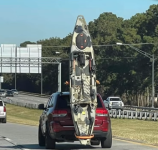
It stands to reason then, that the most aero efficient way to cartop a canoe would be to minimize the length wrt flow path by mounting your canoe with the keel vertical and facing forward.
While this may cause minor problems at the first underpass, you could relax knowing that you’re as efficient as possible.
Disclaimer: you may have some difficulty with buoyancy after that first underpass!
No offense but my 20+ years as a lead engineer calculating aerodynamic loads for Boeing suggests that you don't have a clue. So, here's a quick tutorial...
1 - force increases by the square of the speed. And, it works for everything.... double your speed and the force quadruples, triple your speed and the force goes up 9x. It works for car accidents and hockey pucks and it works for basic aero stuff, and it figures into your fuel mileage. You will always wear your seatbelt if you understand this fact, and you might adjust your following distance when driving.
2 - length is a secondary or tertiary effect if the flow is smooth. 15 ft canoe or 20 ft canoe, you won't notice the effect unless you're some kind of mad scientist. If the air ain't smooth, it doesn't matter...nothing matters at that point.
3 - wings aren't long and skinny to decrease drag. They are long and skinny to maximize lift. They are swept back (on fast stuff) because that does reduce drag at higher speeds, but now we're getting into transonic (mach .4 to mach .99) stuff that doesn't have anything to do with canoes on cars, unless you're going for a land speed record with a canoe on your rocket car, of course..
4 - Frontal area of the canoe counts, as does smooth airflow around the canoe. AND the car. That frontal area of the canoe ain't such a big deal if the airflow is smooth - as you would expect for a canoe shape.
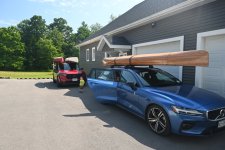
For some reason, my Subaru Outback and 16-17 ft canoes "get along" really well and I notice no difference in mileage (because I do have a canoe on my car 13-14 days/month).
Why you ask?
I don't know, but I would guess that the extra drag created by the air getting goofed up at the front end of the canoe and car is equaled out by the canoe hanging out over the back of the car... could be that the stern of the canoe is acting like the winglets that you see on airliner wingtips, which create nice vortices that dissipate the drag that an un-winglet wing creates. Whatever is going on, it works.
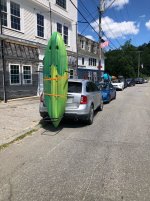
5 - Carrying 2 canoes side by side will be like carrying a big box on the roof because the air is just going to ram itself into the space between the canoes....junk airflow as we used to say.
Summary -
All cars. vans. pickup trucks will have different results, and it's just kind of a crapshoot. However, drive within the speed limit to get better mileage (your newish car was designed to do that to meet government mileage standards), wear your seatbelt in the car, and when you are flying, read the emergency exit card, note the nearest exit and count the number of seatbacks between you and it, and listen to the flight attendant and keep your seat belt fastened unless you have to go potty. And I quit at the beginning of the absolutely moronic 787 program, so the later 737-MAX is not my fault. But if you like flying on 777's, I'm glad to take some credit.