• Happy Look Up At The Sky Day! 😎⛅🌅

Alan's Bloodvein II

I've only done a shouldered tumblehome once, but mine had a concave curve. Glass adhered to the outside just fine. It was the inside that got finicky.

Keep in mind: The exterior glass fibers are a major part of your structural strength. If you break them, you have a much weaker hull - or will need to add a significant amount of weight in overlaping the seam to compensate.
 
...I’m guessing the strong back is the heaviest so it will always want to rotate with the canoe upright.
Not on the Merlin build. The OSB forms & stripped hull were heavier than the plywood legs of the strongback (but not by much). The set-up rotated easily and I could rest the hull on a 5 gallon bucket to color the sides. Only issue was that I needed a helper to get it on the stands (we lifted one end at a time and one person stabilized it while the other positioned the other end on the stand. I'm in the process of reworking the stands to see if I can make that a one-man operation)

Keep in mind: The exterior glass fibers are a major part of your structural strength. If you break them, you have a much weaker hull - or will need to add a significant amount of weight in overlaping the seam to compensate.
I think I'm going to try and wrap the glass upside down to do the whole exterior as one piece but have some 6 inch wide e-glass tape on hand. If the cloth starts to bunch up (there's an extra 1 1/2 strips on the tumblehome area compared to the bow & stern), I'll glass what I can cleanly, allow that epoxy to set overnight and then flip the hull, trim off the loose cloth and glass the knuckle with the tape the following day.

The flat top of the knuckle + the sheer is about 4 inches at the widest point so a 6 inch wide tape should give me 2 inches of overlap and Raka says that I have (I think) 72 hours to still get a chemical bond. I'll be using the tape to reinforce that area on the inside anyway but the sharper edge contour should provide extra strength as well. I think 2 inches of overlap will be sufficient but I've been wrong before.
 
I glassed my red kite with 6 oz glass and it was a breeze, easily conformed.
I used carbon cloth two layers at once for the carbon copy kite and I had great difficulty to get the carbon to fully conform around and over the crease.
With glass, no issue at all.
And a warning about using glass tape: it’s likely straight woven with finished edges. That tape will not conform to compound curves very well. Bias woven tape will, but it’s quite a bit more expensive and difficult to find.
 
For better or worse, I did something a little different tonight.

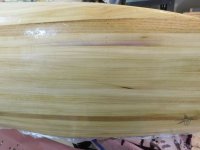
I'm training for a new job and I'd taken the Raven out of the rafters to do a "show & tell" at driving school (relax, I'm not teaching it). As often happens, someone mentioned that you can see daylight through the hull where the strips were not perfectly tight.

Like seeing the staple holes, I've always considered the slivers of light to be part of the process and they don't bother me in the least. However... I got to thinking that maybe I can do something about them.

Now, ideally, I'd tighten up my building process and get the strips fitting in perfect alignment but that seems like a lot of work and it's too late for this boat anyway so I was left with how to eliminate (or, at least minimize) the issue as I finished sanding.

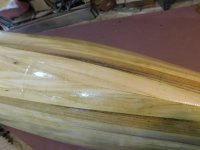
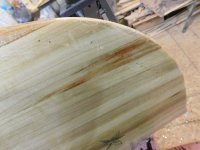
First, I looked between the forms and applied masking tape to any cracks that I could see. I then grabbed the bucket of sawdust that I used to thicken epoxy on the last build (It's White Pine sawdust but, hopefully, the color difference won't be horrible) and sprinkled a little on & around the visible gaps
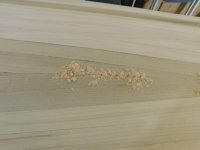
DSCN4323.JPG

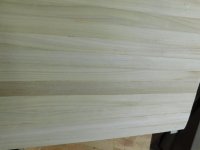
I then used the heel of my hand to pack the sawdust into the cracks and wiped away the excess.
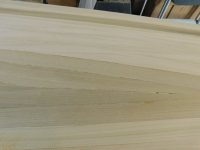
DSCN4324.JPG
If I had to patch an area on the sides, I just put a pinch of sawdust in the palm of my hand and packed it in
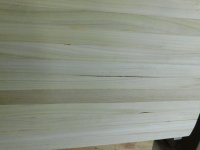
DSCN4325.JPG
DSCN4326.JPG

I then took the handle off of my broom and used the broom head to sweep the hull lightly and swept the floor of the shop since I was already holding the broom (I reinstalled the handle for the shop floor)

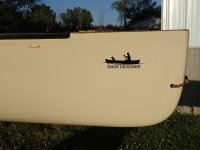
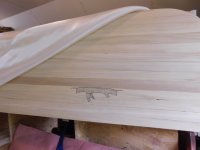
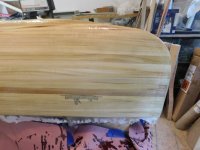
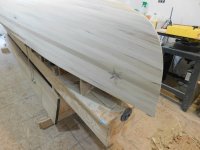
Next step was to trace my daughter's Trillium onto the bow and color it in lightly with pencil (I mean, why not, right?)
DSCN4327.JPG

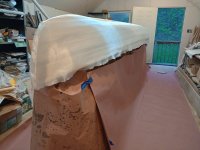
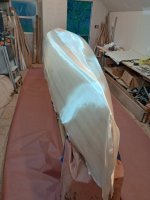
Finally, I checked my cloth supply and found that I have just enough 4 oz, 50 inch wide e-glass to cover the hull and the 50 inch will just barely cover at the widest part. I also have a ton of 30 inch wide, 4 oz e-glass which I'll use on the inside but I think I'll just do a single layer on the exterior and then 2 layers inside to improve impact resistance.

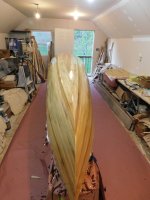
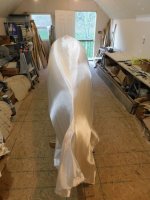
I rolled the cloth over the hull, smoothed out all the wrinkles with a clean paint brush and that's where we are this evening.
DSCN4331.JPG

Between now and Wed I've got a driver's test to pass and my taxes to do.

Assuming that I'm successful at both, I'm hoping to celebrate by encasing this in epoxy on Thursday.

 
Looking great. Can't wait to see it glassed.

I use thickened epoxy to fill any gaps, usually after the 2nd pass of rough sanding. I used to spot fill the gaps but the last couple times I just started putting a skim coat to the entire hull (doesn't take much time or epoxy). I use a squeegee to spread it and force it into the cracks and then use hard pressure with the squeegee to remove any excess that's on the surface of the hull.

The rest of the sanding proceeds as normal and it all but eliminates any epoxy leaking through to the inside during glassing, which makes sanding the inside that much easier.

Alan
 
The only issue I can see with sawdust packing, is it will shrink when the epoxy soaks in.

I have an alternative method that is pretty easy.
1. put a strip of masking tape to either side of the area to fill, usually done day before I am glassing
2. make up a small batch of epoxy and wetout the marked areas lightly
3. Thicken the epoxy and apply at taped areas (usually small putty knife), pushing into the area to be filled
4. use the putty knife to remove any excess
5. pull up the tape and start the glass process

Doing the filling just before you start, means the filled area and the new epoxy/glass application just sort of blend together and disappear with no sanding or attention. Using the tape and putty knife means that when you scrape the area, there is just the right amount raised above the rest to help it blend into the surrounding area.
 
I use wood glue, instead of epoxy. no need for epoxy, and the wait time involved.

You are just filling a hole, not a structural situation.

Jim
 
I use wood glue, instead of epoxy. no need for epoxy, and the wait time involved.

You are just filling a hole, not a structural situation.

Jim

The main reason for using epoxy Jim, is simply to let it blend and bond in a continuous operation, glue would have to be left to dry and possibly be sanded, but using epoxy for cracks skips all of that .... just push the glass on as usual and it all disappears into the process

Brian
 
Back
Top Bottom