

Thanks Robin, and of course all of you who have appreciated this and other projects!
Robin, I had some "discussions" on the WCHA site about potentially replacing entire damaged planks. Whoever removed the previous skin which was undoubtedly fiberglass at some point, did a lot of damage to the outside of the planks. I'm going into uncharted territory here with the individual plank removal and re-installation. I was dreading it, but now that I'm deep into it I'm realizing that in order to preserve the history of this canoe it's necessary to retain as much original wood as possible.
I'm finding that although carefully removing all the tacks is tedious, it gives me the chance to really clean up the interior surface as well as the bearing surface of the ribs too. It's amazing how much paint, varnish, dirt, sand, and other crap has lodged between the ribs and planks. Here's an example of how much clean up can be done with the plank on the bench. I clamp it to the bench and (carefully) use my 3' belt sander with an 80 grit belt. First however, I used a heat gun and scraper to remove 95% of the gunk so the sander only takes away the little bit that remains. On some really stubborn spots that show between ribs I used a random orbit sander, but carefully so as not to create sanding divots.
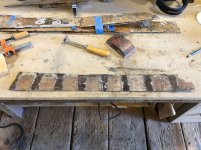
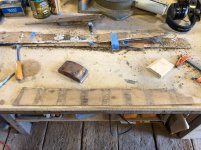
Over the years, previous owners had attempted to remove paint and varnish by scraping. That made some gouges and scrape marks between and along the rib edges, so sanding removed some of that. What I can't clean up without making the plank too thin will remain as patina once done. Here's an example of what I find between plank and rib.
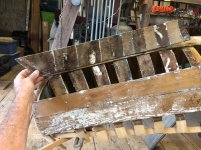
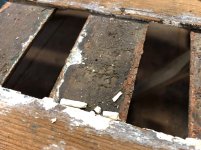
I only remove one plank at a time from each side, and once "restored" I apply a 50/50 wash coat of varnish/thinner to the inside of each plank. I then re-tack the planks in new locations on each rib, pre-drilling for each tack to avoid splitting. And yes, as you know, clinching the tacks-especially at the centerline- is difficult for one person. Fortunately I have long arms!
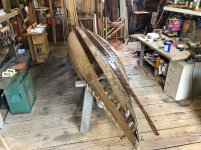
Once she's refastened, and some truly unusable plank sections are replaced I'll be able to turn her over and admire a mostly restored interior. What will remain is to apply heat and scrape/sand the flat sections of the ribs. While the planks are off I can heat and remove junk from the narrow sides of each rib, so only the flats will need attention.
More to come as I progress.
Robin, I had some "discussions" on the WCHA site about potentially replacing entire damaged planks. Whoever removed the previous skin which was undoubtedly fiberglass at some point, did a lot of damage to the outside of the planks. I'm going into uncharted territory here with the individual plank removal and re-installation. I was dreading it, but now that I'm deep into it I'm realizing that in order to preserve the history of this canoe it's necessary to retain as much original wood as possible.
I'm finding that although carefully removing all the tacks is tedious, it gives me the chance to really clean up the interior surface as well as the bearing surface of the ribs too. It's amazing how much paint, varnish, dirt, sand, and other crap has lodged between the ribs and planks. Here's an example of how much clean up can be done with the plank on the bench. I clamp it to the bench and (carefully) use my 3' belt sander with an 80 grit belt. First however, I used a heat gun and scraper to remove 95% of the gunk so the sander only takes away the little bit that remains. On some really stubborn spots that show between ribs I used a random orbit sander, but carefully so as not to create sanding divots.
Over the years, previous owners had attempted to remove paint and varnish by scraping. That made some gouges and scrape marks between and along the rib edges, so sanding removed some of that. What I can't clean up without making the plank too thin will remain as patina once done. Here's an example of what I find between plank and rib.
I only remove one plank at a time from each side, and once "restored" I apply a 50/50 wash coat of varnish/thinner to the inside of each plank. I then re-tack the planks in new locations on each rib, pre-drilling for each tack to avoid splitting. And yes, as you know, clinching the tacks-especially at the centerline- is difficult for one person. Fortunately I have long arms!
Once she's refastened, and some truly unusable plank sections are replaced I'll be able to turn her over and admire a mostly restored interior. What will remain is to apply heat and scrape/sand the flat sections of the ribs. While the planks are off I can heat and remove junk from the narrow sides of each rib, so only the flats will need attention.
More to come as I progress.


