• Happy National Limerick Day! 🅰️🅰️🅱️🅱️🅰️

Help with a canoe cart

Joined
Jul 31, 2011
Messages
772
Reaction score
712
Location
Aberdeen, MD
As I age, I'm trying to figure out how to use a canoe cart to maximum benefit. After renting one and finding it somewhat useful, I bought a nice 15'-no-air-all-terrain Suspenz cart. It handles flat terrain like a champ, and I've done several 1-1.5 mile long portages with it. It handles a gravel trail (like the portage into Boreas Ponds) very well. It handles the portage from Little Clear to St Regis to Fish Pond (with its roots and washouts) fairly well. Where I run into trouble is on rough patches, where the cart bounces and hits off-angle washouts and drainage channels (usually angled across the path). In those cases, the canoe tips sideways, or shifts sideways to the way you're walking (Roll and Yaw, if you're familiar with those terms).

The gear I carry in the canoe isn't really all that heavy... I use 2 packs. One is about 20lbs of personal gear (hammock, over and underquilt, clothes, odds and ends, saw/hatchet. It's the bright green one in the picture below.) The other is about 30lbs of camp gear (tarp, cooking gear, foodbag, fuel, stove, camp chair. It's the darker OD green one in the picture.) I also have a 2-piece paddle, a PFD, fishing rod, and a thwart bag with rain gear, tackle, and lunch/water. Maybe 60-65 lbs total. The canoe is a Hemlock Nessmuk II, 22lbs, 12' long, 30?" wide.

The straps consist of two sets of plain straps that larks-head into the frame (both on one side, front and rear, according to the instructions), and two sets of locking clamps that larks-head into the other side of the frame. You run one strap over to the opposite side, run the end through the clamp, and cinch it down. Pretty simple, but when you hit anything at an angle, it all goes haywire. I've tried looping the straps through the gunwales and thwarts in an attempt to keep it more rigidly in place, to no avail... it keeps shifting.

This afternoon, at home, I tried a different approach. The locking clamp strap cannot be both larks-headed to the frame and pass through the drainage holes in the thwarts the way the regular strap can... so I un-larks-headed them and used an S-hook on the frame instead... this allowed me to pass their narrow end through the holes and then hook into the frame, with the buckle end still up on top. This SEEMS to have helped, but my yard is a bit smoother than an actual trail. I tried two methods of running the straps; straight up from the frame, and at an angle from frame to a spot about 2' off center. The off-center method seems to be a bit more rigid.

One thing I'm considering is making my own set of straps... I would basically take one normal strap and sew a hook into it, to clip into the gunwale at one of the drainage slots. I would then shorten the locking clamp strap to about 4" long so it was between the frame and gunwale, enabling me to cinch it there. However, I would need to buy two more locking clamps (no issue).

Does anyone understand what I'm experiencing, and have a better way to load?

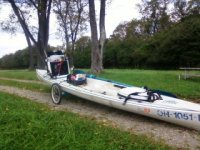
Here's a picture of it this past weekend... hadn't slipped too badly in the picture, but it sure wasn't solid. You can see my straps wrapped around both thwarts in an attempt to keep it in place.
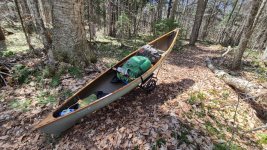
20260426_132826.jpg

Any suggestions would be helpful. Thanks!
 
I've never used a cart but I helped a buddy of mine build one (a couple of tries) for his SOT fishing yak. What we found worked the best was to use jogging stoller wheels, pvc pipe & bungee cord. There's not much that bungee cords are really good for but they seemed to work here because they allowed the boat to move on the axle (think walking side-to-side) but could stretch and contract to pull it back into position.

We also found that it worked better to offset the axle rearward instead of placing it in the center. By moving it to the rear, he had more weight on his arm when pulling it (not insignificant as that beast weighed nearly 80 lbs) but the axle seemed to right itself better than when centered.

You already own the cart and the wheels look big enough to roll over the terrain as well as the jogging stoller wheels but you might try moving the wheels forward or back and see it it helps. Also, strapping it rigidly may not be the way to go. Bungees can stretch & contract which may help keep it in alignment.

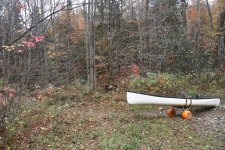
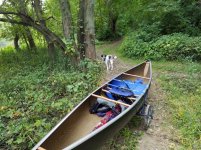
0928161357 (1).jpg
 
I've used my Rolleez (now called Wheeleez) cart on and off for the last 20 years or so.
The low pressure polyurethane tires absorb most any ADK lumps and bumps. If my pack is not too heavy I wear it while pulling the canoe and cart.
I've tugged that combo over 5 miles into Cedar Lakes without issue, back when I was still using my 32 lb DY Special stripper.
Straps just loop over gunwales, but I tighten the snot out of them...
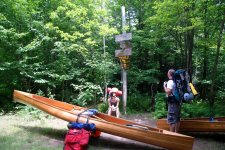
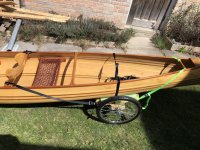
Here's a pic with my 25 lb carbon copy Kite.


DSC_1062.JPG


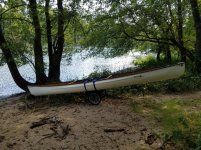
And here's the same cart under my DY Special, back in 2011

DSC_2829.JPG
 
I have a suspenz cart too. I use 1.5 inch wide NRS straps (not sure there's any benefit over 1 inch) and short sections of clear plumbing tubing to add friction between boat and straps (100% sure that helps quite a bit). 1 1/4 inch tubing would fit your gunewal20180918_122511.jpg20180930_140420.jpges.
 
Last edited:
We bought one of those Suspenz carts on sale at REI for a good price, otherwise I was going to make a DIY cart using a kids bicycle frame and wheels. What you're experiencing highlights the flaws in using that cart with a canoe, especially carrying gear on a rough trail. We've used it a couple of times on easy carries but right from the start it seemed that the cart was really designed with kayaks in mind. The main problems are that those side-hull pads allow the canoe to roll in the frame and the two long straps are probably better at holding down a more cylindrical kayak hull, not the open and thus flat-topped form of a canoe. If you think about it, a canoe should sit upside down on that cart, like a roof rack, so the gunnels and stops would provide stability side to side and the long straps would then work well over the rounded hull. But that wouldn't let you use the canoe to hold gear.

Your strap idea is on the right track; securely cinching down the canoe at two locations along each side helps to stabilize it between the pads. I use the front thwart and seat drops on a solo canoe. I'm going to use four short cam straps and get rid of those long straps. I already tried this using temporary straps and it made a big difference. I'm also going to try using foam blocks on the cross frame. This should help stabilize the canoe.

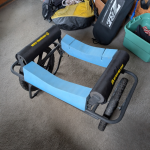
Below is a photo of the foam blocks on the cross frame. I just popped them on to see if they have potential. The one hassle I can see is now we'll have to keep track of two foam blocks, but I should be able to secure them with the cam straps for travel. I may be able to eliminate the side bars and clevis pins altogether, reducing weight. We'll see.

1777818609221.png
 
Last edited:
I have the same cart, and use it frequently. I put the cart between the yoke and rear thwart on tandem canoes.

For long or rough portages at least the shortest straps need to be separate for each side. This prevents sliding side to side. I can't tell for sure from your picture, are there separate straps through the gunnels on each side?

You might try moving the straps farther inboard on the cart. I can't tell if it will be better or not.
 
Folks, can't thank all of you enough for the prompt responses.

I'm only currently using 2 straps, one front/one back. But I have wrapped them through the gunwale slots and the thwarts in an attempt to 'brace' them diagonally from cart to canoe. I have tried center and off-center placement... back of center/heavy front seems to work best (just like on a car trailer).

I think what I'm going to do is use 4x cam locks (due in a couple days). I will larks-head one to each corner of the frame with about 3-4" of strap left (I'm a fair sewing machine runner, and can easily make the loops required). I will then make 4x other straps (with a loop at one end) roughly 4' long, and larks-head them through the gunwale slots roughly 2-3' off center. I can then leave those permanently attached during the entire series of portages, just flipping them in for paddling and out for portaging, and they'll clip right into the cam locks.

Just for giggles, I also did some mods to the clevis pin retainers on my cart. They're made of thin, plastic-coated cable, and don't close up like string or cordage would, the cable being kinda springy like it is.... theoretically (and it happened when I was messing with it), they could come loose on their own and you'd lose a pin. I took some tiny zip ties and used them to hold the loops closer-in, so they can't come undone themselves now. I also bought a spare clevis and have zip tied it to the frame. I need to find some hot pink spray paint for the axle knobs and clevises themselves, and I'll be done.

When I finish it all, I'll add some photos for posterity.

Again, you lot rock... thank you so much for your responses.
 
Not addressing your original question, but the biggest problem I had with my cart was the axle nuts coming loose. They were just simple machine nuts with no locking mechanism.

I use threadlock on them because I don't disassemble the cart. But if I was gonna disassemble the cart, I'd use lock nuts.
 
I had an awful time with the boat shifting on the cart during the Bowron Lake portages until I watched another canoeist set up his cart for a portage. Solved the problem. The next time I canoe, I'll take couple of photos because I couldn't describe it so it would make sense. (Suspenz cart)
 
Last edited:
Many years ago I bought a WheelEze carrier and made the mistake of assuming it would work, instead of trying it at home. It would skew sideways anytime I hit a bump and would never stay where it was supposed when on the trail.

Fast forward to last year and I had a trip with a large portage, with a relatively smooth trail, so I decided to make my own. First thing I did was try and strap it in just like the WheelEze one from years ago, same results. Then I figured out what worked for me, I suspect might help you as well.

First, move it back between the last thwart and the hand hold ... not in the middle of the canoe.

You need one strap to hold the cart to the canoe in the middle of the cart
You need one strap at each corner, tied of to each side of the thwart and handhold
I used CamBuckles, tension each one snug so the cart is straight.

You grab the front handle and pull it like a wagon, with each corner fastened, the cart is rock solid even over curbs. Do not try and shortcut by looping the strap side to side, you need the 4 corners separate.

In the pic, I attached the cam buckles to the cart (sewed a loop and larks headed them) then sewed and eye to the strap so I could just larks head them to attach to the canoe and then just thread each strap through each corner buckle.

I put most of the weigh over the axle and some towards the rear to offset the forward weight. Hope this gives you some ideas.

Brian

IMG_5836.JPG
 
Many years ago I bought a WheelEze carrier and made the mistake of assuming it would work, instead of trying it at home. It would skew sideways anytime I hit a bump and would never stay where it was supposed when on the trail.

Fast forward to last year and I had a trip with a large portage, with a relatively smooth trail, so I decided to make my own. First thing I did was try and strap it in just like the WheelEze one from years ago, same results. Then I figured out what worked for me, I suspect might help you as well.

First, move it back between the last thwart and the hand hold ... not in the middle of the canoe.

You need one strap to hold the cart to the canoe in the middle of the cart
You need one strap at each corner, tied of to each side of the thwart and handhold
I used CamBuckles, tension each one snug so the cart is straight.

You grab the front handle and pull it like a wagon, with each corner fastened, the cart is rock solid even over curbs. Do not try and shortcut by looping the strap side to side, you need the 4 corners separate.

In the pic, I attached the cam buckles to the cart (sewed a loop and larks headed them) then sewed and eye to the strap so I could just larks head them to attach to the canoe and then just thread each strap through each corner buckle.

I put most of the weigh over the axle and some towards the rear to offset the forward weight. Hope this gives you some ideas.

Brian

View attachment 154521

I'm glad you typed this up and included a picture. This is essentially the setup I use. On a tandem, I like to place the cart between the yolk and the thwart, but going to the rear seat works too.

There are some variations on this that can be done with lighter rigging, but I think this is the way to go the first time.
 
Last edited:
Wow! You are doing what I found works. I use my bow and stern lines instead of straps and use a trucker's knot to tension them. I also put my cart in the center of the canoe and balance it with the loading. Thanks for the photo.
 
Just a note about the cart design, I move it back so that the canoe can sit between the wheels and that lowers the center of gravity and makes it more stable. Moving it back allows keeping the cart portion narrower (same width as the center of the canoe) , which translates to less weight and a better fit on the trails.

Commercial units use smaller wheels and have to fit a wider variety of hulls, so it makes sense for them to put the canoe over the wheels.

The important point is that you need separate tension on all four corners (IMO) to make the cart trail stable.

Brian
 
One thing to consider if you set a canoe on the Suspenz cart towards either end of the canoe, where there's a lot of taper, is that the metal bars holding the pads have exposed corners that might damage a hull if the cart gets hung up and the canoe gets jarred and shifts. The DIY cart Cruiser made (excellent cart by the way) has angled pads to accommodate the taper.

Just for giggles, I also did some mods to the clevis pin retainers on my cart. They're made of thin, plastic-coated cable, and don't close up like string or cordage would, the cable being kinda springy like it is.... theoretically (and it happened when I was messing with it), they could come loose on their own and you'd lose a pin. I took some tiny zip ties and used them to hold the loops closer-in, so they can't come undone themselves now. I also bought a spare clevis and have zip tied it to the frame.
I found a way to keep the clevis pin leashes from falling off but I'm hoping that using contoured foam blocks on the cross frame will work and I can just eliminate the side bars and not need the pins. I'll let you know.
 
Last edited:
I've just got a cheapie folding cart that I've used 3-4 times a year for probably 20 years- the first thing I did was throw away the factory straps because I found they would stretch and loosen over time, and replaced them with 1 1/2" non-stretch kevlar reinforced cargo straps with rubberized hooks that go with me anyway because they also serve as my center straps on my roof rack. I simply hook one side to the cart frame, go straight across and down to the other, and repeat on either side of the center thwart, they've done the job over flat, rough, or even rocky terrain, as well as when my buddy towed the fully loaded canoe at 20mph with his scooter.
I think the main problem isn't your lashing, I think you have plain nylon or polyester straps (most factory straps are) that can stretch and retract like a rubber band, allowing for too much movement.
 
The straps I used were not stretching like a rubber band, the problem is trying to use this Suspenz cart and their strap system with canoes. Probably works fine with kayaks, but the cart doesn't seem like it was designed with canoes in mind. At least that's my take. The solution(s) provided here allow using the cart with canoes but it's not ideal and to better accommodate a canoe would require some modifications. But I'm sure their customers are mostly kayakers and it may not be worth carrying a special canoe cart for a somewhat limited market.

I'm not intending to be overly critical of Suspenz, but with a couple of modifications and/or offering optional strap setups they could at least provide a cart that works better with canoes.
 
Last edited:
The straps I used were not stretching like a rubber band, the problem is trying to use this Suspenz cart and their strap system with canoes. Probably works fine with kayaks, but the cart wasn't designed with canoes in mind.
If it's any consolation their strap system doesn't work well on kayaks either. Just like with a canoe, the cart sits near the bottom third of a kayak where it's tapering so the cart wants to slide off. Wrapping the straps around a canoe or kayak doesn't help - they need to attach to something solid in front of the cart.
 
If it's any consolation their strap system doesn't work well on kayaks either.
That's not encouraging. 😕

I noticed on their website that they highlight fishing kayaks and other rec kayaks that have channels in the hull. Their cart probably works great with those hulls. My suggestion to better accommodate both kayaks and canoes is to put width-adjustable saddles that cradle the hull to allow for hull taper, basically mimicking the saddles on a car roof rack. The strapping system would have to be different since a canoe is "upside down" on the cart compared to a roof rack and requires additional stability due to the flat space across the gunnels. But maybe it's the same problem with open cockpit rec kayaks.
 
Last edited:
Back
Top Bottom