• Happy Name Change: Longacre Square to Times Square (1904)! 🇳 🇾 ⌚

Copyright Question

Joined
Jun 22, 2017
Messages
1,291
Reaction score
3,282
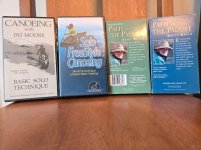
I recently came across several historical artifacts. I believe the Loonworks video may be the same one offered for sale on www.freestylecanoeing.com. I'm pretty sure the Bill Mason videos are out there somewhere but I don't know where.

My question is around the Patrick Moore video. I'd like to have the video put on YouTube to share but I don't understand if there are legal implications. Patrick is gone and I'm not aware of anyone that could grant permission to share the video.

20260405_092400.jpg
 
Is there a copyright symbol or word with a name and date anywhere on the box, the physical tape, or in the content of the tape (usually in the opening or closing credits)? Something like "© 1999 Patrick Moore" or "Copyright 1999 Patrick Moore".
 
Is there a copyright symbol or word with a name and date anywhere on the box, the physical tape, or in the content of the tape (usually in the opening or closing credits)? Something like "© 1999 Patrick Moore" or "Copyright 1999 Patrick Moore".
Regardless, the copyright is held by the creator of the art. Unless of course it's already on the web in some site that by using you're relinquishing your reproduction rights (probably most websites, esp. Facebook, whereby joining you basically have no copyright rights). Copying the work of a prior (pre-web) professional production, unless it's specifically in public domain, would go against copyright law and ethics. I know it's done all the time, but.......
 
Regardless, the copyright is held by the creator of the art.

I know copyright law. I used to practice and teach it. I can't and don't give legal advice on the internet, but I'm just trying to ascertain some facts by asking about the presence or absence of a copyright notice.

I have that Pat Moore tape somewhere, but I can't find it to look at it myself.
 
Is there a copyright symbol or word with a name and date anywhere on the box, the physical tape, or in the content of the tape (usually in the opening or closing credits)? Something like "© 1999 Patrick Moore" or "Copyright 1999 Patrick Moore".
Yes. It says "copyright 1989 Patrick Moore all rights reserved"
 
All the Bill Mason stuff is also on YouTube. I did a quick search for Pat Moore, didn't come up with anything.
That's one reason I wish his tape was public...he was a paddling legend and disappeared without a trace. He may well have made the best canoe paddles ever.
 
I know copyright law. I used to practice and teach it. I can't and don't give legal advice on the internet, but I'm just trying to ascertain some facts by asking about the presence or absence of a copyright notice.
I remember that you did. That's why I was curious why you had asked. From my understanding, the absence of a copyright notice doesn't mean a lack of copyright protections.
 
Regardless, the copyright is held by the creator of the art. Unless of course it's already on the web in some site that by using you're relinquishing your reproduction rights (probably most websites, esp. Facebook, whereby joining you basically have no copyright rights). Copying the work of a prior (pre-web) professional production, unless it's specifically in public domain, would go against copyright law and ethics. I know it's done all the time, but.......
The creator passed away and there is no one to contact.
 
Not sure if this applies, but when I was the drama instructor at the school, I decided to perform a play by a little known Canadian author. I contacted the publishing house to arrange to pay royalties, and they said I would have to contact the author directly. They gave me a phone number in Tennessee. I phoned it and asked for the author, a woman with a strong southern accent told me he was dee-ead. I asked about permission to perform the script, she said you have permission. That was it.
 
I recently came across several historical artifacts. I believe the Loonworks video may be the same one offered for sale on www.freestylecanoeing.com. I'm pretty sure the Bill Mason videos are out there somewhere but I don't know where.

My question is around the Patrick Moore video. I'd like to have the video put on YouTube to share but I don't understand if there are legal implications. Patrick is gone and I'm not aware of anyone that could grant permission to share the video.

View attachment 153910
Yes the Loon Works video is still available from freestylecanoeing.com
And for a laugh you can watch me give the worst example of a low brace ever committed to film.😂. I can laugh about it today….
 
Like @gumpus, I too think it would be of instructive and historical interest to have Pat Moore's videotape available on YouTube.

However, there are copyright considerations. I can't give client legal advice on this forum, but I can review some general U.S. copyright law principles and some probable facts. It's hard to make this brief.

Copyright protection attaches automatically upon the creation of a work. No copyright notice has to be put in the work, but doing so makes infringement litigation easier to prove. Copyrights also don't have to be registered in the U.S. copyright office, but if they are registered, that makes litigation in federal court possible and, if the registration is made upon first publication, statutory (automatic) damages are likely available even if no actual damages are provable.

A copyright lasts during the life of the creator plus 70 years. If the creator dies, the copyright will be owned by his legal heirs for the 70-year period. Legal heirs are usually a spouse, children or other lineal or collateral relatives.

As a theoretical matter, if Pat's video were put on YouTube, some unknown heir of his could file an infringement claim. A claimant can seek either actual damages or statutory damages. Actual damages means the claimant must prove exactly how much profit he lost from videotape sales because of the YouTube upload or how much profit the uploader gained from YouTube. If the claimant elects statutory damages, he doesn't have to prove any actual profits lost by him or any profits gained by the infringer, but can automatically be awarded a discretionary amount over range of about $750-$30,000. However, if the work was not registered within three months of first publication (1999 for Pat's video), no statutory damages are available in a federal court suit—only provable actual damages.

As a practical matter, the legal risk of infringement and the amount of possible damages would depend on certain facts. Is Pat alive? If he is dead, does he have legal heirs? Did he register his copyright with the Copyright Office? Is the videotape still available for public sale, making some heir of Pat current profits? If the video were put on YouTube, would the YouTuber be making any profit off of it?

In answer to these practical questions, as far as I know or can tell, most people who knew or knew of Pat assume he has died. No one I know is aware of any living family members or heirs of his. As far as I can tell, the videotape has not been available for new sales by Pat or anyone for many years; hence, I doubt any legal heir could prove lost profit actual damages if the video were uploaded to YouTube. Similarly, If the video were uploaded, the YouTuber presumably wouldn't be making any profit gain off of it; hence, there would be no actual damages for profit gained by the infringer.

As to whether Pat ever registered his copyright, I doubt it. I can't find any evidence of the videotape's registration via various search terms in the Copyright Office's Public Records System database. However, searching that system will not necessarily reveal everything that a paid search by the Copyright Office does. No infringement suit can be brought in federal court until such a registration has been processed, which takes many months, and the heir would have to hire lawyers to bring a federal suit. If my presumed facts are correct, the heir wouldn't be able to prove any actual damages, but statutory damages may be available if, and only if, Pat had registered the videotape in 1999.

Based on the hypothesized facts, a risk summary for uploading the video could be as follows:

- If Pat never registered the videotape in 1999, and if it is no longer for sale, and if the YouTuber makes no money off the uploaded video, there would be no provable damages and no available statutory damages even if some unknown heir of Pat exists. No one would bring such a fruitless lawsuit.

- If Pat did register the videotape in 1999 (contrary to preliminary searches) and all other facts presumed are the same, no actual damages would exist for the hypothesized claimant, but he or she could seek some sort of statutory damages. These statutory damages would probably be awarded at the low end of the range, but the claimant would have to bear the costs of a lawyer, court fees and probably years of litigation delays. Would anyone bother doing that? My suspicion and intuition is that such legitimate claimants usually just contact YouTube, asking them to take down the video.

(There are other legal technicalities I didn't mention because they wouldn't really change my summary.)

Not that it affects the legal analysis, but as one who communicated frequently with Pat before he presumably passed, I feel certain that he would have wanted his life's work and legacy to be available for posterity on YouTube.

 
I will translate @Glenn MacGrady excellent analysis and summary.


If you post these tapes on YouTube on your account, there is a remote chance YT will respond to a DMCA / NOCI complaint, pull the videos and send you a nastygram.

Do not list on YouTube with active monetization turned on.
 
It was my understanding that copyright protection for heirs was good for 50 years after the copyright holder’s death, or is the length different between photographs and videos?
 
Last edited:
giphy.gif
 
Back
Top Bottom