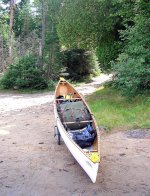
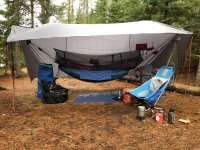
As an old person and charter member of the multiple back surgery club, I am vitally interested in the minutiae of details that make wilderness canoe camping trips workable - even comfortable - for me. Youngsters, keep scrolling. If you have no trouble getting out of your tent and standing up straight in the morning, you wouldn't understand.
One of the biggest pitfalls I see in myself and others who have taken strenuous trips in their youth is that your mind hasn't caught up with your body, especially if you haven't been out in a few years. I find I have the mind of a 20-something planning trips for a body that has aged more than 40 years. In a nutshell, it doesn't work!
In this post I'm going to go through my tent set up in painful detail and show the big and little things that work for me. My basic premise is that everything should be organized into self-contained units that put what you need, where and when you need it. When you overlay the possibility of rain or intense bugs, it makes even more sense. I'm usually matching my process with others 15 years younger than I. My objective is to take pride in my age, frequently the oldest on a trip these days, and not consider it a handicap.
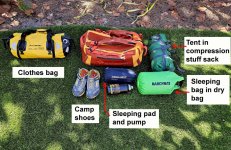
First the bags. I use a 50 liter Sea to Summit Hydraulic Pro Dry Pack to hold my tent, sleeping bag, air mattress and pump, night time pee bottle and camp shoes.
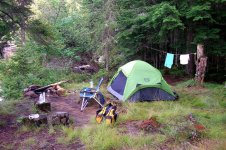
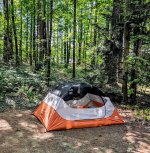
Tent - I prefer a two person tent for just me with two entrances and two vestibules. The front vestibule holds my clothes bag and I stash my empty Hydraulic Pro Dry Pack, life jacket, paddling shoes (NRS Boundary Boots) and anything else I want to keep under cover in the rear vestibule. I use a Hilleberg Rogen 2 in warm weather and a Hilleberg Allak 2 in colder weather. Both tents I purchased used, as they are very expensive. I have tried quite a few tents and have come to appreciate the build quality of Hilleberg. I keep the tent in a compression stuff sack with the poles, against the advice of Hilleberg.
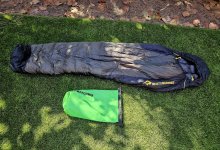
Sleeping Bag - My sleeping bag is a Sea To Summit Spark Pro 15° hydrophobic down bag. I get cold easily and this bag works for me. I keep it in a 10 liter dry bag that I use as a stuff sack. This keeps the down sleeping bag dry even when it is packed with a sopping wet tent, which happens.
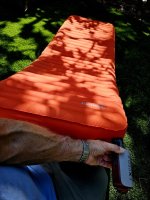
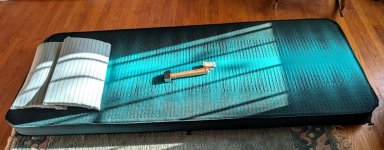
Sleeping pad - I used cots in the past and like them, but they are too much weight and volume and I don't like the building a ship in a bottle vibe I get with them. I have settled on the Therm-a-Rest NeoLoft air mattress. It has an R value of 4.7, which is important to avoid having the heat sucked out of you from below. It is about 4-1/2" thick inflated and packs down quite small. I slightly prefer an Exped MegaMat, but the packed size is just too large. I do use a rechargeable Exped Mega Pump to inflate the mattress, which works on the NeoLoft with a provided adapter. It inflates quickly and so far I've used it on up to a 13 day trip without having to recharge it. I also use a cheap, no-name inflatable pillow that I roll up with the air mattress.
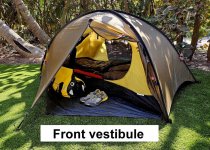
When I get to camp, the first thing I do is scout out my camping spot and shed my life jacket there. Then I go back and get my two dry bags holding my tent/sleeping bag and clothes. My clothes dry bag is a yellow 40 liter roll top Wildheart dry bag, which is very inexpensive on Amazon. I set up the tent and stake out the vestibules (Rogan 2). In the tent I put the green sleeping bag dry bag, the air mattress bag which also holds the pump, and pee bottle. The yellow clothes bag goes under the front vestibule. I can reach anything I need from inside my tent with only unzipping a short section of mosquito netting. From my clothes bag, I also put in tissues, wipes, battery pack with charging cables, a small cordless fan/light, my cell phone and inReach, toiletry kit which also holds my medications, bandaids, Neosporin and moleskin, along with any clothes I may want to change into by morning and my water bottle. If it's going to be cold in the morning, I'll put in a jacket and wool hat.
A note on the Garmin inReach. I keep it clipped to my PFD while paddling. When I get to camp, I clip it to a belt loop. When I'm done using it for the day, it goes in an inside pocket in the tent which also holds my reading glasses, watch and cell phone. In the morning I reverse the order and clip it to my belt loop before getting out of the tent. I'm very intentional about where I put it and seldom put it anywhere else unless it's having trouble connecting. It's a single point of failure for communication, weather and evacuation and every trip someone is temporarily losing theirs. One time on a month long trip, I accidentally clipped it to the back of my PFD and thought I'd lost it. Bad feeling.
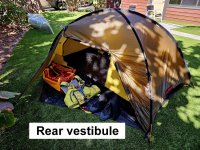
The tent/sleeping bag dry bag, now only holding the tent stuff sack and pole bag, goes in the rear vestibule along with my life jacket, paddling shoes and possibly my grab bag from the canoe. If it's going to rain or I expect heavy dew, I may put my camp chair in too.
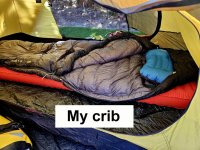
I get in the tent and blow up my air mattress and pillow and set out my sleeping bag. I have everything I need to dive in the tent and not emerge until morning if I should get chased in by foul weather or bugs, and the set up happens very quickly.
In the evening and the morning, I take my medications in the tent. I dress any blisters or cuts with the supplies from my toiletry kit. I charge my phone and inReach every night so I start every day at 100%. In the morning, I put my sleeping bag back in the stuff sack, roll up and put away my air mattress and pillow and put them back in the dry bag in the rear vestibule. I can reach out and put any unneeded or dirty clothes back in my clothes bag in the front vestibule along with the tissues, wipes, battery pack and toiletry kit. I set out any trash and bottles. By this time, I've already worked out some of my morning stiffness. My camp shoes (Humtto water shoes), which I've left in the front vestibule, are ready to be slipped on as I get out of the tent.
At that point, the tent is empty. Once I empty the vestibules, the tent is ready to come down. I take it down and completely pack the Sea to Summit Hydraulic Pro bag before I do anything else. Then I close up the yellow clothes bag and I walk them down to the canoe to be loaded. Only then am I ready to make coffee.
One of the biggest pitfalls I see in myself and others who have taken strenuous trips in their youth is that your mind hasn't caught up with your body, especially if you haven't been out in a few years. I find I have the mind of a 20-something planning trips for a body that has aged more than 40 years. In a nutshell, it doesn't work!
In this post I'm going to go through my tent set up in painful detail and show the big and little things that work for me. My basic premise is that everything should be organized into self-contained units that put what you need, where and when you need it. When you overlay the possibility of rain or intense bugs, it makes even more sense. I'm usually matching my process with others 15 years younger than I. My objective is to take pride in my age, frequently the oldest on a trip these days, and not consider it a handicap.
First the bags. I use a 50 liter Sea to Summit Hydraulic Pro Dry Pack to hold my tent, sleeping bag, air mattress and pump, night time pee bottle and camp shoes.
Tent - I prefer a two person tent for just me with two entrances and two vestibules. The front vestibule holds my clothes bag and I stash my empty Hydraulic Pro Dry Pack, life jacket, paddling shoes (NRS Boundary Boots) and anything else I want to keep under cover in the rear vestibule. I use a Hilleberg Rogen 2 in warm weather and a Hilleberg Allak 2 in colder weather. Both tents I purchased used, as they are very expensive. I have tried quite a few tents and have come to appreciate the build quality of Hilleberg. I keep the tent in a compression stuff sack with the poles, against the advice of Hilleberg.
Sleeping Bag - My sleeping bag is a Sea To Summit Spark Pro 15° hydrophobic down bag. I get cold easily and this bag works for me. I keep it in a 10 liter dry bag that I use as a stuff sack. This keeps the down sleeping bag dry even when it is packed with a sopping wet tent, which happens.
Sleeping pad - I used cots in the past and like them, but they are too much weight and volume and I don't like the building a ship in a bottle vibe I get with them. I have settled on the Therm-a-Rest NeoLoft air mattress. It has an R value of 4.7, which is important to avoid having the heat sucked out of you from below. It is about 4-1/2" thick inflated and packs down quite small. I slightly prefer an Exped MegaMat, but the packed size is just too large. I do use a rechargeable Exped Mega Pump to inflate the mattress, which works on the NeoLoft with a provided adapter. It inflates quickly and so far I've used it on up to a 13 day trip without having to recharge it. I also use a cheap, no-name inflatable pillow that I roll up with the air mattress.
When I get to camp, the first thing I do is scout out my camping spot and shed my life jacket there. Then I go back and get my two dry bags holding my tent/sleeping bag and clothes. My clothes dry bag is a yellow 40 liter roll top Wildheart dry bag, which is very inexpensive on Amazon. I set up the tent and stake out the vestibules (Rogan 2). In the tent I put the green sleeping bag dry bag, the air mattress bag which also holds the pump, and pee bottle. The yellow clothes bag goes under the front vestibule. I can reach anything I need from inside my tent with only unzipping a short section of mosquito netting. From my clothes bag, I also put in tissues, wipes, battery pack with charging cables, a small cordless fan/light, my cell phone and inReach, toiletry kit which also holds my medications, bandaids, Neosporin and moleskin, along with any clothes I may want to change into by morning and my water bottle. If it's going to be cold in the morning, I'll put in a jacket and wool hat.
A note on the Garmin inReach. I keep it clipped to my PFD while paddling. When I get to camp, I clip it to a belt loop. When I'm done using it for the day, it goes in an inside pocket in the tent which also holds my reading glasses, watch and cell phone. In the morning I reverse the order and clip it to my belt loop before getting out of the tent. I'm very intentional about where I put it and seldom put it anywhere else unless it's having trouble connecting. It's a single point of failure for communication, weather and evacuation and every trip someone is temporarily losing theirs. One time on a month long trip, I accidentally clipped it to the back of my PFD and thought I'd lost it. Bad feeling.
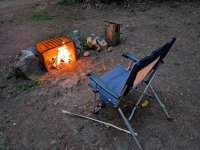
The tent/sleeping bag dry bag, now only holding the tent stuff sack and pole bag, goes in the rear vestibule along with my life jacket, paddling shoes and possibly my grab bag from the canoe. If it's going to rain or I expect heavy dew, I may put my camp chair in too.
I get in the tent and blow up my air mattress and pillow and set out my sleeping bag. I have everything I need to dive in the tent and not emerge until morning if I should get chased in by foul weather or bugs, and the set up happens very quickly.
In the evening and the morning, I take my medications in the tent. I dress any blisters or cuts with the supplies from my toiletry kit. I charge my phone and inReach every night so I start every day at 100%. In the morning, I put my sleeping bag back in the stuff sack, roll up and put away my air mattress and pillow and put them back in the dry bag in the rear vestibule. I can reach out and put any unneeded or dirty clothes back in my clothes bag in the front vestibule along with the tissues, wipes, battery pack and toiletry kit. I set out any trash and bottles. By this time, I've already worked out some of my morning stiffness. My camp shoes (Humtto water shoes), which I've left in the front vestibule, are ready to be slipped on as I get out of the tent.
At that point, the tent is empty. Once I empty the vestibules, the tent is ready to come down. I take it down and completely pack the Sea to Summit Hydraulic Pro bag before I do anything else. Then I close up the yellow clothes bag and I walk them down to the canoe to be loaded. Only then am I ready to make coffee.