• Happy World Bartender Day! 🍺🍸🍹

The Home Improvement Build: A budget (hopefully lightweight) lapstrake solo build.

Joined
Mar 21, 2015
Messages
578
Reaction score
375
Location
SW Wisconsin/Driftless
So, it's been over a year. I know I teased some of you over in the winter projects thread. I'm back to the basic hull shape that I attempted to build in this thread.

Plenty of contemplation, as well as multiple internet searches, have lead me to the conclusion that plank stock suitable for lapstrake boatbuilding is not available in my area at a cost I could justify. Alternatives considered:

  • Elm, suggested by @Alan Gage at the end of the last thread. Very in-keeping with the original intent of the previous build: impact and weather resistant, bends smoothly, very not prone to splitting. Unfortunately, not available anymore. Dutch Elm disease has been rampant through the forests in my region since I was a kid, and in the last decade or so, has reached its ultimate conclusion: For all practical purposes, American Elm is gone. Not "at risk", not "rarer". Just no longer present. As far as I can tell, the resistant hybrid elms have never taken off as a replacement re-plant. They'd take at least a half-century to be worth harvesting. (Forestry Management in the area is mostly hands-off, people don't plant anything, unless they're trying for a walnut grove.)
  • Port Orford Cedar would be lovely, but it's a west-coast import. Figure paying as much as you would for furniture-grade hardwood.
  • Douglas Fir might do, if I could find any clear. It's almost all construction grade. #1 at best - and a rather poor #1 at that.
  • For a while, I thought that I'd be able to get Southern Yellow Pine: Plentiful, grown in quantity on plantations, harder than most pines, (about the hardness of cherry, which isn't hard, but at least more resistant than the white pine junk or NWC, which is mostly what I'd find around here) as well as some rot resistance, and doesn't tend to split. Unfortunately, anything that's imported to the upper midwest is construction grade again. Rare to get anything better than #2. Direct ordering online, I could get clear stuff - for about $4-5 a board foot.
Clearly, this wasn't going to happen this way. Then I fell down a bit of a rabbit hole out of one of the threads here discussing sailing canoes. That path lead me to a vessel called a "Mersea Duck Punt", which is cool in its own right, but not what I was looking for. What caught my attention, though, was the material. Those have been successfully built at many different weights, but all out of plywood. I got to wondering, and found out some interesting things:

  • Ordinary hardware store exterior grade plywood uses the exact same glue as marine grade plywoods (resorcinol formaldehyde - boil-proof)
  • Untreated exterior plywood in the US is usually Southern Yellow Pine, which is actually more naturally rot resistant than the mahogany plies in many marine plywoods.
  • The real place that the certified marine grade plys are superior is in the arrangement of the plies: BS1088 and similar require more, thinner plies, and have strict rules about joints, knots, and patches in the interior plies.
I was able to source some 1/4" ACX "premium" Arauco plywood for about $30 a sheet. They have a good reputation with the DIY yacht crowd who use it for things like engine covers.

A proper marine plywood would, of course, still be a superior material: probably get similar structural strength with 4mm BS1088, but would the weight savings be worth trippling (or more) the cost? Judge for yourself. For this project, I think not.

Likewise, I did maybe too much thinking about fastening methods. I decided to abandon the rivet method, which was intended to allow natural planks to shift a bit as they expand and contract. Typically, a glued lapstrake is done with epoxy. I went through multiple woodworking shop test reports, comparing pretty much everything from white elmers to polyurethane glues and old stuff like hide, weldwood, or cascamite.

What came out on top for the things I cared about: Titebond III.
  • Tensile strength in wood-wood joints isn't beat even by epoxies. We're talking well over a ton per square inch, and in some tests closing on two. The substrate will fail well before that.
  • Properly waterproof. Many years-long unprotected outdoor projects. One short-term boiling test. Not to BS1088 or similar, but I'm not building a yacht that has to hold together while it's on fire. While it says "Not for below-waterline use" our canoes - especially with a waterproofing topcoat - are not ever "below the waterline" in the way they mean.
  • Ease of use. It's a wood glue. I can clamp it like one, unlike epoxy that needs to be treated gingerly to prevent overclamping. Water cleanup. Low chances of sensitization.
  • It's cheap and available everywhere. Literally at the local mall wart.

Some of you might have feelings about this. Many have probably heard some horror stories. So have I. I looked up as many as I could. Findings among the TBIII failure reports:

  • Split about evenly between "Stale Glue" (TBIII does have a shelf life from date of manufacture) and "Bottle got frozen at some point before use." One good thing about these failure modes: they show up immediately upon putting a load of any kind on the glue-up. Not weeks or months of use later. Just do some test pieces and try to break them.
  • One outlier where someone glued up some very oily exotic hardwood without using a solvent to strip the surface oil.
  • "It's not certified for structural use": Well, neither is any other glue that we use. They're not worth certifying when the companies that are building structual beams already need the kinds of giant clamping and pressing jigs that enable RF, which is much more economical at that scale.
  • "Glue Creep" - Yes, TBIII is slightly softer than the alternatives, and will non-elastically deform. When close to its failure strain. Again, if I get anywhere near those kinds of loads, the underlying substrate will be destroyed anyway.

I am willing to hear counter-arguments, but please base them on something more than "people say".

Thanks for reading so far - that's more of a wall of text than I intended. Pictures in the next post.
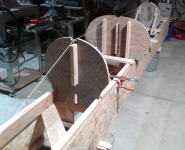
 
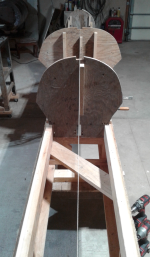
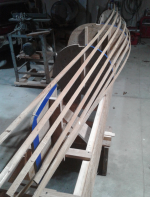
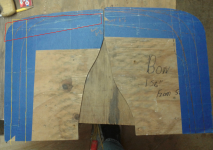
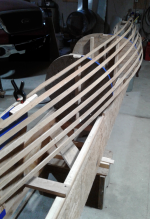
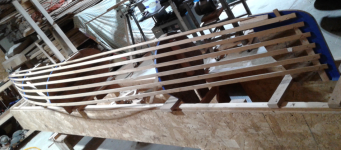
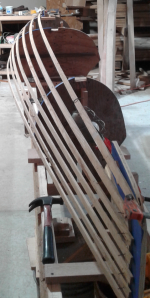
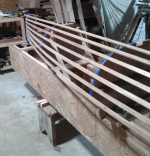
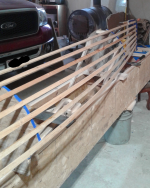
I re-built my strongback and got to aligning my building forms:

Forms_Quartering.pngForms_Straightlined.pngForms_Rough_Splined.png

These turned out nice and true, and then I set up a rough splining to sanity-check and start figuring plank spacing.

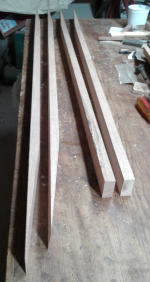
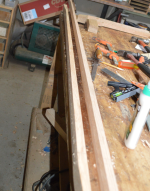
In parallel, I started building the core keel timber. I really went too slender on the previous attempt. The base stock here is White Oak rift-grain, 1 3/4" x 13/16"

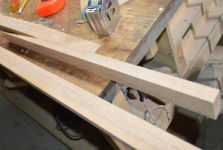
Scarf_Rough.pngScarf_Clean.png

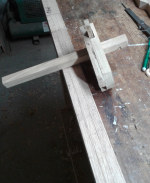
I had limited lengths, so scarfs it is. I'm not sure if it's the species, the straight rift grain, or if I've just gotten this much better at plane tuning, but this stuff is hand-planing beautifully. A little longer than 12:1 scarf (the length ended up at an even number that was easy to duplicate.)
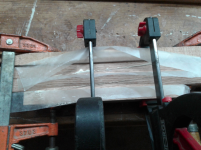
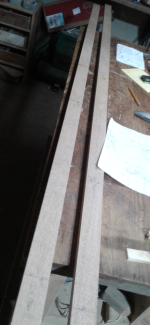
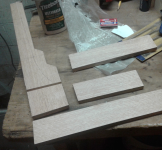
Keel_Sections.pngKeel_Scarfs_Glued.png

A little over 14' of stock for a 13' hull. Best to start long and cut to fit. I haven't glued the final scarf yet - I'm considering leaving it in two pieces so it fits on the bench while I cut the rabbet. I may still put some pegs through the structure and glue them in place to guard against sheer/twisting loads, but I haven't decided yet.
 
Always fun to see something different. It sounds like you've researched it well. Looking forward to following along!

Alan
 
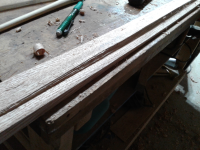
Kind of a potato day for the build today, so you get possibly too many photos of a scarf joint.

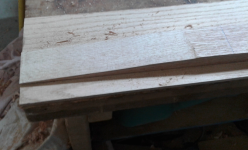
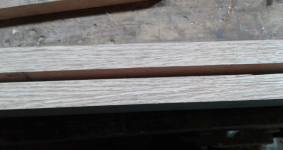
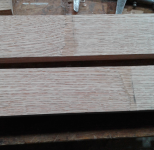
When a scarf joint fits up properly, it practically disappears:
Scarf_Good.png

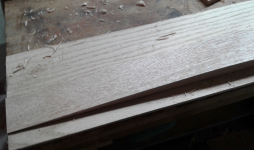
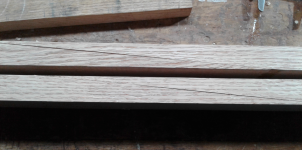
When you miss spreading your clamping pressure correctly, less so:

Scarf_Bad.pngScarf_Short_end.png

(This is the other side of the same joints.) I'm only mildly annoyed here, because the open joint section is less than 1/4" deep, and in an area where most of it will be removed when cutting the winding bevels. I will try to do better with the final (third) scarf, but I'm leaving that one for later. Right now, being able to handle the keel as two pieces is just too handy.


Another thing I learned on the previous attempt at this hull is that I can't leave the stem structure and shape to be built by eye. I'm sure there are people who can run a stem by the seat of their pants, but I'm apparently not one of them. So, some more detailed planning:

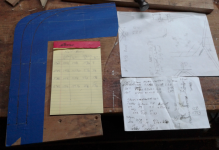
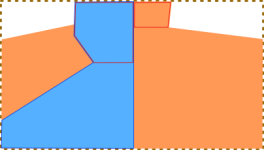
Hieroglyphic_Notes.png

I'm working to determine where and how much meat I need in the stems and transition to the keel. The hard black curved lines are where the inside-plank beam is 1/2" and 1" respectively. The straight-ish black line is sprung from the keel stock clamped onto the forms.

I said recently on the "Obsolete Stuff" thread that I took enough drafting in high school to influence how I communicate plans to other people. However, when the notes are just for me, I end up with these very spare weird hieroglyphics. The half-sheet in the lower right is actually all the data needed to spline out all five forms that I'm building on - three stations, and the two unique stems.

P.S. Sorry that the photos are lower quality than I usually post. The battery for my good camera is out of commission, so I'm borrowing an older tablet until I get the replacement battery in.
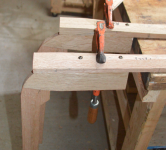
 
As a professional boat builder for more than thirty years my advise is to not use fir plywood, exterior or otherwise. I’ve taught several classes with kids and parents to build the Six Hour Canoe and to keep costs down we used exterior grade plywood. Despite the best efforts of prep almost all had paint failure by the next summer. These boats are flat bottom and sides so lots of area. If you make lapstrakes out of it there will be more stresses induced by the twisting into place. Will any of the shapes need steaming to bend to shape?
Buy the best wood you can find. A lot of work goes into building a lapstrake boat so don’t use materials that will not last.
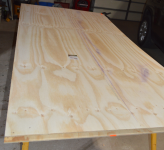
Many boats have been built of pine, find the ones with vertical grain in a thickness that once you have the plank shape you can split (if you have a bandsaw) for port and starboard planks.
Jim
 
my advise is to not use fir plywood, exterior or otherwise.

No fir! The stuff I'm working with is Southern Yellow Pine, untreated. I have run across references to fir shedding paint, but it was usually in the context of treated ply. (Treated lumber in general has issues with paint/finish adhesion) If you had issues with untreated doing the same, I would be interested in knowing what kind of paint you were using.

I've rejected the white pine that is available in my area for two reasons:
  1. Too soft for how I use my canoes. I like exploring tight back creeks and little inlets. Log bumps, having to walk across unexpected gravel bars, etc. I don't have the luxury of always having a sand beach, or float entry. White pine dents and abrades if you look at it crosswise.
  2. Quality pine, especially if looking for vertical grain, is not really available at all - mostly people have rustic "Knotty Pine" - and what there is available is not affordable.
Will any of the shapes need steaming to bend to shape?

I don't anticipate any. The most extreme plank will have about a 75-80 degree twist center to stem, max width about 2.5", closer to 1.75" near the stems.


Sketching out what I intend for the stem structure here: (Again, sorry for the potato images)
Stems_Layout.png

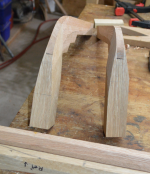
I'm going with an inner stem that follows the 1/2" beam line. I could build this up with a glue lam, either super-thin and dry bent or steam-bending some thicker layers. However, that's a pretty tight curve that wants a lot of meat behind it. Tentatively, I'm intending to build up in block fashion. Vertical stem posts, with a transition to the keel. (I'm sure that timber has a name. I don't know what it is.) Joint to the keel is a long bevel, at least 8:1, which should give me long-grain glue performance. The stem is let in with a bridle joint, so I've got flat-on-flat glue there as well.
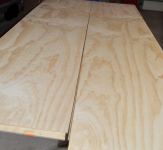
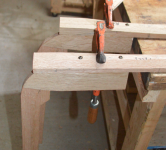
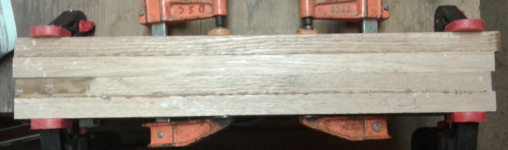
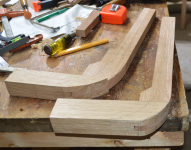
Started laying up the blanks for the inner stems. The outer stems can wait - I've got options on how to handle them, and I haven't decided if they will be a simple taper, or more of a "cutwater" style.

Inner_Stem_Blanks.png

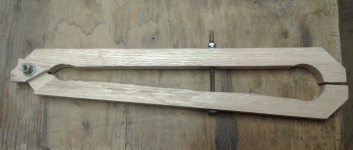
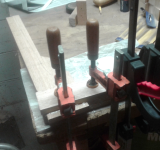
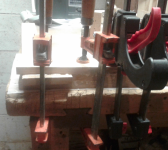
Also, one can never have too many clamps. What I currently lack are clamps that can reach deep, but don't have to grab all that tightly. Found This "Instructables" listing and thought it would be worth a try. Note that some of the instructions are a bit muddled when it comes to matching the halves of the hinge, and their way of making the jaws parallel was too backside-puckering for me. YMMV.

A_Clamp.png

This turned out okay. I think that further ones will be a bit shorter with more meat left on the jaw arms. 7" reach should be plenty for this project.
 
We used AC exterior for plywood. It was not the treated wood because the kids were hands on as much as possible. Each boat chose their own paint, they were primed and some sprung for yacht paint and others porch and deck paint. It really didn’t matter in the end.
I’m surprised that Wisconsin is such a wood desert.
Jim
 
I’m surprised that Wisconsin is such a wood desert.

Southwest Wisconsin. The Driftless. We've got wood - Hardwood. I can find you locally harvested Hard and Soft Maples, Cherry, Walnut, Hickory, Ash, (Tulip) Poplar, Smaller quantities of Black and Honey Locust, Oak (White in reasonable quantities, Red is a weed around here.) What I can't get are good light-ish flexible, split-resistant stuff for a boat.

We're too far south for the northwoods pine stands. (And the relic pine locally are both inaccessible for harvest, and would only last a couple of years if they were accessible) We're too far north for Cypress, Sycamore and the plantation-grown SYP.

We're also on a weird cusp between city sprawl that only values whatever the latest architectural craze is; and farming communities that like to stick with what they know, so there's not enough market to motivate importing in bulk, which might bring costs down.
 
Elm, suggested by @Alan Gage at the end of the last thread. Very in-keeping with the original intent of the previous build: impact and weather resistant, bends smoothly, very not prone to splitting. Unfortunately, not available anymore. Dutch Elm disease has been rampant through the forests in my region since I was a kid, and in the last decade or so, has reached its ultimate conclusion: For all practical purposes, American Elm is gone. Not "at risk", not "rarer". Just no longer present.
Southwest Wisconsin. The Driftless. We've got wood - Hardwood. I can find you locally harvested Hard and Soft Maples, Cherry, Walnut, Hickory, Ash, (Tulip) Poplar, Smaller quantities of Black and Honey Locust, Oak (White in reasonable quantities, Red is a weed around here.)

What about red elm? American elm is all but gone here as well but there is enough red elm that it can be had from small scale sawmillers. It's not something you'd find commercially but maybe someone has it. Finding a good, small scale, sawmiller is not always an easy task either. And if they don't already have it sawn and dried you'll be waiting a good bit until it's usable.

Alan
 
I've looked. It's not present. Even walking the woods - all of it died over a decade ago. There are maybe some sapling sized stuff, and even they are dead or dying. We've still got some firewood grade - this is stuff that was drying on the stump for ten years in an inaccessible location and finally fell down so we could reach it better. Too much checking to be used for anything else.
 
Cottonwood tends to have interlocking grain and is generally resistant to splitting. It might not be as tough as what you're looking for though and pretty much no one saws it. It's super easy to saw though and dries well as long as the logs are quality with no stress (centered pith and the tree wasn't a leaner). It was one of my favorite woods to saw and was about the only locally available option for framing lumber (no softwoods here to speak of). It does not hold a nail very well though.

Sounds like you already have a plan to move forward with though. Just throwing it out there for future reference.

Alan
 
Back
Top Bottom