• Happy National Flapjack Day! 🥞

Questions and requests for advice as I'm starting out

there are plenty of thin-kerf 10" blades on the market that are actually about 1/2 the thickness of a skilsaw blade, and give a much cleaner cut because they're generally used in fine woodworking, I even have a couple that are 3/64" and about 180TPI. the larger blades mean far les tearout, an important consideration with fibrous woods like WRC or EWC
The 7.5" thin kerf are much thinner than the 10" thin kerf blades. I have both and use both. Typically you aren't cutting very thick material for strips, so putting the 7.5" blade on a 10" tool is common and saves wood.
For "cross cutting" operations, the larger blade and more teeth is going to give you a finer/better cut, however, cutting strips is almost an exclusively "ripping" operation and the last thing you need is more teeth, you want thin kerf to remove less wood (requires less power) and far fewer teeth (i.e. 24 on a 7.5" blade) designed for ripping. The fewer teeth give bigger gullets between teeth to let the courser fibers get clear of the cut. If you try and use a cross cut blade (i.e. 180 teeth) for ripping then you get a lot of burned wood and possibly ruined blade.
 
The 7.5" thin kerf are much thinner than the 10" thin kerf blades. I have both and use both. Typically you aren't cutting very thick material for strips, so putting the 7.5" blade on a 10" tool is common and saves wood.
For "cross cutting" operations, the larger blade and more teeth is going to give you a finer/better cut, however, cutting strips is almost an exclusively "ripping" operation and the last thing you need is more teeth, you want thin kerf to remove less wood (requires less power) and far fewer teeth (i.e. 24 on a 7.5" blade) designed for ripping. The fewer teeth give bigger gullets between teeth to let the courser fibers get clear of the cut. If you try and use a cross cut blade (i.e. 180 teeth) for ripping then you get a lot of burned wood and possibly ruined blade.
as a contractor and woodworker for over 45 years, I can definitely tell you that there are far thinner "cabinet maker's" blades than any you can find for a skilsaw because of the simple fact that you can use blade stabilizers with them and vibration is far less of an issue because the motor vibrations do not get transmitted to the arbour. Lower teeth counts open up far more chance of ripping the fibers as opposed to cutting them cleanly especially if the higher tooth blades have gullets for clearing sawdust, their only disadvantage is they require you to cut slower. My cleanest ripping blades have 72 teeth and a gullet every 12 teeth and are 0.05" thick, the thinnest available circular saw blade is 0.0625 and only available in 6 1/2"
 
Just so I make sure we are both talking about the same thing SG ... I am only talking about ripping strips ... there are a whole variety of wood working operations that use a large variety of different blades ... so I am keeping this focused on strips for canoes, which means generally we are ripping softwoods.

Whether I check Wood Magazine blade selection guide or the Frued blade selection guides, they say the same thing, lower tooth count and bigger gullets to remove waste for ripping operations and thin kerf for less waste and lower load on the saw.

For strips I use a 7.25" 24 tooth carbide blade with a .059" kerf ... this blade is not really anything special, just a Diablo brand from Home Depot, the Diablo 10" version for my radial is almost double that thickness. I couldn't find any 10" ripping blades currently available, that are even close to that thickness for ripping strips.
 
Glad this post was able to provide a place for some of this discussion on cutting the strips. My plan is to use my 6 1/2" blade in my battery powered circular saw. I did one test cut yesterday, and I think the kerf is about .08". I have this saw mounted in one of the Kreg rip cut t square looking guides, and have it set for just a hair over 3/16". I did one test cut yesterday after I got my lumber, and it worked well. But I want to do the majority of this outside, and today is a bit of wet and rainy one.

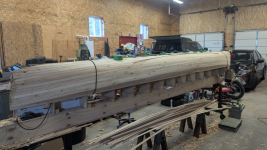
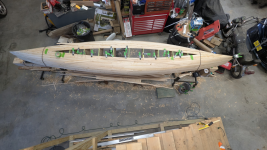
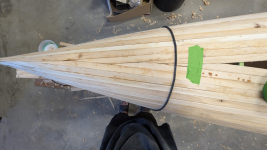
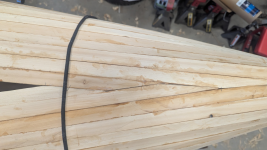
The lumber I got yesterday was a mix of true 1" thick rough sawn 6x and 8x white cedar collected, milled, and kiln dried about 10 miles away. All about 8'-8" long, totaling 62 board ft based on it being 8' long, but also true width, and these were a bit skinny with drying. And since I've decided to go with the Kite, that is 15' long, I probably could get away with scarfing the lumber and ripping as one long piece, but on listening to the folks here, and handling the 8' srip I made, I think I will be better off working with the shorter strips, at least for this first boat. I may glue up one long one, just to see how it goes.

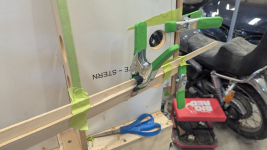
I also got a new skinny bike tire and made up 6 Jimmy clamps, I will make at least 6 more when I get a bit more time. What seemed to work best for me was put the spring clamp in vice so it was 1/2 open. Then use a set of angled needle nose pliers to widen the tire chunk and pull it over the clamp jaw to about the end of the rubber grip. Then flip it around and do the other side. I had a little blunt spludger dental tool I could sort of prod at the rubber if it didn't go into place. The process seemed to go pretty quick. I left the inside rubber looping down about the length it was on the grip, and attached the 1/4" tubing with a small zip tie.

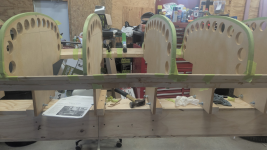
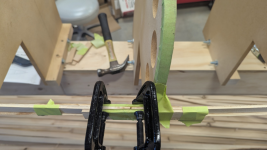
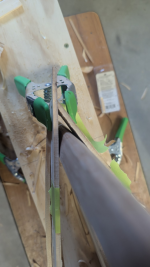
I will make sure to take pictures of everything tomorrow when I'm out in the shop, and the weather is better.

The white cedar I got is very light in color, so I'm starting to think about what wood to use for the trim. While I know ash is pretty standard for gunwales, I'm thinking it might look fairly nice to go with contrasting wood for that and the rest of the trim. Thoughts on what to use? I may have a chunk of 8/4 walnut I could use for the stems (not sure it is long enough) , but that seems a bit of a waste. Especially if I'm going try and match the gunwales.

I also may have a favor to ask of someone if there are any that happen to be coming down from the Twin Cities area to Canoeacopia next weekend. Just fallowing up with someone first.
 
The white cedar I got is very light in color, so I'm starting to think about what wood to use for the trim. While I know ash is pretty standard for gunwales, I'm thinking it might look fairly nice to go with contrasting wood for that and the rest of the trim. Thoughts on what to use? I may have a chunk of 8/4 walnut I could use for the stems (not sure it is long enough) , but that seems a bit of a waste. Especially if I'm going try and match the gunwales.

I think walnut would be the obvious choice, if a bit expensive. I would think there would be enough in the area to find it a local mill.

Alan
 
I'd second walnut as a contrast wood, especially for anything under glass: It's fairly light for a hardwood, bends well in strip-thicknesses and is soft enough that it can be worked alongside the cedar without making the cleanup/outside sanding hideously painful. I've successfully embedded it in the hull stripping for accents, and would do so again. Regarding using it for gunwales: What are you intending for a finish? What's your storage expected to look like? The downside of walnut is that it isn't all that rot/weather resistant unless protected. (This doesn't matter for bits in the hull, as the glass and epoxy waterproofs it.)

Stems: cutting up 8/4 walnut does feel wasteful, but that depends on how nice it is, and how you're doing the stems.

I'm going to circle back to something you said in your first post, as it now seems relevant and within proximate range:

I also am planing on using at least an outer stem (still debating on inner)

I'm having trouble visualizing how you intend this to work mechanically. What would that outer stem attach to? I can imagine an inner stem with the strips run past to the end and interlocking like is done on a stemless.
 
I'd second walnut as a contrast wood, especially for anything under glass: It's fairly light for a hardwood, bends well in strip-thicknesses and is soft enough that it can be worked alongside the cedar without making the cleanup/outside sanding hideously painful. I've successfully embedded it in the hull stripping for accents, and would do so again. Regarding using it for gunwales: What are you intending for a finish? What's your storage expected to look like? The downside of walnut is that it isn't all that rot/weather resistant unless protected. (This doesn't matter for bits in the hull, as the glass and epoxy waterproofs it.)

Stems: cutting up 8/4 walnut does feel wasteful, but that depends on how nice it is, and how you're doing the stems.

I'm going to circle back to something you said in your first post, as it now seems relevant and within proximate range:


I'm having trouble visualizing how you intend this to work mechanically. What would that outer stem attach to? I can imagine an inner stem with the strips run past to the end and interlocking like is done on a stemless.
Very fair point, at the end. And that comes from my inexperience, and not having fully thought it through as well. And as of now, I'm thinking I will fallow the Kite plans in full with both an inner and outer stem. Off hand, I guess I could still use ceder for the inner stem, and walnut, or another wood for the outer?

Regarding the gunwales. I'm not a big fan of the blocky scuppers at all, and while the ovalish ones look better, I'm still not sold. The one in the kite plans looks like a fairly slender two piece, but does not look like it has enough room on the inside for scuppers, so I think I may try that. But like you said with it not being under glass, especially if I just oiled it, walnut would not be ideal. For hardwoods, I guess it would be esiest for me to get walnut, cherry, ash, hickory, and maple, and maybe mahogoney. I guess I could also try staining one of those lighter colored woods, but I'd prefer not to. I think I could get cherry a bit cheaper than walnut. That might be a good choice.

While I can hold off on getting the gunwhale and even deck wood for a while, I'm going need the stem material before I can even start stripping, so I need to get on that.
 
I'm having trouble visualizing how you intend this to work mechanically. What would that outer stem attach to? I can imagine an inner stem with the strips run past to the end and interlocking like is done on a stemless.

I'm assuming he means an inner stem with the strips attaching to the side of it, so the face of the stem will be exposed after shaping. I did that on a couple builds when I wanted a tapered stem and a more blunt profile.


Alan
 
Of the woods that you've listed as available to you, I'd use the Cherry. It ages into a deep, dark red and, in my experience, darker woods like Walnut tend to lighten with age while lighter woods tend to darken. Cherry is a little fragile when working it- it will split easily if bent too sharply so you'll want to soak it for a couple of days if you're bending strips into laminated seats or building stems from it.

My favorite so far is Sassafras if you have it available (I think you're near the Western edge of its native range). It is extremely easy to work with, ages into a chocolate brown and is extremely rot-resistant. (Extra bonus: it smells wonderful!) It will still need soaked if twisting or bending sharply but (at least to me) seems more forgiving than Cherry.
 
Inner stems, tapered per plan and just like Alan shows is what I did on my stripped Kite. No outer stem.
Gunwales? More cedar, but wrap it in carbon fiber, should make for a striking contrast.
 
Back
Top Bottom