• Happy Nobel Prize to my physics prof, Leon Lederman (1988)! ⚛️

Post your training paddles

This is good info to have. I have been running into a similar problem and believed it was some form issue causing the imbalanced fatigue. While my form is definitely a work in progress, I am glad to hear that there might just be some muscle adaptation happening alongside.

I think it's a combination of specific paddling strength and form/technique. They both get better with time on the water.

I remember one summer when I was in the best paddling shape I'd ever been in. I won the Jensen Handicap race in Minnesota that summer (lucky draw for a great partner). The next year I started building my own house and had only been on the water a couple times for leisurely paddles. The race has a traveling trophy so when I came back to return the trophy the next summer I decided to race since I was there anyway and what a difference it was!

I felt like I had nothing to give. I felt strong at the start but soon I felt very fatigued and I couldn't sprint to save my life. I could maintain a steady power but I just did not have a higher gear to kick into. I didn't feel out of breath, just like I had no power. I doubt my form or technique had degraded that much but those paddling muscles sure had.

Alan
 
Is this your Barracuda? What a beauty!

That is the AGX. It was my first hull design and gave me the speed I had hoped the Barracuda was going to give me.

18.5' long and 27" wide

Surprisingly friendly to paddle for what it is. I'm much more comfortable in this than I ever was in a racing C1. Speed seems to fall somewhere in the middle between a racing C1 and something like a SR Blackwater or Barracuda. And it has room in the bow for a (small) dog, which was a large design criteria.

Alan
 
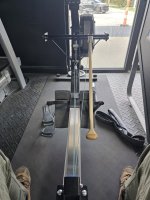
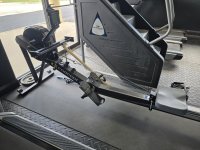
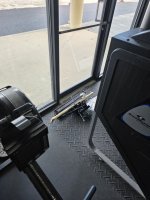
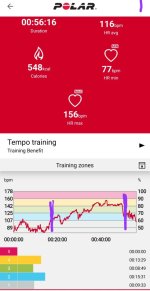
Received and installed a new addition to the pain cave. Takes about 90 seconds to install or remove. I am fortunate to have a great relationship with the gym owner, so I wont even have to transport it. HR monitor also showed up today, so feeling almost professional... 😄

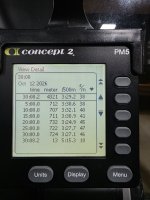
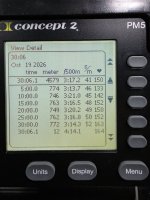
The test run was a wake up call. 10 minutes at 55spm, damper setting 6, was enough to know I wont be faking my way through this training plan.

1000020820.jpg

1000020821.jpg

1000020826.jpg
 
Looks like the Paddlesports trainer that I use during winter months. Beginning around Christmas time I start with 20 minutes at 60 spm, increasing to an hour as time goes on. it is a good machine for building up power strokes and timing. Unfortunately it does not replicate doing buoy turns very well. I bought it at canoe Nationals in Syracuse several years ago for Yukon River race training and I consider it well worth it for all around training
 
Looks like the Paddlesports trainer that I use during winter months. Beginning around Christmas time I start with 20 minutes at 60 spm, increasing to an hour as time goes on. it is a good machine for building up power strokes and timing. Unfortunately it does not replicate doing buoy turns very well. I bought it at canoe Nationals in Syracuse several years ago for Yukon River race training and I consider it well worth it for all around training
It is indeed the Paddlesports version. Good to hear that an accomplished veteran finds it useful. It kicked my butt this morning.
 
Good consistency and your stroke rate continued to improve through the workout.

Alan
 
Whenever there is open water, I paddle 3-5 times a week as my aerobic workout. Usually for an hour, but also adding in some longer paddles in the spring to build an aerobic base. Last winter,I paddled right up to Dec. 1st, and got back on the water in late Feb. If the water temp is below 50º, I wear a drysuit and/or stick right next to shore. I also practice deep water self rescues a couple of times a year.

I use the Crew Nerd app with a heart rate monitor, and spend the majority of my time in zone 2, but throw in some fartleks once the aerobic base is built up. Structured intervals would probably be more effective, but I don't enjoy them.

Early in the season, I also struggle with getting my heart rate up without fatiguing muscles. One thing that has helped me is to use a smaller blade size in the spring. After 8-10 weeks with the smaller blade, I'm able to switch to a larger blade. By that time, the bigger blade "feels" more efficient; I see my stroke rate drop slightly, but speed increases for a given heart rate. I use ZRE Revolution Lights in 7.5" and 8.5"
 
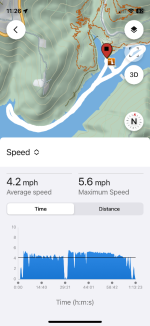
I’m not going to consider this a training paddle from a workout standpoint but still training session. This is from a 5.1 mile paddle on Sunday morning. I was going out on the water with someone for the first time together and we took their Wenonah Minnesota II. We are loosely talking about doing the MR340 together as that is a race she wants to do and I think I do as well. I’m slated to race in the Texas Water Safari in 2027 with my partner from 2025 and I’d love to slide into the MR340 after the Safari with this potential new partner if we sync in the boat.

I had no idea what to expect and I started in the bow. The purpose of this paddle wasn’t to push hard but test out how we performed together. I couldn’t see from the bow what her stroke looked like and we didn’t track as straight as I would have liked. I could tell when she was using the paddle as a rudder to straighten us out which told me she needs practice driving a canoe straight. No worries there as we can work on it. You can see on the graph where we stopped to trade places. Once I got in the stern I told her I would be calling the switches and when I did she was to finish the stroke she was on and then switch sides. We didn’t paddle any harder than when I was in the bow but you can see how our speed went up due to our efficiency.

Her stroke isn’t bad but needs some improvement as she does a little bit too much arm paddling and we will go over the catch and a straighter more extended bottom hand/arm position.

She is eager to learn and wants to race. I can see she has the potential to be a strong paddler. She’s been a cop in New Orleans, done Homeland Security as well as private security traveling the world with clients. I know she’ll have the mental fortitude to handle adventure racing.

We will continue to train together and I look forward to doing a session where we push it to see how our time changes.

The more we spend time in the boat, the faster we will get.
 

Attachments

  • IMG_2243.png
    IMG_2243.png
    280.6 KB · Views: 8
Went out for a harder effort with a faster boat tonight. Another beautiful evening and not another boat on the lake. Time after work is getting really short though. It was pretty much dark by the time I got off the water.

6 mile paddle
5.5 mph average speed
6.5 mph max
121 average heart rate
132 max heart rate
68 strokes/minute average
592 calories burned

I feel like my atrophied paddling muscles are holding me back. They quickly fatigue and don't allow me to get the heart rate up higher. We'll see if I can get them built up at all before the cold weather and darkness puts a halt to the paddling season.

View attachment 157872
That boat is gorgeous. Looks fun to paddle as well.
 
Thank you all for posting. This gets me motivated to paddle.
Alan, what's an AGX?? Looks like a really cool canoe.
 
I need to get in the real boat soon and figure out the stroke dynamic. Watching some of the marathon guys, I think I am applying power for a much longer stroke. Easy to do on the erg, with cadence being the only penalty. Might not work well in real life.

I naturally want to do a longer, stronger, slower stroke. The typical racing stroke feels very hurried to me, almost frenetic. Almost all physical activity is like that for me: big weights with low reps, heavy pack ruck instead of running, etc.

It will come with practice. I tend to be a slow twitch muscle guy too but have no problem paddling a canoe at 60 spm over long distances and quicker than that over short distances. Once you get used to it I find it's considerably less tiring. A short stroke seems to use more of your core muscles whereas a longer stroke can burn up the smaller arm muscles.

I find myself pulling hard as soon as the paddle is fully planted and then backing off almost immediately to begin the exit and recovery. If I want to accelerate I find it easier to up the stroke rate at the same intensity rather than keeping the same stroke rate and pulling harder.

When tripping or paddling over longer distances at a more relaxed pace I will back off the cadence but likely still be in the upper 50's. Even with a slower cadence I don't think my power stroke gets a lot longer. It's just that the exit and recovery are slower and more relaxed. At this point it feels completely natural and I don't have to think about it.

On a related note I began running about 1 1/2 years ago and soon learned a high cadence is important for that as well. My cadence was quite low at 155 spm with overly wrong strides. I began working on a higher cadence and trying to go up to 165 felt ridiculous, like I was taking little prancing baby steps. I kept at it and it wasn't too long until my cadence was over 170 spm and after a week or two at that cadence it felt completely normal. I'm now running in the 175 range and if I intentionally drop into the 160's it feels very slow and plodding, even if my speed is the same.

Alan
 
Last edited:
As my normal crew position is in the bow, I start at the gun race beginning sprint at roughly 80spm. We keep that up for the first 3-4 hut rotations, until the open paddling space widens. Then, (depending on nearby same boat class competition, voyageur or C4) I back off to cruise at around no lower than 60spm, which seems to work and be acceptable long term for most crews.. To fight boredom and prevent fatigue slow-down on long stretches, we often agree to up the rate to 80 again in sprints for a set number of hut rotations (4-8), with an equal number of cruise rate huts in between before doing it again. That seems to put some distance between us and following boats, and to gain on those ahead enough often to challenge and set up to demoralize their efforts.
 
Last edited:
I hope to continue to receive such as I journey toward my first race.

I think you will. I've haven't met a much nicer bunch of people than the ones I met when I was canoe racing. I don't know what kind of racing is available in your neck of the woods but Minnesota has a good core group of paddlers and there are regular races through the season around Minnesota and the rest of the upper midwest. Most of them are shorter (8-12 miles) and I found these to be excellent events to attend and often included a pot luck or most of the group going out to eat afterwards. Those races are a much smaller commitment and it gives you a chance to not only to potentially spend more time with paddlers but on the smaller loop/out and back courses you'll spend a lot more time in the company of other boats so you can get a good look at how the other paddlers are doing it.

When I did long races (75 miles) I often found myself paddling alone with no other paddlers in sight for hours on end. Both are rewarding but they are very different experiences.

Alan
 
Back
Top Bottom