• Happy Paperback Book Day (1935)! 🐧📃🔙📖

Planes on grain runout in cedar strips

Joined
Jul 2, 2026
Messages
21
Reaction score
98
Location
Downeast Maine, USA
Several instructions show block planes for the first smoothing outside a cedar strip hull.

I would prefer to plane in the direction of rising grain. A sharp plane should not tear-out diving grain in cedar but that's no guarantee.

Some instructions do warn about planing toward diving grain. None mention aligning runout so all strips have grain rising in one direction.

With cove and bead, that would mean each strip is either a port strip or a starboard strip. Perfect parallel grain can go on either side.

Plane? Align grain or not? Sandpaper? Fairing board? Random orbital?

Or maybe everyone has cedar with better grain than I'm accustomed to.

Estimated shipping date for the kit was July 30. That may not end my questions.

Thanks,
Dave
 
It is possible to overthink these things. Once you start building, you will find your level of comfort with your desired outcomes. My desired outcome is to usually build a canoe as quickly as possible, and not worry much about aesthetics. I only ever plane the outer hull if the stripping has been particularly bad. For instance, irregular thickness in strips, or poor application. I get this sometimes when students are building. Usually, I just take an orbital sander with 60 to 80 grit, depending on how fast I want to do the initial sanding, and make everything fair. Then crack fill and one more sanding with 120.

I have never worried about grain, except when putting the bead and cove on. Orbital sanders don't care much about which way the grain is running.

So to plane or not to plane? I used to once in a while, but generally don't do it now.
 
Always ask questions; it's far better (IMO) than asking "How do I fix this?" (we'll help but don't enjoy it as much)

Personally, I use a rasp to knock down high spots. Specifically, I use a Farrier's rasp which can be found at your local Tractor Supply if you don't know any horse shoers. (We throw them away while they're still plenty sharp enough for your needs)

You're probably going to want to stick with the fine side of the rasp as the rough side will remove material too quickly.
 
I might touch up a couple proud edges with the plane but for the most part I don't use one. I usually heard it recommended to run the plane at a 45 degree angle (better for fairing the hull), which I've tried, and it seems to work ok with no/minimal tear out.

I give the hull a look over before sanding and any spots that are really egregious will get planed off. Then it's straight to a quick round of 40 grit on the ROS which will chew off most of the glue drips and remaining high spots. From there I can decide if it needs another round of 40 grit or if I can start stepping down.

Alan
 
I haven't built a strip canoe or worked with cedar, but for years one of my go-to tools for wood shaping has been the Stanley Surform. They call it a plane but it's really an open rasp. It cuts fast and is much less likely to tearout than a conventional single blade plane.
 
Besides a clear plank, the main thing that concerns me, is that my strips were as close as possible to being Quarter sawn.

So selection of planks, I look for Flat grain, or slash cut.

Quarter sawn strips machine the best. They are stiffer, and sand more even.

I used to just use a ROS sander, to remove glue, and level the hull.

Now I use an old hand plane, to remove glue and bumps on the hull.

Sand with an ROS, and finish with hand sanding, to remove the swirl marks, left by the ROS. Those pesky swirl marks will show !

The level of perfection is up to the builder ! My first canoe ( I still have it ), floats as good as any I have, but far from perfect.
I'm still striving to improve !

Jim
 
I’ve built just one stripper and did not find a plane useful for hull fairing. This from a carpenter who normally prefers cutting off as much wood as possible before resorting to abrasives. Rasps, files and sandpaper are your friends.

Rick
 
Thanks for your replies so far. This question may relate to my earlier one about staples. If the strips all lay flush then may not need planing. If it's only an occasional high edge, the grain on each edge is what's important, not the grain on neighboring strips.

I did buy a "surform shave" last week specifically for work inside the bow and stern. It's the very short curved blade that trails a 1-hand handle. The surform plane and surform block plane here are from the '70s with newer blades.

I think I'll look for a farrier's rasp. The only other rasps here are 4-in-hand.

Thanks,
Dave
 
A few thoughts on planing the mating "edges" after stripping.

The width of the strips is going to definitely affect how much of a point (and material) you have at the strip joints and the amount of wood to remove will impact the tools which will do the "best" job for "you". To knock the edge of, almost any hard, flat abrasive device will work well, i.e. rasp, surform, block sander and plane.

When using a plane, the easy way to avoid tear out with cedar for me, is to never try and plane directly along the strip joint or the grain, take shorter strokes, light cut and move across the joint ... think 30 angle. This sort of avoids the whole grain tear out issue. the planing part is just to remove that point part, the rest is all abrasives.

If you use strips narrower than the routine 3/4" size, you can start thinking about just using some abrasive flatware (sanding block, rasp etc)

If you go even thinned to a 5/8" size, I find skipping straight to an ROS with 80 grit works well and doesn't cut too fast to get in trouble quickly.

Brian
 
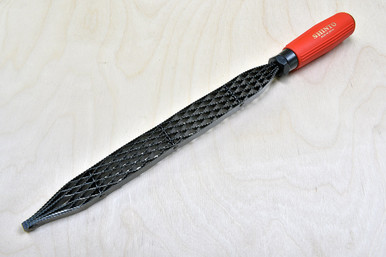
For that sort of job I like to use a Japanese Shinto rasp


They are really sharp and have fine and course teeth. You don't want to slide one across your knuckles.
 
A Japanese Saw Rasp, is by far your best tool, combared to a Surform rasp.
It has a course and fine side. Leaves a much smoother finish when done.

I use the rasp, without the attachable handle. You can also save a few bucks ordering without the handle. My preference.
SawRasp

Jim
 
Back
Top Bottom