• Happy National Lipstick Day! 💄💋

Planes on grain runout in cedar strips

Joined
Jul 2, 2026
Messages
20
Reaction score
96
Location
Downeast Maine, USA
Several instructions show block planes for the first smoothing outside a cedar strip hull.

I would prefer to plane in the direction of rising grain. A sharp plane should not tear-out diving grain in cedar but that's no guarantee.

Some instructions do warn about planing toward diving grain. None mention aligning runout so all strips have grain rising in one direction.

With cove and bead, that would mean each strip is either a port strip or a starboard strip. Perfect parallel grain can go on either side.

Plane? Align grain or not? Sandpaper? Fairing board? Random orbital?

Or maybe everyone has cedar with better grain than I'm accustomed to.

Estimated shipping date for the kit was July 30. That may not end my questions.

Thanks,
Dave
 
It is possible to overthink these things. Once you start building, you will find your level of comfort with your desired outcomes. My desired outcome is to usually build a canoe as quickly as possible, and not worry much about aesthetics. I only ever plane the outer hull if the stripping has been particularly bad. For instance, irregular thickness in strips, or poor application. I get this sometimes when students are building. Usually, I just take an orbital sander with 60 to 80 grit, depending on how fast I want to do the initial sanding, and make everything fair. Then crack fill and one more sanding with 120.

I have never worried about grain, except when putting the bead and cove on. Orbital sanders don't care much about which way the grain is running.

So to plane or not to plane? I used to once in a while, but generally don't do it now.
 
Always ask questions; it's far better (IMO) than asking "How do I fix this?" (we'll help but don't enjoy it as much)

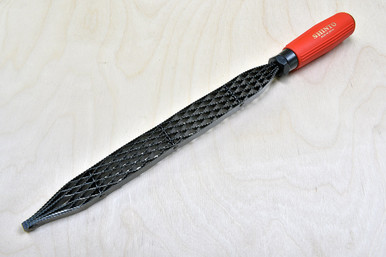
Personally, I use a rasp to knock down high spots. Specifically, I use a Farrier's rasp which can be found at your local Tractor Supply if you don't know any horse shoers. (We throw them away while they're still plenty sharp enough for your needs)

You're probably going to want to stick with the fine side of the rasp as the rough side will remove material too quickly.
 
I might touch up a couple proud edges with the plane but for the most part I don't use one. I usually heard it recommended to run the plane at a 45 degree angle (better for fairing the hull), which I've tried, and it seems to work ok with no/minimal tear out.

I give the hull a look over before sanding and any spots that are really egregious will get planed off. Then it's straight to a quick round of 40 grit on the ROS which will chew off most of the glue drips and remaining high spots. From there I can decide if it needs another round of 40 grit or if I can start stepping down.

Alan
 
I haven't built a strip canoe or worked with cedar, but for years one of my go-to tools for wood shaping has been the Stanley Surform. They call it a plane but it's really an open rasp. It cuts fast and is much less likely to tearout than a conventional single blade plane.
 
Back
Top Bottom