• Happy - National, Punctuation: Day. . . ⁉️

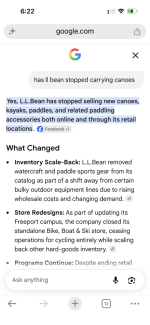
L.L.Bean no longer sells, canoes, kayaks, paddles, PFDs or canoe accessories

It’s not just LL Bean but most outdoor stores.
Yes, some of its from internet sales, but major retailers have adapted to that as well.
It’s driven by the purchasers.
What are people actually buying because we can’t have a warehouse full of high dollar items that aren’t in demand.
Are manufacturers selling direct to the public? How many people take up canoeing/kayaking? Even my wife just bought an inflatable kayak from the manufacturer at a discount from stores price, with free shipping.
Flyfishing equipment, guns are the same way. Eddie Bauer used to sell both high end but found the market no longer supports it.
REI only sells inflatables.
Our local Sportsman Warehouse, store is almost bare of anything forcing you to buy online. No longer carries Old Town canoes, just inflatables, pontoons for flyfishing.
I think today’s population is not as outdoors oriented. Unless they buy a brand new travel trailer to use a couple times a year.

The public for several years has stepped away from purchasing high quality goods.
Probably spending to much money on over priced houses and new diesel pickups for status.
 
It can be difficult to pinpoint why people visit your store. In the Carolinas we have Great Outdoor Provision and Half-Moon Outfitters as a couple examples of outdoor stores. I know a paddler who works at one of the stores. I ordered a new boat there from him some years ago. Selling nice canoes and kayaks had a pretty small profit margin. The gear was a little better. But well over 90% of their profits were from clothing and shoe sales. I think one possible key is to find specialty clothing brands that are of a high quality and that you won't find at WalMart or the department stores. Even though they would stock just a couple high end canoes and kayaks, and a small selection of high end paddles, it made me enjoy visiting the store. I liked the experience of going to a store that sold canoes and kayaks and had an experienced paddler or two who could converse about them along with related adventures. And even to non-paddlers, the store seemed to have a "feel" to it because of the display of all of the items that didn't represent significant profits. So a lot of people were willing to pay more for clothing that felt a little more exclusive, and that was sold by actual outdoor enthusiasts who could actually speak to their value from experience. The boats they did display took up a seemingly inordinate amount of space in the store if you look at the available square feet compared to contribution to profits. I'd say at least half the store was used to display items that represented less than 10% of profits. But I believe if you remove the boats and all the other outdoor gear and accessories, fill the space with a wider selection of more profitable clothing, stop worrying about hiring experienced outdoorsmen/women, you lose the look and feel and attraction. Knowing which sales represent profits is only part of a story. Nobody went to that store to get the best deal available on a piece of clothing. And yet, plenty of people still bought clothing there, myself included. I don't know how much any of this might hold true for LL Bean?
 
I visited LLB this summer after paddling the Allagash. While I regret not buying a bunch of their PFDs that were on sale (good quality and low cost, good for friends / loaners), I am also deeply saddened by their change in scope. When I asked some of the workers they were tight-lipped, yet visibly depressed about closing the paddle shop, and one person told me that LLB makes all their money from clothing, so they are prioritizing that aspect of the business. While not a traded company, they are acting like it.

Two decades ago or more they gave up their local sourcing and dropped the quality of clothing to make more money. Then about a decade ago now they stopped their lifetime guarantee. Now they are pulling back from the walks of life that made the company stand out to begin with - it's become less and less of a "Maine" store and more and more a national chain for moderately good clothing.

Very very depressing. My very first credit card (which I still have) was from L.L. Bean - I have always loved and gone out of my way to shop there - but it's getting more and more difficult to see the benefits of doing so when the quality and the selection are no different than Target. At least I am supporting a private company, so I will likely still stick with them for the time being, but I do so with a bitter taste in my mouth...
 
Along with REI and EMS, in my early gear needy days I shopped LLBean for gear, but when each of those franchises opened stores in my state, mainly far from me, causing state sales tax to automatically be collected, I backed way off from mail order and distant store visits. My wife still shops Bean for clothing she likes.
 
The historic LL Bean that many of you are describing sounds great, I wish I would have seen that one. I was not that impressed with the Bean I saw a few weeks ago, and with what VA and Nikon are sharing I’m not that motivated to return.

Like Chris postulated, the paddling gear and canoes may not be what I would end up buying, but it would get me in the door.
 
A stop at LL Bean has always been highlight of my annual pilgrimages to Maine. I still enjoyed it, including the paddling building, as recently as the summer of ‘25.

I always loved that the store had no locks on its doors because, since the 1950’s, the store was open 24/7 and 365 days a year. When I frequented the store in the 90’s (oftentimes driving through late at night), it had only ever closed twice: after the assassination of JFK, and for the funeral of Leon Leonwood Bean himself. Later they closed during 9/11, then the death of chairman Leon Gorman, and also during Covid.

I was mistakenly under the impression that it had recently been sold to private equity but that is not true: it is still privately held with ownership tied to the original family.

Are we sure the long-running renovation work doesn’t simply require the temporary closure of the paddling section for its relocation?
 
Back
Top Bottom