• Happy World Photography Day!📸📹🎞️💾

First Canoe

I hope you have your strongback, secured to your saw horses.
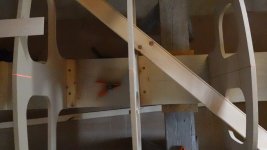
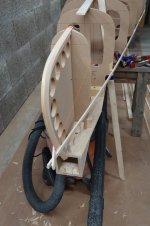
I use Fish line, (203 ) to align forms. I leave it on, until I'm stripped close to center. Nice to be able to check alignment while stripping !

Just be very minimal with your glue !
It's not fun to scrape excess glue, especially from the inside.
You only need enough glue to hold the strips together, until the epoxy takes over.

It took me a few canoes, before I realized that !
Oh, My first canoe ! Took me days, to get the Yellow glue, scraped and sanded.
Then the Yellow glue, still showed through the resin !, ( Polyester resin at the time)

Jim

PS ! I use C-clamps to hold my forms to the cleats. I can easily adjust on the fly, and I won't need the clamps, until I take the hull off the forms anyway.

Looks great !
 
@Jim Dodd
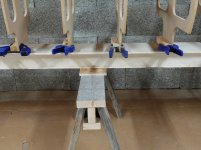
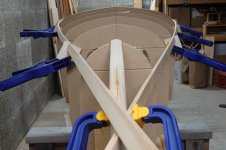
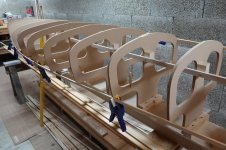
The 5/8" connecting plates have 4 screws up into the strongback and 4 screws down into the sawhorse. The sawhorses are ones I copied from a post by @Robin and are pretty heavy. It's all on cardboard as I saw in one of your posts.

The Titebond nozzle is way too big and I'm looking for a different glue bottle. Even small Titebond bottles have the 3'8" wide nozzle. Every source is clear that it doesn't take much glue. I know that TB isn't required but I know it performs well. I'll review more posts on this forum to see what others recommend. Small, plastic-bristle, discount store "artist" brushes are great for spreading small amounts of glue but obviously tedious for stripping. The wait time for the stem forms means I'm more than a week from the first strip.

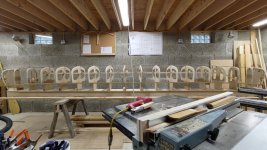
There is a line down the strongback, but only a chalkline. The forms bottoms are the same width as the strongback top which should help if I stay centered. When I first used a laser level, I was converted. So very convenient and not deflected by contact with the work.

Thanks
Dave

Oh. Forgot the pic.

Secure.JPG
 
Last edited:
I used a syringe (without the needle) from Tractor Supply for my 1st couple of builds (pretty easy to suck up some glue by tipping the bottle) but I've started using a small, rinsed-out Elmer's school glue bottle on the last couple. Seems to lay down a small bead & it's easily sealed when done for the night by twisting the cap.

Don't get overly stingy with the glue. I had one hull (my Raven IIRC) where some of the glue joints pulled apart during sanding because I was overly zealous about minimum glue. Not much fun and I'd rather scrape some extra glue from the interior... a fine line to be sure.
 
I found glue bottles at a Hobby Lobby. Don't know if you have one near by ?
A good hobby store should have glue bottles, with long small tips.

I strive to get a pencil lead diameter, glue bead, or less,.
If you see squeeze out ? That's too much.

Evan if you starve a glue joint ? you can add a little glue, and strap the glue joint.

My strongback legs. With these ? I'm able to tilt my strong back.
This helps, when stripping the football, as well as sanding, the entire hull.
 
The hobby shop 30 miles from here closed maybe 15 years ago. Rural living is great . . . usually. The idea of a twist-open glue nozzle sounds good. I'm sure I can find Elmers glue here.

No yellow pencils in the house, only mechanical pencils with 0.07mm and 0.05mm leads. Those might be too small as glue guides. My school drafting pencil from the '60s has a 1/16" lead. The books here say 1/16" to 1/8". One pic shows the cove full which I suspect caused them some scraping although the caption is only about the right amount of glue.

So I suppose a yellow pencil lead is 1/16" ? I suspect a glue bead of 1/8" would be too much.

Thanks for the warning about being too stingy since most warnings are about too much glue.

--

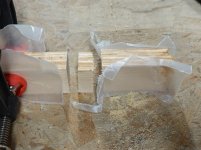
I built a sacrificial lamination of the same strips as the stems. I'll cut this in a few days to see if the center glue has set up. I can probably cut 2 or 3 times if a few days is not long enough.

In the mean time, it's raining outside and I can set up the center 14 forms although I'll have to move the level around to add the end forms later. Might look for other projects instead so I can set up from one end to the other as suggested to me earlier.

Thanks all

Dave
 
Last edited:
Dave

Amazon has a very wide variety of glue bottle application tips.

As for glue, anything, but Yellow. Beings you are using Bead and Coved strips ? Your glue joints will be near invisible.
So the glue won't show much anyway.

Jim
 
I suspect a glue bead of 1/8" would be too much.
Yep, I think that would be too much. Aim for 1/16 & if you get too much squeeze-out, cut it back a little (move faster with the glue bottle). I like to see a little here & there but not have it all over the place.

Honestly, it's probably something you need to do (and, maybe, screw up a little) to get a feel for it. Like so many parts of this project, just dig in, don't think TOO much and it will come together just fine. (The second or third are easier, I promise)
 
Last edited:
. (The second or third are easier, I promise)
Thanks. I'm glad that the second or third strips are easier. (That's what you said, right?) I'm starting to get used to the idea that other canoes will follow but I'm gonna need another building or a shed off the side of one that's here already.

At the end of this post are some thoughts on glue usage as well.
Thanks for those thoughts on glue, color match, and early cleanup with a putty knife to prevent spreading. You make an excellent case for me giving up my old familiar Titebond.

I have never heard of "Express glue". A web search shows that some are PU glues.

(EDIT)

I see that other threads on this site mention LePage Express PU glue which is a PVA glue. I'll try it.

Thanks all,

Dave
 
Last edited:
Anyone with experience with other "express" glues is welcome to mention which ones.

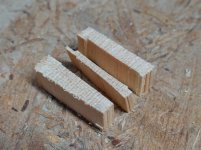
Good news about the laminations I made with Titebond III. I just cut the test piece after about 40 hours. The cut was 3" from the end so I could take other samples later. It is dry inside. I split it with a chisel and it resists splitting on a glue line but shows grain on both sides of the split. I took another sample from the center of the test lamination and it is also dry and also splits wood instead of glue.

Test.JPGTestSplit.JPG

The "real" lamination has been curing for 65 hours. I am confident that I can proceed.

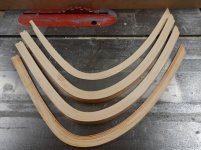
When I laid these up, I first clamped the bit below the waterline and progressed up the the gunwale. The bit below the waterline was all square but the layers had splayed out left and right by the other end. I did try to control them but in the end they were less than square.

So I flattened one side a bit. I worked on only the side that will go against the fence of the table saw and only the end that had splayed significantly.

FlattenOneSide.JPG

Then to the table saw. First cut was down the middle then 2 cuts to make them 3/4" wide.

Sawn.JPG

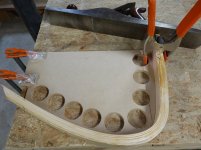
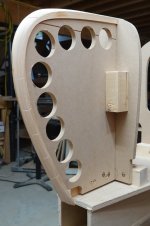
I can now go on to attach these to the forms and bevel them so I can staple strips to them.

Dave
 
Thanks. I'm glad that the second or third strips are easier. (That's what you said, right?) I'm starting to get used to the idea that other canoes will follow but I'm gonna need another building or a shed off the side of one that's here already.


Thanks for those thoughts on glue, color match, and early cleanup with a putty knife to prevent spreading. You make an excellent case for me giving up my old familiar Titebond.

I have never heard of "Express glue". A web search shows that some are PU glues.

(EDIT)

I see that other threads on this site mention LePage Express PU glue which is a PVA glue. I'll try it.

Thanks all,

Dave

The post was more about using a glues properties to your own advantage and that for softwood like cedar almost any glue is going to be overkill from a strength perspective. I have TB, TB II, TB III, LePages Pro, LePages Express and two different epoxies ,,, they get used to make building easier for me.

In hot weather (like we have here currently) I suspect that my Express (that is just the name, not a class) glue would setup too fast for stripping and I would need to go to one of the other glues to get sufficient open time to apply and get a strip on.

In your application (stem lamination), TB III is a good glue, but you likely would have been better off using TB or TB II IMO. Under constant stress or heat, TB III is flexible and tends to "creep" , it doesn't setup as hard/rigid as the other 2 TBs. I doubt you will see any appreciable creep in your glueup in the build timeline, it is however something to be aware of when selecting your project glue(s).

The surface sheer strength of WRC, NWC and Spruce are all , on the average less than 1000 psi (likely way less) .... TB has a sheer strength of ~3000 and TB III ~ 4000 .... whatever glue used is going to be overkill on softwood. If you look at the sheer strength of most glues, it is the same story ... almost all glues are strength overkill for softwood, so pick the properties that make your life easier and suit the job at hand.


Brian
 
Thanks, Brian.

I know very little about wood glue. My measures are "Does it stick together?", working time, and sometimes weather-resistance.

What I took away from reading "not a treatise on glue" is that glues that would serve best would a) have a color that matches better and b) be cohesive enough to knock off the cedar without smearing or tearing wood. It seemed that LePage Express did that for you at one time.

TB III dries to a dark brown but I use it for the longer open assembly time compared to other TBs. (I don't want hide glue.) I don't use enough wood glue that I keep others on hand. Even a table, bookcase, or kitchen cabinet doesn't really take much.

It's 71F in the basement. That's about as warm as the basement gets unless I set up portable heaters. I don't expect to use heaters until time for glassing.

CLC says "yellow carpenters glue". Gilpatrick says "yellow carpenter's glue". Schade says "yellow wood glue . . . such as Elmer's ProBond or Titebond" (PVA, not waterproof). I can't find work time data for any of the several ProBond glues.

I'm not sure where I went wrong thinking LePage Express would work. LePage claims open time is 8 minutes at 20C. That's equal to TB III and longer than any other Titebond except Hide glue. Perhaps LePage Express claims longer working time than it actually has or your shop is warmer than 20C. Mine's currently 21C.

The longest working time for TB (not III) is the original. About half as long as what I've used these past years.

I know TB III is not a good match. Nothing else here will work well.

Dave
 
Last edited:
I haven’t used it on cedar strips, but my last flooring project specified either a Bruce or Wilsonart white wood glue for manufactured wood flooring and a wood composite that is water resistant. It dries either clear or translucent and was water resistant also. Available at Home Depot, Lowes, etc.
Typical with any wood glue, I keep a wet rag handy to clean up the glue line as dried glue can interfere for appearance sake. Also easier sanding.
 
Last edited:
Back
Top Bottom