• Happy National Fried Chicken Day! 🐔🔥🍗

Driving with your canoe on the car all summer long

Joined
Apr 6, 2026
Messages
5
Reaction score
54
Location
Worcester County, Massachusetts
Spring and summer finally arrived here in New England. I don’t think I’ve taken my canoe off the car for the past two weeks, other than to paddle somewhere and then return it to my car rooftop. This is a lot easier than storing the canoe after each time I use it, and then putting it back on the car to drive to a pond or river.

I’ve been paddling once a week, sometimes twice or more. I’ve been thinking that I might just use my car rooftop as my canoe storage place until it gets too cold to paddle.

Anyone else doing the same thing, and how’s it been working out for you? I’m worried about the finish on the canoe (Gel-coat on Kevlar). The canoe gets a lot of sun stored on top of the car. I’ve put 303 UV protectant on once since late April when I bought this canoe. I’m not sure how frequently to apply the protectant to keep the nice glossy finish from fading. Can I get away with applying the protectant every 6 weeks or so? Any other concerns with summer-long cartopping?
 
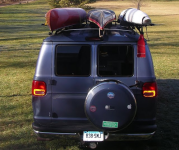
I used to keep one, two or three gelcoated, composite paddlecraft on top of my full-size van all summers for a few years, but that van was a dedicated canoe vehicle in which I kept all my gear and slept.

1783298752833.png

The gelcoat should protect the resin and Kevlar from UV damage, but UV can cause the gelcoat itself to oxidize and become a powdery white. You can see it forming on the orange Lotus Caper canoe, which was 20 years old in that photo. I didn't think to use 303 in those days.

My subsequent experience is that 303 will come off fairly fast in the water or in strong rain storms, so I'd probably put the 303 on at least once a month if I were leaving canoes on top of my vehicle now.

You could invest in a canoe cover, from RedLeaf Designs for example, if you want to incur that expense. That would solve the UV issue almost completely. However, putting the cover on and off every time you use the canoe can be annoying to some people. To me, it's just as easy to put my canoe in the garage as it is to use a canoe cover.

In any event, you certainly can try leaving your canoe on your car, applying 303, and just keep watching for gelcoat oxidation.
 
My canoe lived on top of my SUV in college. I had decent racks and a locking system. It is a tough life for a canoe, but it works.

I keep a tightly wound reflective rope hanging on the back of the canoe. This keeps you, spouses, and random strangers from banging your heads. It also helps remind you when reversing.

The most important thing is to check your tiedowns often.
 
A canoe on top of the car decreases your gas mileage. I figure -2 mpg per canoe, but it has been a long time since I measured accurately.

It bothers me somewhat that we burn fossil fuels in an effort to experience nature in a pristine state. Same concern applies to paddling canoes made from petrochemicals. But I'm not bothered enough to stop paddling.

In an effort to help out, I recently retired my 4WD Tacoma (22 mpg highway, 18 mpg w/2 canoes). The new canoe hauler is a Subaru Crosstrek Wilderness which gets 29 mpg highway. I don't have enough data yet to say for sure, but I guesstimate it will get 26 mpg with 2 canoes. I would like to do better, but if you saw my driveway in January you would understand why I need 4WD or AWD.
 
I drove to Wisconsin last weekend without a canoe on top and averaged 37 mpg for the 6 hour drive. On the way home with a newly purchased canoe and a headwind I got 15 mpg. If most of your driving is low speed and local it probably doesn't matter.

We spend months at a time traveling in our RV while pulling a car with my canoe and my wife's kayak on top. I just spritz them with 303 occasionally.
 
Back
Top Bottom