• Merry Christmas, Peace on Earth and Goodwill to All! 🎄🎅🏻🎁

Cold Water Thermophysiology

If you dump into cold water, you have some time.
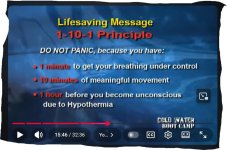

View attachment 151995

And if you have fallen through the ice, and can’t get out, get your arms as far out onto the ice as possible and let them freeze to the ice. That way, when you do become unconscious, you keep your head above water, extending the time for possible rescue.

I saw this on a video where the instructor actually demonstrated this. I wish I had saved that video. I never found it again.
 
I saw this on a video where the instructor actually demonstrated this. I wish I had saved that video. I never found it again.
Erica,

Just do a google search for "Dr. Cold", "Professor Popsicle" aka Dr. Gordon Giesbrecht from Manitoba Canada. Also search the same on Youtube. You will find many videos from his cold survival education training program.
 
Erica - I used to show that video in my winter camping class each year. It was a real eye opener to everyone and showed solid, real world techniques that they could relate to. I know the video is still out there and it looks like @yknpdlr has given you a starting point to find it.

That's all for now. Take care and until next time...be well.

snapper
 
It's the most misleading coldwater safety summary I've ever seen.

Nobody is guaranteed one minute even in warm water. Some folks just go under quietly and never come up (ask me how I know). The gasp reflex is a real thing and increases the odds of not coming up. The smaller you are and the less body fat you have the less time you have even in an ideal scenario. Even the "don't panic" comment seems absurd...best case scenario you're not going to be calm when dropping into ice cold water then add the fact that the average American can't swim 100 yards in a pool...and we expect folks to remain calm because of a PowerPoint slide?

I didn't watch the movie but the summary looks flat out irresponsible to me.

Coldwatersafety.org is where I go for cold water safety information. They have a section on debunking myths including the 1-10-1 myth.


I'm not terribly fond of getting soaked in tepid water so I'll go to great lengths to avoid a cold water dunking (zero chance that I'm ever among those 9 volunteers).

That said, if it happens, I'll certainly try my best to remain calm (the alternative is neither productive nor pretty) and the 1-10-1 idea might help in that respect.

Similar to the "rule of 3s" (you can last 3 weeks without food, 3 days without water and 3 hours without shelter), it's usually good to have your priorities in order prior to being exposed to the situation but remaining calm is primary IMO as panic is never helpful.

I'll have to read more on the coldwatersafety.org site... looks like an excellent resource.
 
The average American who cannot swim 100 yards in a pool is not the most likely person to to find themselves in a situation where they are intentionally outdoors in winter wilderness conditions. As one myself who spends a great deal of time outdoors in all seasons, I believe that learning all I can from recognized experts in a field of safety (especially one who actively puts himself in the situation as his videos show) have something to to help me if I ever find myself in that situation. Therefore I have viewed and showed to my SAR team many of Dr Giesbrecht's teachings and philosophy with his cold survival videos. For example, if I recognize that If I am aware enough to fight the panic reflex, and what to best do next, then I may have a chance at survival. I do not pooh-pooh an entire field of study from viewing just "one Powerpoint slide". Doesn't seem to me like a good basis for extreme judgement of an entire field of study. I have not been to the cold water safety website. I think I will go there now to see if it may have any additional useful tips to help me survive beyond what I already know.


By the way I have taken the active in-situ survival and rescue courses and am certified by New York State Homeland Security and Emergency services in swift water/ flood water rescue, cold/Ice water rescue, and rescue motor boat operation.
 
Last edited:
I was taught in the military that in an emergency situation, your training will automatically kick in and you will do what needs to be done without having to think about what needs to be done. I go out to a lake and over turn my canoe to learn where the point of no return is, to test my pfd, and to test how to save myself in a cold water dunking. I have found that with my pfd, I go under water, then immediately my head rises above the water before I get the cold water gasp. After the cold water gasp, I either drain the water from my canoe, or I hold on to the gunnel and swim myself and the canoe back to shore. I also have found that even with the canoe completely filled with water, it will float with the gunnel just below the surface of the water.
 
Back
Top Bottom