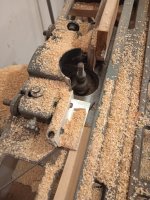
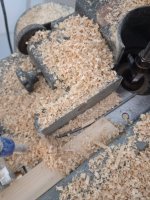
Didn't work exactly as planned but I'm getting there.
I normally carry the bandsaw to the porch but weather (rain changing to snow) chased me inside. I blocked off the heat to the shop (keeps the sawdust upstairs) and proceeded to cut out the forms (I also cut out a paddle blank if you're wondering about the Catalpa board on top of the pile)
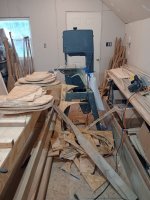
Sanding creates a LOT more sawdust so I took the sander onto the porch
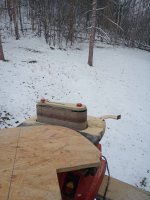
With the previous builds, I've been pretty quick to round over the chines but this hull has more of a pronounced flat on the tumblehome and, of course, Alan can see this thread so I decided to try it as designed this time.
I sanded off as much as I could and then cleaned up the sharp corners / flats with an old horseshoeing rasp
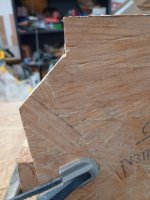
Once cleaned up, I used the laser level to align the forms on the strongback, added 2 leftover Pine strips to the tops to ensure even spacing, and then dug out my box of clamps
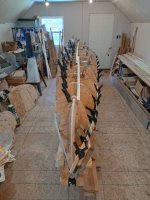
I'm a little undecided about not rounding over the chines. I figure that, above waterline, there wouldn't be any difference in performance but I do think that I like the aesthetics of the sharp corners.
I started stripping at the sheer and, while the Poplar didn't bend & twist as easily as most of the woods that I've tried (the Cherry is the only one that was stiffer), it was sufficiently flexible to maintain contact with the forms as the strips twisted along the tumblehome section. I put 2 strips the length of the hull and then, as I moved upward, I used shorter strips where the flats became more pronounced (The tumblehome fades flush with the bow & stern about 3 stations in so I stripped the flats with shorter pieces as the flat became wider).
I've gotta say, I wasn't a great big fan of having the strips just hanging out in mid-air with nothing to staple to but it worked out OK.
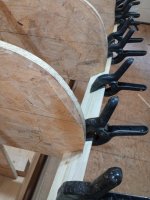
I allowed the glue to dry for a couple of hours and then resumed stripping the length of the hull, trimming off the cove on the inside where the next strip had to jump out of the cove and be glued to the underside of the tumblehome. This took some creative clamping in some areas but the natural rigidity of the strip was sufficient to hold pressure for much of the length in those flat areas. (hopefully, I'm explainng that clearly... here's a picture to help)
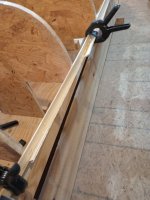
And that's where I am tonight. From here on out, it should be running strips as usual and trimming the flats off even with the hull. I know Alan usually builds at insane speeds so I'm hoping to do him justice and have this stripped pretty quickly. We'll see...