• Happy Sherlock Holmes Day! 🔍2️⃣2️⃣1️⃣🅱️

Power Banks - 2026

Glenn MacGrady

Administrator
Staff member
Joined
Oct 24, 2012
Messages
6,851
Reaction score
13,845
Location
NW Connecticut
Our power bank (AKA battery pack) threads are five to six years old. Technology changes fast.

The topic is currently available power banks to charge electronic devices such as phones, laptops/tablets, satellite communicators, and other electronic devices you take on canoe or camping trips. NOT whether you use electronics or not. NOT how to save charge without a power bank. JUST power banks currently available.

I only base camp now, for five or six days, but my needs would be the same if I were still in-canoe tripping. I want to be able to charge a phone maybe twice over the five-day period and a laptop maybe once.

I've preliminarily narrowed my search to Anker power banks to simplify the decision and because Anker products have a good reputation for reliability. However, feel free to recommend or discuss any brand of power bank.

In my mind the key parameters boil down to mAh battery storage capacity, charging watts, size/weight, and price. Currently, I'm considering these three Anker power banks, which all have built-in USB C cables, but I'm not yet married to any one:

Anker Laptop Power Bank - 25,000 mAh, 165 watts, 20.6 oz., $96.00 (w/REI coupon)

Anker Zolo Power Bank - 20,000 mAh, 40 watts, 12.5 oz., $36.00 (on sale Amazon)

Anker Zolo Power Bank - 10,000 mAh, 22.5 watts, 8.1 oz., $24.00 (w/REI coupon)

Any thoughts, experiences, opinions or facts are welcome.
 
I have an Anker that is more than 5 years old (20,000 mAh), I am very happy with it, holds a full charge for months. I also have a few other cheapie ones, they work but are not as robust and seem to drain somewhat over the course of a month long trip.

Multiple ports are nice to have if you have several things to charge at the same time.

I would look for one with both USB3 and the older USB2 ports, USB3 is the current standard but I have a variety of older devices with different input ports (you can always adapt with various conversion cables).
 
I have tripped with a CXLiy 074 Power Bank. It kept my phone charged on 10-day trips, when I was using the phone for mapping. On big rivers, navigation generally means following the water, so I didn’t use the phone a lot, mostly while looking for camp sites, not wanting to pass them. This power bank is now 6 years old, so not really relevant since you are looking for current technology PBs. I never charged a laptop with the 074, which I think would rapidly deplete its charge. Capacity 24000mAh. Its power is waning as it ages, and it doesn’t seem to charge the phone as many times as it used to. Of course, I’ve migrated phones, too, which probably makes a difference. I would buy this one again.

I have a bigger, newer power bank, a Jackery 300. It weighs about seven pounds and has numerous outputs. The first one I had lived in my van, charged off the 12v system, and after 5 years, died of fried charging circuitry. The Jackery people said exposure to temperature extremes in the van likely shortened its life. So, I don’t leave the new one in there. I have used the Jackery to charge my laptop and phone, but the main use is to power a fan in the van. Capacity 20.4Ah Runs the fan for about 5 nights, plus incidental use to charge phone.
 
I have a power station about the same physical size as a Jackery 300 (280Wh) that I use for my travel CPAP machine; it has enough charge for about 4 nights, as well as keeping a phone for GPS fully charged. The use of a power station of this size is a bit different than one big enough the keep a phone charged but I thought it might be of interest to some in terms of what a power station/bank can be used for. In combination of two 70W solar panels, I can go out for as long as my food lasts and my CPAP will work every night.

Sorry, this doesn't help with your specific question of currently available power banks but I hope it is of interest to some.
 
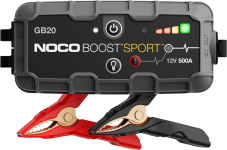
I've never used one for this purpose but what about a small NOCO boost pack? They're made to jump start vehicles but are essentially just a battery bank. The smaller ones have USB output terminals. On the smaller ones the large jump start cables are removable so it would be smaller/more portable while traveling. You'd just leave them in the car.

For car camping I don't see a downside.

For backpacking or real canoe tripping it's probably a bit bigger and heavier.

But, on the plus side, you can use it to jump start your car if the battery goes dead.

I have a small one in a vehicle I leave unattended for months at a time in case the battery is dead when I need it. It had been sitting for 1 1/2 months and still showed a full charge when I checked it last weekend.

Amazon Link

1779392384010.png
 
25,000 mAh, 165 watts

20,000 mAh, 40 watts

10,000 mAh, 22.5 watts
Would be helpful to know, even ballpark, what these numbers actually mean in terms of how many charges a given unit would provide. 2-3? 5-6? 10? Or maybe I'm missing something?
 
Would be helpful to know, even ballpark, what these numbers actually mean in terms of how many charges a given unit would provide. 2-3? 5-6? 10? Or maybe I'm missing something?
It depends on what you are charging. A 50 gallon fuel tank can fill a 1gal moped 50 times, a 5gal motorcycle 10 times, and a 25gal truck 2 times.

Most small electronics have capacity measured in milliAmp-hours, noted as mAh. Divide that capacity into the rated capacity of the power bank to get an estimate. NOTE: many banks can only discharge to 10-20% of their rated capacity. So, a 10,000mAh bank may only be able to actually deliver 8,000mAh.

Watts is a measure of power delivery capability. The higher the watts, the "faster" power can be discharged from the bank. Phones usually need between 3 and 5 watts to charge, laptops may range from 40-150 watts.
 
Last edited:
Battery capacity is further complicated by the fact that actual energy storage is mAh x voltage, which is often not specified.

The Anker Zolo banks listed in the OP use 5v internally, as probably do most phones and tablets.

Some typical phone and tablet batteries:
  • Samsung Galaxy s26 (current flagship) from 4,300 to 5,000 mAh, depending on variant. Previous galaxy variants for the last few years are similar.
  • iPhone 17 is 3,600 mAh
  • Samsung Galaxy Tab A9+ (Mid-range 11" tablet) 7,090 mAh
  • Close equivalent competitors are similar.

Laptops are a whole 'nother beast. They typically use a three-cell stack, working voltage ~12v, and list capacity in Watt Hours.
NOTE: "Watt Hours" are different from the "Watts" that the banks are rated at. "Watts" in this case is a measure of how fast the bank can deliver power.

Your listed banks have nominal 125, 100, and 50 WH capacities, respectively.

  • Typical Chromebooks have about 40-ish WH batteries
  • Lenovo Yoga x13 (13" performance 2-in-1) has 50WH.
  • Heavier "Gaming" laptops with discrete graphics boards have bigger batteries - sometimes 100WH+. They also burn through them faster.
 
Back
Top Bottom