• Happy National Viet Nam War Veterans Day! 🇺🇸 🪖

Seat location Bell Wildfire solo

Joined
Mar 25, 2026
Messages
3
Reaction score
6
Location
Austin, Texas
Hey,
I recently bought a Bell Wildfire in royalex. It came with a kneeling thwart, but I'd like to install a nice contoured seat with webbing (homemade conk).

Can anyone help me locate the correct position for the seat?

Pseudonym, doing a resto-mod on this site, said the correct seat location was 3" aft of center. This is very different from the kneeling thwart in mine making me question the location.

There are three sets of holes in my gunnels set 10" aft of center (measured from ends corresponds with thwarts 27" fore and aft, and with a sharp line scribed on the gunnel. (Image below.). The holes are 2.5 inches on center, making the distance between the furthest 5" which is much less than the typical 8 or 10" on center holes for most seats.

I don't want to start drilling random holes in the gunnels!

Any help would be much appreciated.

John in Austin,TX
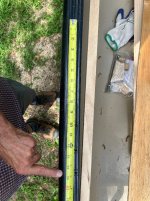
Kneeling thwat holes Wildfire.jpeg
 
Hulls have different shapes, different centers of buoyancy, different centers of lateral resistance, different size and shape paddlers, and hence different "ideal" solo seat locations.

Forget inches. Identify your "ideal" solo seat location via empirical experimentation. That is, sit or kneel in your canoe—whichever you do most of the time—and trim your canoe level or slightly bow light, whichever you consider ideal.

How? Two ways. For both, use a temporary seat such as a milk crate that you can slide fore and aft. Sit on or kneel off it.

1. Have someone else, a spotter, looking at you from the side. Move the temporary seat fore and aft until your spotter says the hull is in level trim or slightly bow light.

2. Pour some water on the bottom and move the temporary seat fore and aft until the water puddles is in the longitudinal center of the canoe—i.e., level trim—or slightly behind the longitudinal center—i.e., slightly bow light trim. You could also use a big bubble level longitudinally centered in the canoe, if you can see the bubble from your seat.

When you are in the trim you consider ideal, mark where the front edge of your movable seat is. Put the front edge of your permanent seat in the same place.

Of course, when you put anything at all in the canoe, gear or a dog or whatever, it will go out of "ideal" trim and you will have to re-trim with your load by feel. This could suggest that there is really no exactly "ideal" place for your solo seat unless you always paddle empty, or unless you determined your solo seat location by an exact and unchanging gear load in the canoe along with your body.
 
Hi Glen,
Thank you for giving me some instruction on the empirical methods. I had been thinking along these lines (a little water in bottom, bubble level, etc. but I was not sure this was the right way to go. Milk crate is a great idea.

FLY, my plan is to attempt to adapt a sliding seat design from Mike's Caper and front seat of late Egret models. In no way can I come close to Mike's woodworking and design skills, but I think can steal his design and make a knockoff.

john
 
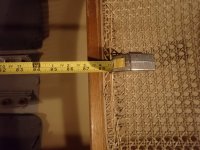
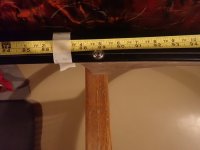
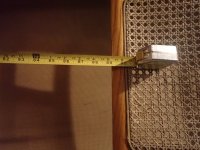
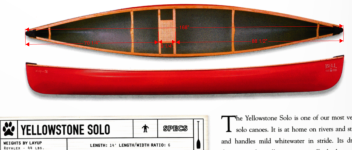
I measured my Yellowstone Solo. Total length from the outside ends of the deck plates is 168" (14'). Center is 84". From the outside edge of the front deck plate to the front edge of the seat is 87", so it is 3" back from the center.

P3282748.JPG

Yes, someday I need to fix the caning on that seat. ;)

Run the tape along the gunnel from the front of the deck plate to the screw holding the seat hanger is just shy of 89".

P3282750.JPG

Probably a little shy because the metal tape doesn't follow the gunnel perfectly.

As a general rule, you want the front plane of your body to be just behind the center of the boat so you will have neutral to slightly stern heavy trim. I have seen recommendations for whitewater pedestals to be 10" to 12" back from the center, but I think that is more the knelling position than the front of the pedestal. In my Outrage, the front of the pedestal is actually in front of the center line, but when I kneel in it, the front of my body is pretty much just behind the center.

With a bench seat, you need to be in trim when you are kneeling (slightly in front of the front edge), and sitting (slightly behind the front edge). 10" back might be OK when you are knelling (like with a kneeling thwart), but I think you would be out of trim sitting. 3" is probably a happy medium. If you are putting a sliding seat in I guess it doesn't matter - you can put it where it needs to be.

Good luck adding the new seat.
 
Last edited:
I think you should try it out first. I've always found 3 inches way to close to centre for me. Those series of holes would make it fairly easy to install some kind of sliding seat. I have used six inches from center up to a foot, my comfort level usually sits at ten inches from centre.
 
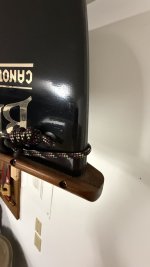
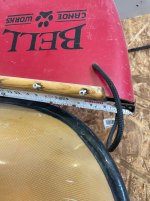
Front edge of seat is 90” straight back from tip of bow woodwork on my Bell Wildfire. Wood protrudes about an inch from the actual hull (pic), so if you don’t have that type of construction, that would make it 89 inches from the actual fiberglass.
IMG_0096.jpeg
 
On my composite Wildfire, the seat is back 89" from the tip of the bow millwork, which protrudes about an inch from the hull. With wood gunnels, the boat is 14' 2" (170"). The center is 85" and my seat is back 4" from the center. Sounds like Stevet's seat is back 5" from the center.

P3282751.JPG

The seat on my Yelowstone Solo is 10". The seat on my composite Wildfire is 9.5". If you got a 10" seat and used the back holes in your picture at 14.5" for the back of the seat, you would drill new holes for the front of the seat at about 4.5" back from center. That doesn't seem too bad - especially if you kneel a lot.
 
Hard to beat real measurements

Well, the only thing "real" about measurements is that's where the factory put the seat. It doesn't mean the factory position is ideal for all paddlers, or all paddling postures (sitting, kneeling off the front edge, kneeling from further back on the seat), or all trim preferences.

Three inches back from the longitudinal center seems rather close to me, as a front edge kneeler, unless the hull's waterline is fishform. As an estimated average, I probably like 5-6 inches back on my several solo canoes, in order to be a bit stern heavy for forward travel. I can pitch my COG forward on my knees to crack the stern to enhance sharp turns.

But, again, since trim will always be altered whenever something in addition to the paddler's body enters the canoe, or when wind direction changes, these exact seat measurements are often unnecessarily anal. I change trim in real time by moving my omnipresent day pack fore and aft while I paddle.
 
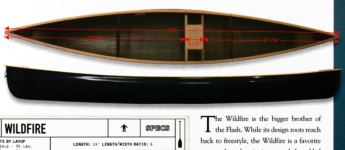
You can also scale the distance from a catalog picture

hey, something i'm qualified for! (note that i scaled the boat length as 168" from tip to tip, so Ecksilon's actual tangible canoe measurements are far more useful)wf.png
 
Last edited:
hey, something i'm qualified for! (note that i scaled the boat length as 168" from tip to tip, so Ecksilon's actual tangible canoe measurements are far more useful)View attachment 153750

Gadabyte, your picture measurements are of a composite Bell Wildfire. The OP, @John B, has a Royalex Bell Wildfire, later renamed the Bell Yellowstone, which is a different-shaped hull than the composite Wildfire. @eckilson measured his Bell Yellowstone. @stevet measured his composite Bell Wildfire. The measurements are different, which is maybe meaningful, maybe not.

No one other than Bell made a Royalex Wildfire/Yellowstone, but five companies have now made composite Wildfires. I'd be surprised if all five companies put the seat in the same place. It's not uncommon for paddlers to be dissatisfied with factory seat longitudinal positions, heights and cants in both solo and tandem canoes.

Empirically self-measuring makes the most sense to me, or a sliding seat, if one subscribes to Platonism.
 
my bad, thanks Glenn. here's one from the same catalog gumpus linked, but for the yellowstone solo. agreed on the self-measuring, even coming from my furniture/cabinetry background - physical reality is always a lot more accurate than a tape measure, and certainly more accurate than scaling an image (even if i do have the right boat this time).ys.png
 
physical reality is always a lot more accurate than a tape measure, and certainly more accurate than scaling an image (even if i do have the right boat this time).

Not necessarily. I wouldn't assume that all Yellowstones that shipped from, or were photographed by, Bell had the seat in identical positions. Your measurement shows the seat further back than @eckilson's 3 inch measurement, but that doesn't mean his seat was placed "properly" by the factory guy. Someone else's Yellowstone seat may be closer to your photometric, as the composite Wildfires seem to be.
 
Well, the only thing "real" about measurements is that's where the factory put the seat. It doesn't mean the factory position is ideal for all paddlers, or all paddling postures (sitting, kneeling off the front edge, kneeling from further back on the seat), or all trim preferences.

Three inches back from the longitudinal center seems rather close to me, as a front edge kneeler, unless the hull's waterline is fishform. As an estimated average, I probably like 5-6 inches back on my several solo canoes, in order to be a bit stern heavy for forward travel. I can pitch my COG forward on my knees to crack the stern to enhance sharp turns.

But, again, since trim will always be altered whenever something in addition to the paddler's body enters the canoe, or when wind direction changes, these exact seat measurements are often unnecessarily anal. I change trim in real time by moving my omnipresent day pack fore and aft while I paddle.
Yes I agree. Mem's comment and yours got me thinking that 3 inches is closer to center than normal based on my experience too. So I measured my Loonworks Aria which is basically a wood/canvas Wildfire and the leading edge of the seat is 4 5 inches behind center just like the one scaled image and more in line with my experience and yours and mem's. I agree that individual needs may vary. I was surprised to see the difference between the scaled images of composite and Royalex Wildfires.
 
My solo seats are generally 5 - 6" from the centre point.

For me positioning is also based on the distance to the front thwart, 99% of the time I am in a fully loaded boat I need enough space to store my large drybag/pack in front of me, enough space for my Pelican case(s) and still be able to get in a kneeling position easily when I come to rapids, my knee cups are right on the centre line.
 
Your measurement shows the seat further back than @eckilson's 3 inch measurement, but that doesn't mean his seat was placed "properly" by the factory guy.
If the seat in my Yellowstone was placed incorrectly at the factory, I have been paddling it in ignorant bliss for 20-years. I had it out just last weekend.

55160691232_54eb0c94fa_o (1).jpg

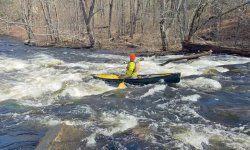
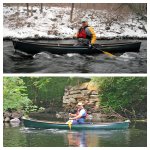
There does seem to be a consensus that seats should be a little further back, so I decided to find some pictures to illustrate Glenn's first method for determining seat placement.
Have someone else, a spotter, looking at you from the side. Move the temporary seat fore and aft until your spotter says the hull is in level trim or slightly bow light.
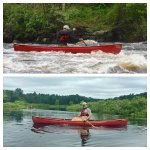
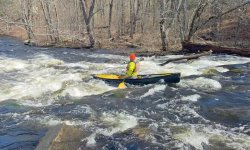
Here are a couple that I found - the boat is pretty much in neutral trim either kneeling or sitting.
YSkneelsit2.jpg
It actually has worked out fine for me. I get why dedicated river paddlers want the boat to be slightly stern heavy, but for me this is a general purpose boat. For anything technical I will kneel, but I probably spend more time sitting than kneeling in this boat. It is fine on the river - surfing and playing in the current or running drops - but I am just as likely to have this boat out on a lake getting blown around in the wind. Push the seat too far back, and you will have a sail out front - especially when you are sitting.

In my composite Wildfire, the seat is another inch back, but it doesn't seem to make much difference in trim.
wildfiresitkneel.jpg
I am a big guy (240 lbs) so the boat is pretty low in the water anyway.
 

Attachments

  • 55160691232_54eb0c94fa_o (1).jpg
    55160691232_54eb0c94fa_o (1).jpg
    177.1 KB · Views: 1
This is a basic method for determining seat location
- locate and mark the boat centre on both sides the gunnels (tape)
- cut a stick/rod so it fits under the gunnels at that point

If you place the stick at this point, the canoe will drop in the rear. The purpose of marking the gunnel on both sides is to help keep the balancing stick location equal on both sides, the tape gives a reference point ... this also means you should check that both sides are equal from centre when you make the final seat location determination.

- move the stick towards the stern a bit and try again, repeat until the boat balances
- mark this point on the gunnels with tape

You have just determined the centre of balance, if not the same it is very close to the centre of buoyancy( CoB). The leading edge of the seat is usually about 6" - 9" back from the CoB. This is because when you sit you lean forward and your weight is actually forward of the seat by some distance.
Personally, I use around 7" and it is usually spot on.

Brian
 
Symmetrical vs asymmetrical probably should be taken into account as well. J. Winter's designs gather width as they progress toward the stern. I always use Cruiser's method for determining carrying thwart placement, and on the Osprey and Raven, the leading edge of the seat was usually a couple of inches behind the balance point.
 
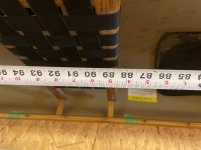
Here’s my wife’s Royalex Yellowstone
88 1/2” to the front of the seat.
 

Attachments

  • IMG_4807.jpeg
    IMG_4807.jpeg
    325.4 KB · Views: 0
  • IMG_4806.jpeg
    IMG_4806.jpeg
    211.7 KB · Views: 0
Back
Top Bottom