• Happy Connecticut Day! 🇺 🇸 🇦 ❺

What Happens to a Lake When Its Dam is Removed

Glenn MacGrady

Administrator
Staff member
Joined
Oct 24, 2012
Messages
6,978
Reaction score
14,509
Location
NW Connecticut
1786213663756.png

It depends.

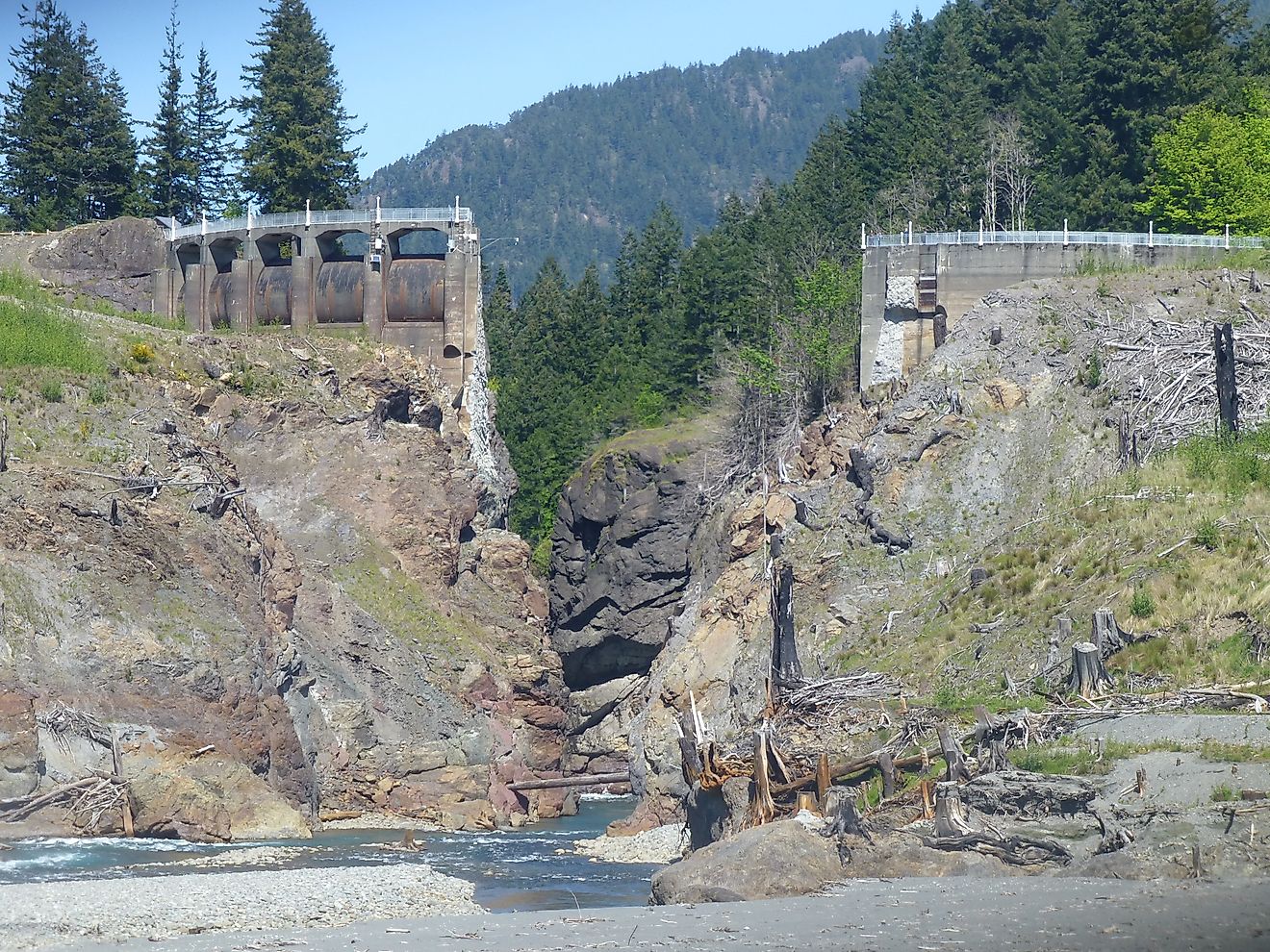
"When engineers pull the plug on a dam, the lake behind it does not just quietly fade away. A reservoir is an artificial, still-water (lentic) system, and removing the barrier that holds it back triggers a rapid shift back into a flowing (lotic) river. Of course the water drains, often in hours rather than weeks, and then the real transformation begins as decades of trapped sediment, submerged tree stumps, and buried riverbed start to reappear. In the United States, more than 2,300 dams have come down since 1912, according to American Rivers . . . . Below, the process is broken down step by step, illustrated with four of the country's largest and most closely studied dam removals."

 
Then there are the legal issues. Who owns the land that was under the former reservoir?

A hydro-electric dam in Ellsworth, Maine, has lost it's generating license. One of several reasons is that the dam kills too many fish. The owners may be required to remove the dam. The shore has some public land, but much more private land. Who owned the land under the reservoir and who inherits that land? A recent article in a local newspaper said the resolution can be "very complex".
 
thanks for posting this. Very relevant for all river runners.
I have made runs on the Klamath River in California 3 times, the second largest river in California. Last trip the put in was right below Iron Gate Dam in 2023.
The effects of multiple dam removals has been dramatic in the last 2 years.
The anadromous fishery has responded quickly. Salmon have already traveled up stream past all of the dams and made their way across the enormous Klamath Lake. Fish are already spawning in the Williamson and Sprague Rivers well up into Oregon. I will be camped on the Williamson River next week.

There were plenty of naysayers that said that this would never work. The large winter discharges in a river this big, have moved tremendous amounts of sediment downstream and out into the Pacific past the river mouth. The river already has more or less normal clarity. Big success story. More to follow. The Elwha River in Washington got the ball rolling some years ago.
 
Last edited:
What I don't understand, because I've never researched the subject, is what happened to the original purposes for which the 2,300 removed dams were originally built.

They weren't built as hobbies. I assume they were built for important (or seemingly important) purposes such as hydropower generation, flood control, capture of drinking water, capture of water for farming and other irrigation, improvement of navigation, and perhaps even recreation.

Did those purposes all disappear for all 2,300 removed dams, or were those purposes superseded by other means or technologies, or were those purposes never necessary in the first place.
 
Did those purposes all disappear for all 2,300 removed dams, or were those purposes superseded by other means or technologies, or were those purposes never necessary in the first place.
Yes. :)

Many of those 2300 dams were smaller dams that had become liabilities for the current owners. Dams have a lifespan and when they get old they become very expensive to maintain and/or they no longer serve their purpose. A dam built for flood control for example, may no longer hold enough water to mitigate storm events and now is a flash flood risk if it breaches. Same is true of dams built for other purposes.
 
Some of the dams (many of?) were put in just as economic stimulus for the area (sort of like the CCC kept some people employed during the depression), but there were many other reasons listed for a project just to help get the thing pushed through so the project would happen.

In the 1970s and '80s my parents lived on a small reservoir in Missouri, the Pomme de Terre Reservoir, the dam of which was on the Pomme de Terre River near the small town of Hermitage, north of Springfield, MO. Dam construction for "the Pomme", as it's locally called, was started in 1957 and finished in 1961, though normal pool for the reservoir wasn't reached until 1963. My father, a ranger at one of the Corps. of Engineer parks there as a summer job between school sessions teaching the rest of the year, told me that among the reasons listed for the Pomme de Terre Dam were power generation capabilities and flood control. Space and fittings were there for electrical turbines, but they were never installed because testing after the dam was operational indicated a design flaw that caused large water releases or even generating full power to inundate some of those same areas the dam was supposed to protect from flooding. One of the farms that would have been affected included the fields of the family of a girl my youngest brother married a little later on.

Then the Harry Truman Reservoir was constructed on the Osage River north of the Pomme de Terre with the dam near the town of Warsaw MO.

Construction was authorized for the Truman Dam in 1954, but not started until 1964 and not completed until 1979 because it took years to procure land, move people, towns, cemeteries, bridges, highways, etc., out of the flood zone. It actually forced the closure of one admittedly lightly used railroad line. Though one of the given reasons for the Truman Dam was flood control, it was constructed just a few miles upstream of high pool on the bigger Lake of the Ozarks downstream (dam completed in 1931, also on the Osage River), and when Truman Lake was filled it flooded the Pomme de Terre River to within just a few miles of the the dam on that river. Hmmmm... evidently a whole river system has to be flooded in order to prevent flooding?

Did you also notice I mentioned that the Truman Dam and reservoir system was authorized in 1954, which was three years before the Pomme de Terre Dam was started? Yup, flood control was a reason for the Pomme Dam even with plans already in motion for flooding most of what's there? Pork barrel politicking at it's finest! At least the Truman Dam does generate electricity as does the dam for the Lake of the Ozarks downstream. I don't know if any cows have been swept away by air conditioners in Kansas City or St. Louis. Maybe sharper pencils were available to those engineers.

As an aside, there's an old probable meteor crater that is indicated by the drainages in the upper end of the Truman Reservoir system. It's just a much smaller version of Recped's Manic 5 Costco chicken gorging trip described in another thread, though the water doesn't go full circle. You can check it out here:
It would be a heck of a portage to complete the circle. Carry a map and compass and a brace of pistols to protect yourself from moonshiners and other angry landowner sorts. Please don't tell 'em I sent yuh.
< Huge Grin >
 
Some streams were dammed up for log driving in the spring.
At least locally, those were splash dams that were broken periodically to wash the logs downstream in the resulting flood. I doubt that the amount of ecological damage that practice inflicted would be tolerated today.

Did those purposes all disappear for all 2,300 removed dams, or were those purposes superseded by other means or technologies, or were those purposes never necessary in the first place.
There have been some dams removed around here because they provided water for the cooling towers of some coal-fired power plants. Now that many of those generating stations have been shut down, the dams are no longer needed.

I also know of one hydroelectric plant where the generating equipment got pretty outdated and the dam was starting to require costly maintenance a bit too frequently. That generating station shut down and the dam was removed because the government was providing cash for solar and wind generation but not for renovations of aged hydro plants.

The power company simply followed the free money into the trendy parts of the industry (and probably got paid to remove the hydro dam as well).
 
What I don't understand, because I've never researched the subject, is what happened to the original purposes for which the 2,300 removed dams were originally built.

I'll bet the answer differs depending on where you are located. I my area (New England), dams were built as early as the 17th century to provide power for sawmills, grist mills, foundries, etc. The dams were small initially, but once they were built the damage was done to the river ecosystem.

The dams got bigger and even more numerous with Samuel Slater's construction of the first successful water powered textile mill in the US on the Blackstone River in 1793. Here is that mill today from below the Pawtucket Falls.


The Blackstone River (my home river) is a great example of what happened next. The lower Blackstone River from Blackstone MA to Pawtucket RI is about 15-miles. At one time there were 15 dams along that 15-mile stretch - each powered a textile mill. Four were removed over the years, but there are still 11 dams today.


These dams are small by western standards - a fall/drop of anywhere from 10 to 35 feet. Two of the larger dams have now been converted to hydro power, but most aren't big enough to justify the cost. They just sit there - holding back tons contaminated sediment from hundreds of years of industrial pollution. According to Google AI there are 300-400 dams within 25-mile radius of my house in Woonsocket, RI.

So what do you do with them? Removal is cost prohibitive. It is a couple of million dollars to remove even a small dam. The sediments behind them are also a huge problem, and there may be historical reasons to keep a dam in place (like at the Slater Mill site). These dams and the mill ponds that they create have also been at the center of many New England communities for hundreds of years.

That is the southern New England story. I know it is very different in other parts of the country - especially out west.
 
Last edited:
In the East, lots of small dams were built along the Fall Line to provide for water power. The Fall Line is the intersection of the Coastal Plain and the Piedmont Plateau. Many cities fall right on the line.

As dams age. they fill in with sediment and lose capacity. They become more expensive to maintain. Often their power generating capability is diminished or lost. Small dams do not provide much flood control.

Large reservoirs like the majority of those in the West were political decisions. They were sold to the public under the guise of flood control, power generation, irrigation and recreation. The classic boondoggle of all time is Glen Canyon Dam at Lake Powell, ,AZ. By now it provides little power, and no irrigation. It is a giant evaporation pond that put the magnificent Glen Canyon under water. Some day this dam will come out but it will be expensive.

Having worked as a hydrologist for many years, I was able to learn the details of a lot of large water projects mostly with the Bureau of Reclamation and the Army Corps of Engineers. The days of dam building in the US are mostly over. Now we are in the business of taking them out. In many hydrologic basins, water is best stored as ground water and pumped to the surface rather than stored in reservoirs. Fish and wildlife species benefit greatly from undisturbed rivers with dams and irrigation diversions. ESA may ultimately be the driver to remove the dams on the Snake and Columbia Rivers.

Dan Beard, retired Director of the US Bureau of Reclamation wrote a very interesting book. "Damnation". He has a Ph D in hydrology from the Univ of Washington. I heard a presentation by Dr Beard recently and he is one of the first former bureaucrats to suggest that most dam construction is for political reasons rather than benefits to the public. Meanwhile hundreds of dams are coming out.
 
Back
Top Bottom