
• Happy Midnight Ride of Paul Revere (1775)! ⛪🕯️🕛🏇🏼

Thin Strip Jig

Joined
Feb 1, 2013
Messages
4,711
Reaction score
8,392
Location
Geraldton, Ontario
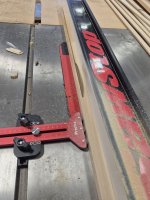
So I saw a video of this thin strip jig, and I had to order one. Fairly cheap on amazon, and seems to be quite good quality. The way it is used is to lock it down beside the blade and measure the 1/4 inch. Then lock that measurement in place, slide the rig back about an inch behind the blade and lock it in. It acts as a fence with rolling wheels. The last wheel locks up if the strip tries to go backward.

Here is where this thing works really well. If you have many boards to cut, and you can manufacure them all to be the same width to begin with. You move the fence each time you want to make a new strip, just by pushing the strip against the jig with the fence. This morning I jointed the edges of three boards, and then ran the other edge through the table saw so they were the same width. Then I set the jig. You push all three boards through before you move the fence for the next cut. It worked remarkably well and produced extremely consistent strips and was much easier to push, rather than having the thin strip between the fence and the saw. On Friday, I'm hoping to do 20 boards, it will take a few minutes to standardize them, but then the cutting will be really fast. Anyone else use one of these?
thin strip jig.jpg
 
The boards don’t need to be the same width to begin with but they do need parallel edges. I’ve used homemade versions and they work well. Never saw one with a locking wheel if it tries to back up, that is a nice feature.
Jim
Jim
 
The boards don’t need to be the same width to begin with but they do need parallel edges
I could be wrong, I usualky am, but if doing multiple boards at the same time without moving the fence for each board, I can't see how they wouldn't have to be the same width . Narrower boards wouldn't contact the blade, and wider boards wouldn't fit between the jig and the fence.
 
I use a different one with a single roller and like it. I like that 3 roller version.

I've used mine a lot and the board Do Not have to be the same width.
 
We have a jig, like yours, at the shop.
Yeah I gave it some thought.
I've used it to cut strips, for Trivets, at the Nokomis Wood Shop. They were less than 2' in length. Works relatively well, but ours slips, a little. You have to monitor strip thickness.
Thicker strips were just reduced on our planer.

How long, and wide, were the planks you ran through the saw Mem ?

Pushing a 16' x 8" plank, back and forth, through a table saw each time, seems to be a lot of work.

I'll stick with the Skilsaw method with wide long planks.

Good to try a new method !

Jim
 
I'm working with 8 foot by 4 inch, so pretty manageable. I do keep my eye on the jig, if one of the boards is slightly wider and you jam it through, the jig could open up a tiny bit. Out of the 20 strips I cut the other day, one was on the heavy side, from when I first started. I'm hoping to run 20 boards through today, we have professional training all day (puke), I'm hoping to disappear from the 96th AI session of the year, and sneak off to the shop to do some real work.
 
Ended up trapped in training h@ll longer than expected, so only got 10 boards cut up. Ran into one problem. The fence in our table saw is persnickety. Once you have set the position, when you lock it down, the fence moves in a fraction. This made it difficult to set the fence perfectly....it was either too tight or too loose, only managed to get it perfect a few times. When it was too tight, as I passed the boards through the thin rip jig, eventually the pressure would cause the jig to move slightly, resulting in slight heavy strips. I kept a close eye on it, and readjusted frequently, but I think I might use my own table saw the next time. The fence stays where it is placed once locked down. Other than that, it was a huge improvement over the old way. It was faster, cleaner and easier, and despite the occasional thick strip, the consistency of the strips was excellent. The reason for this is that I used the jointed edge against the fence for every cut, so there were never any saw induced wobbles that inevitably occur when ripping between the blade and the fence. I might go in this weekend and play around some more, I think I'll need about 140 8 foot strips for the J. Winters Quetico, and I'm about half way there.
 
Yes. I had the same problem with our Saw Stop. I'm not saying it's a fault of the saw. You just have to be aware of it.
The locking nut on the jig needs to be beefer also.

Good to hear you are building another canoe!

Jim
 
Back
Top Bottom