- Joined
- Feb 28, 2025
- Messages
- 32
- Reaction score
- 271
I know it's and oft chased thread and commonly pursued end, but I figured I'd share my experience and process solo-izing the Old Town Penobscot 16. If you care to, take a seat, get comfy, I'm a bit long winded, without further ado here we go.
I don't think I've brought it up here, but one of my true paddling passions is the spring circuit of canoe races in Maine each spring. From the end of March through June, every single weekend you can find one or more canoe races to participate in. While I'm not a hardened athlete I get along pretty well and have spent the last few years dialing in my technique, chasing old boats on marketplace and making friendships along the way. Last year after countless hours of digging I filled out the yard with a few of the boats I had longed for at prices that didn't hurt the wallet too bad. Most covetous of which was a beat up Penobscot 16. I paddled it as much as I could last fall and this spring and finally decided to make a dedicated set of hardware to solo-ize the boat in hopes of eeking out a bit more speed for the races or in the role of a big water solo tripper.
First things first a picture of the standard layout:
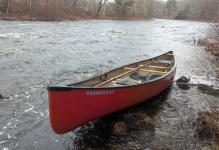
A familiar sight in these parts, somewhere around 35" wide, 16ft long, 13” deep. A recipe for a fairly versatile canoe that can take you far and wide.
After having paddled it from a kneeling thwart and feeling good about it I saw a couple solo Penobscot 16s at the races and considered that the boat could in fact be faster if it were a bit narrower. Reaching the water and performing switches while paddling would be a bit easier. So I set my mind to it.
Here's how it looks after the mods:
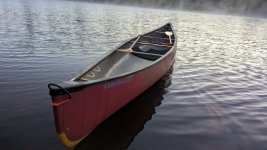
-Pulled the sides into 32" (measured from the outside of the gunwales.)
-Made a few straight thwarts nice and thin (3/8" or so) and some new carry handles from an ash board I had kicking around.
-Outfitted the ends with grab loops (heavy rope)
-Added second airbag loop made of paracord to keep airbag tie in rope from pulling in the grab loop tight while under stress.
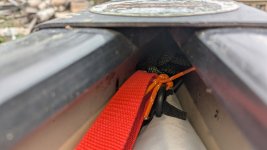
Note: I have orange paracord tied to the end of the airbag to draw and hold it into the end of the bow. It secures to the airbag loop made of paracord which rests below the grab loop at the bow. This makes it so the airbag won't get pushed put if the boat flips and fills with water.
-Lacing loops (vinyl hose and paracord) for the airbag lacing, 1" polyester strapping to hold the airbag into the end of the bow and a D-ring for tying down the air bag and forming a cage.
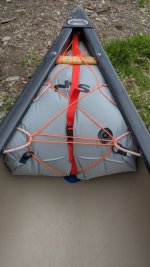
Pictured: A fairly secure float bag. Tied in, tied down and around then strapped in! That should help keep it where I want it.
Oh and of course, dynel and g flex skids painted with tractor paint after nearly 40 years of river beatings wore through the outer layers of plastic and exposed the foam core.
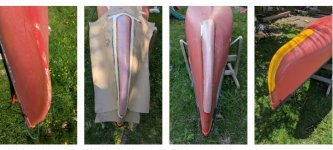
Not the most precise application or repair job but aesthetics are a secondary consideration with this particular boat. It will live on for many more years as a river beater.
And again a look at it after the mods:
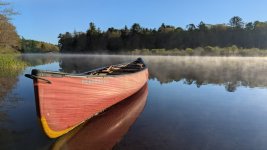
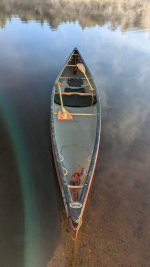
I haven't taken a ruler to it, but there is a healthy amount of space between the leading edge of the seat and the carrying yoke. You can sit far back in a rear quartering wind and avoid getting spun, or heave yourself upto and under the yoke for paddling into a headwind all in all with the large kneeling pad from comfy kayak it's not too shabby.
After getting it whipped into shape I made sure to get up bright and early so I could enjoy the stillness the predawn hours often provide and had an excellent time on the water. The boat is fairly quick in a straight line but still heels and turns playfully enough. During the first hour or so I was dilly dallying and taking in the sights and on the way back to the landing I paddled steadily but not at a race pace and managed to average ~4mph with a peak of almost 6mph. That is pretty darn good for a recreational canoe in any shape I figure.
Here are a few more pics from the outing:
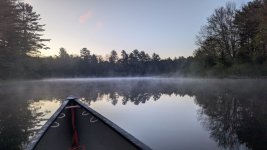
A quiet steamy morning on the Union River in Maine.

Someone's little slice of heaven.

A pair of loons out fishing on this picturesque morning.
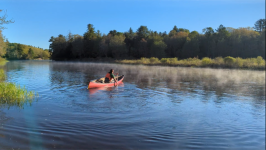
A bit of straight blade fooling about.
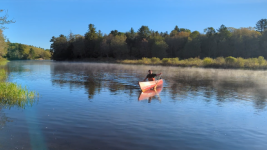
A bit more fooling around, never felt like the boat was gonna toss me out despite throwing it around with all my might.
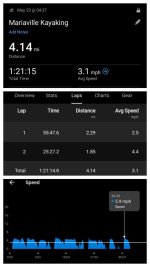
Some paddling stats, I'm not a serious athlete but I'm happy with the progress I've made as a paddler.
While the arrangement is a huge compromise (not as quick or ergonomic as a real solo boat and not as seaworthy or quick turning as the tandem configuration) ultimately I only had to drill one more set of holes in the gunwales and was able to keep the bow seat the same width necessary for use in the tandem setup with a 34" center width.
The boat definitely feels like it has more glide while underway, offside deflection has been reduced a decent amount. I get about 3-4 strokes per side before switching and as a result I feel that it's easier to bring it up to the higher speeds I was pursuing this spring at the races. The lack of permanent hardware such as a bottom mounted tractor seat or foot bars, pegs or rails, minimizes the cost of the modification and keeps the boat versatile. I changed out all the lock nuts for wing nuts so I could change out the seats and reconfigure the boat in a fairly short amount of time without tools. All in all I believe this hull has the potential is a fairly good solo tripper. One say I'll put it to the test on a source to sea trip on the Union River. It is almost the perfect craft for the task.
If you all made it this far, thanks for reading. I hope you enjoyed it.
I don't think I've brought it up here, but one of my true paddling passions is the spring circuit of canoe races in Maine each spring. From the end of March through June, every single weekend you can find one or more canoe races to participate in. While I'm not a hardened athlete I get along pretty well and have spent the last few years dialing in my technique, chasing old boats on marketplace and making friendships along the way. Last year after countless hours of digging I filled out the yard with a few of the boats I had longed for at prices that didn't hurt the wallet too bad. Most covetous of which was a beat up Penobscot 16. I paddled it as much as I could last fall and this spring and finally decided to make a dedicated set of hardware to solo-ize the boat in hopes of eeking out a bit more speed for the races or in the role of a big water solo tripper.
First things first a picture of the standard layout:
A familiar sight in these parts, somewhere around 35" wide, 16ft long, 13” deep. A recipe for a fairly versatile canoe that can take you far and wide.
After having paddled it from a kneeling thwart and feeling good about it I saw a couple solo Penobscot 16s at the races and considered that the boat could in fact be faster if it were a bit narrower. Reaching the water and performing switches while paddling would be a bit easier. So I set my mind to it.
Here's how it looks after the mods:
-Pulled the sides into 32" (measured from the outside of the gunwales.)
-Made a few straight thwarts nice and thin (3/8" or so) and some new carry handles from an ash board I had kicking around.
-Outfitted the ends with grab loops (heavy rope)
-Added second airbag loop made of paracord to keep airbag tie in rope from pulling in the grab loop tight while under stress.
Note: I have orange paracord tied to the end of the airbag to draw and hold it into the end of the bow. It secures to the airbag loop made of paracord which rests below the grab loop at the bow. This makes it so the airbag won't get pushed put if the boat flips and fills with water.
-Lacing loops (vinyl hose and paracord) for the airbag lacing, 1" polyester strapping to hold the airbag into the end of the bow and a D-ring for tying down the air bag and forming a cage.
Pictured: A fairly secure float bag. Tied in, tied down and around then strapped in! That should help keep it where I want it.
Oh and of course, dynel and g flex skids painted with tractor paint after nearly 40 years of river beatings wore through the outer layers of plastic and exposed the foam core.
Not the most precise application or repair job but aesthetics are a secondary consideration with this particular boat. It will live on for many more years as a river beater.
And again a look at it after the mods:
I haven't taken a ruler to it, but there is a healthy amount of space between the leading edge of the seat and the carrying yoke. You can sit far back in a rear quartering wind and avoid getting spun, or heave yourself upto and under the yoke for paddling into a headwind all in all with the large kneeling pad from comfy kayak it's not too shabby.
After getting it whipped into shape I made sure to get up bright and early so I could enjoy the stillness the predawn hours often provide and had an excellent time on the water. The boat is fairly quick in a straight line but still heels and turns playfully enough. During the first hour or so I was dilly dallying and taking in the sights and on the way back to the landing I paddled steadily but not at a race pace and managed to average ~4mph with a peak of almost 6mph. That is pretty darn good for a recreational canoe in any shape I figure.
Here are a few more pics from the outing:
A quiet steamy morning on the Union River in Maine.
Someone's little slice of heaven.
A pair of loons out fishing on this picturesque morning.
A bit of straight blade fooling about.
A bit more fooling around, never felt like the boat was gonna toss me out despite throwing it around with all my might.
Some paddling stats, I'm not a serious athlete but I'm happy with the progress I've made as a paddler.
While the arrangement is a huge compromise (not as quick or ergonomic as a real solo boat and not as seaworthy or quick turning as the tandem configuration) ultimately I only had to drill one more set of holes in the gunwales and was able to keep the bow seat the same width necessary for use in the tandem setup with a 34" center width.
The boat definitely feels like it has more glide while underway, offside deflection has been reduced a decent amount. I get about 3-4 strokes per side before switching and as a result I feel that it's easier to bring it up to the higher speeds I was pursuing this spring at the races. The lack of permanent hardware such as a bottom mounted tractor seat or foot bars, pegs or rails, minimizes the cost of the modification and keeps the boat versatile. I changed out all the lock nuts for wing nuts so I could change out the seats and reconfigure the boat in a fairly short amount of time without tools. All in all I believe this hull has the potential is a fairly good solo tripper. One say I'll put it to the test on a source to sea trip on the Union River. It is almost the perfect craft for the task.
If you all made it this far, thanks for reading. I hope you enjoyed it.