• The 2026-29 Fund Drive needs 15 MORE DONATIONS to reach target. Read the Featured Thread for details. Please donate!!!

Post your training paddles

Hopefully I don't get out in March completely fubar'd...

I'm sure you'll be fine come spring. Even if your technique suffered I've found that with most things it doesn't take much conscious effort to fix a new muscle pattern into your brain. After a couple outings I'm sure you will have adjusted well to the canoe stroke. And all the fitness you'll be gaining on the erg will more than makeup for any loss of technique (which can easily be re-learned).

Alan
 
As I believe I have stated before, I very much like my paddlesports canoe paddle attachment on a Concept 2 erg machine. Before I found that machine at the Syracuse canoe nationals, I had a Waterrower machine that I used as a paddler rather than a straight pull grip. I got it in the fall to train on during the winter before my first Yukon River race the following June. The experienced Yukon voyageur canoe team I joined recommended everyone train the equivalent of 500 miles before the race, with a combination of on water and/or machine use before the race, even through solid water winter time. Which I did until ice-out and we were able to train near home on the water together.

As designated team navigator (and bow paddler), I developed a Google Earth based best guess at an efficient GPS race route around bends and the hundreds of islands and gravel shoals. With Post-race route experience, I modified and improved the route before the next Yukon race we traveled to. G.E allows you to "fly" the route you create at any altitude you set. I would train on my Waterrower in front of a wide screen TV monitor as I "flew" my route at a couple of hundred feed up as I listened to my favorite and appropriate "Epic" genre music. With hours and hours of that, I largely memorized the entire route, especially in the critical complex areas. It all surprisingly came to mind during the actual race.

Unfortunately, after a couple of years, the water tank developed a leak that I was unable to completely repair. My wife did not appreciate a wet floor. Then I found the paddlesports machine, which with a full-size paddle grip and shaft, is better suited to simulate actually using a real canoe paddle.

I liked the Waterrower because the catch felt the most realistic of any of the kinds of available machines that I found to try out at the time (in 2007). And there was the real sound of paddling through real water. With either machine, I don't often go through the full erg training menu routine. Most times I just use it for maintaining pace (normally at 60+spm), muscle tone and muscle memory of a vertical paddle stroke and where I apply the most force and power (first 18 inches after the "catch"). I do not bring paddle beyond my hip in any case. At paddle "exit", I flip the grip horizontal to simulate feathering the blade into the wind. I can experiment to some extent with where I pace the catch, along with how I bend and use back and torso to see how it affects my comfort and efficiency on the machine. Overall, that muscle training works well for normal strength paddling, whether I am training in that mode for paddling a big boat, or solo. I'll take that with its limitations as an overall positive.

However, as a primary bow paddler when other than solo, setting a constant team comfortable cadence for the race and water conditions is important to me. Having forward vision on the water, surface and subsurface, I also provide minor direction control with forward moving draws, occasionally a bow rudder, or major hard turning draws when necessary for current or navigation. My strong stern paddler knows how to follow when He or she sees me initiating making other than straight power strokes. A paddling machine lacks that ability to simulate those strokes other than the straight power stroke. Especially when I paddle solo, I use heeling to enhance correction to straight line travel or to make significant turn action. In may canoe, I can adjust my seat position, or tripping gear for different conditions, "Paddling" on a machine does not respond to any of that.

 
I guess I could always just set it way heavy and enjoy a pleasant surprise next spring.
That was the theory of one (horse) endurance racer I knew. She was a tiny thing and rode the horse in competition with a postage stamp of a saddle but the horse did its training runs with her husband (who was about your size, maybe heavier) and a full western saddle. They claimed the horse flew in competition and probably didn't even know she was up there.
 
As I believe I have stated before, I very much like my paddlesports canoe paddle attachment on a Concept 2 erg machine. Before I found that machine at the Syracuse canoe nationals, I had a Waterrower machine that I used as a paddler rather than a straight pull grip. I got it in the fall to train on during the winter before my first Yukon River race the following June. The experienced Yukon voyageur canoe team I joined recommended everyone train the equivalent of 500 miles before the race, with a combination of on water and/or machine use before the race, even through solid water winter time. Which I did until ice-out and we were able to train near home on the water together.

As designated team navigator (and bow paddler), I developed a Google Earth based best guess at an efficient GPS race route around bends and the hundreds of islands and gravel shoals. With Post-race route experience, I modified and improved the route before the next Yukon race we traveled to. G.E allows you to "fly" the route you create at any altitude you set. I would train on my Waterrower in front of a wide screen TV monitor as I "flew" my route at a couple of hundred feed up as I listened to my favorite and appropriate "Epic" genre music. With hours and hours of that, I largely memorized the entire route, especially in the critical complex areas. It all surprisingly came to mind during the actual race.

Unfortunately, after a couple of years, the water tank developed a leak that I was unable to completely repair. My wife did not appreciate a wet floor. Then I found the paddlesports machine, which with a full-size paddle grip and shaft, is better suited to simulate actually using a real canoe paddle.

I liked the Waterrower because the catch felt the most realistic of any of the kinds of available machines that I found to try out at the time (in 2007). And there was the real sound of paddling through real water. With either machine, I don't often go through the full erg training menu routine. Most times I just use it for maintaining pace (normally at 60+spm), muscle tone and muscle memory of a vertical paddle stroke and where I apply the most force and power (first 18 inches after the "catch"). I do not bring paddle beyond my hip in any case. At paddle "exit", I flip the grip horizontal to simulate feathering the blade into the wind. I can experiment to some extent with where I pace the catch, along with how I bend and use back and torso to see how it affects my comfort and efficiency on the machine. Overall, that muscle training works well for normal strength paddling, whether I am training in that mode for paddling a big boat, or solo. I'll take that with its limitations as an overall positive.

However, as a primary bow paddler when other than solo, setting a constant team comfortable cadence for the race and water conditions is important to me. Having forward vision on the water, surface and subsurface, I also provide minor direction control with forward moving draws, occasionally a bow rudder, or major hard turning draws when necessary for current or navigation. My strong stern paddler knows how to follow when He or she sees me initiating making other than straight power strokes. A paddling machine lacks that ability to simulate those strokes other than the straight power stroke. Especially when I paddle solo, I use heeling to enhance correction to straight line travel or to make significant turn action. In may canoe, I can adjust my seat position, or tripping gear for different conditions, "Paddling" on a machine does not respond to any of that.
You are definitely the most experienced erg user in my sphere of influence, and I REALLY appreciate your willingness to share that knowledge.

Have you found a particular damper setting that best replicates your solo paddle catch?
 
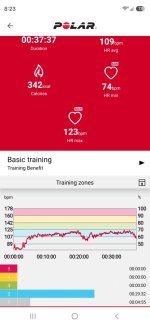
Did 35 minutes of intervals today. Five minutes on, one minute off. Damper setting 4, which was exponentially tougher than 1. I actually started out with the plan to do 30 minutes of 50spm at ds 4, but after 10 minutes, I knew it wasn't going to fit with my training intensity plan. So I switched to intervals with the same settings, which kept my form in good shape and my heart rate in check.

Well, I assume my hr was in check. It felt good, but my in-laws are in town and occupying our bedroom so my monitor and stuff didn't get used this morning. Really just went off of feel, which can be a mediocrity trap but felt nice today. Onward!
 
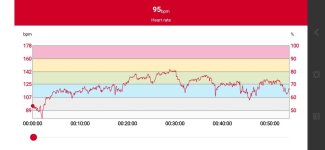
Felt REALLY good today. Didn't push things, just a chill workout, focusing on my "catch" position and stroke initiation. Half hour, 50spm, damper 4 1/2.

12182.jpg

12188.jpg
 
Glad to see you're keeping at it. I was hoping to contribute more to the thread but some combination of cold, dark, or wind seems to conspire to keep me off the water. Been keeping up pretty well with running and cycling though.

Alan
 
Glad to see you're keeping at it. I was hoping to contribute more to the thread but some combination of cold, dark, or wind seems to conspire to keep me off the water. Been keeping up pretty well with running and cycling though.

Alan
Yessir, gotta justify the dollars to the wife 😁

In seriousness, it's definitely not a prime time of year to be tracking canoe training, but i think the erg has been a good investment. It's deer season here in indiana , so hunting is a priority right now. But we are supposed to have at least one really warm day this week, which will be bad for hunting. And probably my last opportunity to get out on the water to get some real boat comparison to the erg.

And you are contributing significantly, even if it's through peer pressure... 😅
 
Last edited:
Still testing my theories about higher power vs. higher cadence.

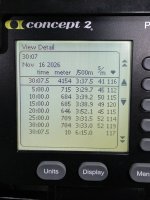
Today, I did 20ish minutes of 50ish strokes per minute at 4ish damper. This was my 5 minute warmup plus the first of four planned 15-minute setting trials. For trial 2, I planned to do 60spm on damper 4, but quickly realized that was going to lead to premature fatigue. So I switched to 5-minute trials, which are less significant statistically, but what I knew I could get through without excessive heart rate creep or fatigue-induced stroke changes.

SO,

Trial 1: 60spm, damper 4.
Result: 48 avg watts, 773 meters, avg hr 141bpm

Trial 2: 60spm, damper 1.
Result: 34 avg watts, 688 meters, avg hr 134bpm

Trial 3: 50spm, damper 1.
Result: 29 avg watts, 654 meters, avg hr 124bpm

Trial 4: 50spm, damper 4
Result: 39 avg watts, 724 meters, avg hr 128bpm


What does this mean? Especially on a paddle erg that may or may not translate to real water numbers?

Beats me, but subjectively, I think 50spm at damper 4 is the sweet spot right now. I'm going to train at these markers for a bit and then run another test. Obviously, the best outcome would be high cadence, high watts, for a long time. Where all of those plot lines intersect for my physiology is what I am seeking.

Screenshot.jpg
 
If I recall from your earlier trainings each time you up the cadence you also up the power output, heart rate, and meters covered. From the way you describe the catch on the trainer it sounds like it's difficult or impossible to increase the cadence without doing so. I think this is perhaps the biggest difference when comparing the trainer and actually paddling a canoe.

In a canoe it's fairly easy to modulate the power output and cadence independently. Even though power and cadence often follow suit I can still paddle at a high cadence with high power or I can paddle at a high cadence at low power. Or I can paddle a low cadence at lower power or a low cadence at high power. Heart rate and speed will follow power output rather than cadence.

I would be interested to see if you could up your stroke rate to 60 but maintain the same power output you have at 50 and then see where your heart rate falls. Or maybe that's not possible on the trainer.

I like to do the majority of my training in the 128-138 heart rate zone so your pace of 50 spm at damper 4 sounds pretty good to me. I wouldn't have a problem training there and then adjusting once I hit open water. I'd view the trainer as a way of building my endurance rather than teaching me how to paddle, which I think has been your approach as well.

Alan
 
I would be interested to see if you could up your stroke rate to 60 but maintain the same power output you have at 50 and then see where your heart rate falls. Or maybe that's not possible on the trainer.
Trial 2 and Trial 4 are the closest I came to having similar power output at different stroke rates. The 60spm resulted in slightly LESS power, but slightly HIGHER heart rate than 50spm. Also less distance, but that number might be meaningless since the damper setting changes the drag factor. I bet if I dropped the damper down to 3-ish, the 50spm power would line up with the 60spm at damper 1, and the 50spm heart rate would drop even further. Which reinforces the notion that my current physiology supports a slower stroke rate with higher applied force per stroke. How that relates to the real-world metric of distance-per-stroke remains unquantified.

All in all, this erg has already taught me a LOT about my physiology and fitness in a relatively short period of time.
 
Back
Top Bottom