
• Happy Birthday, Henry Hudson (1575-1611)! 🍎🏞⛵

Paddles, solo position in a short tandem

Joined
Aug 4, 2026
Messages
28
Reaction score
84
Location
Ea. Washington
Wenonah 14’ Fisherman in Kevlar used, trying to dial it in for my most common use.
Bought this for dog and I, fly fishing our local lakes under 150 acres instead of the Outcast raft.
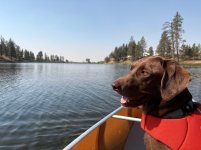
Experimented with it this morning, solo in bow seat position as typical. Dog sat in opening directly behind “new bow” seat (shes 65 lbs), about 40 lbs. water weight opposite end from me. Very stable setup though she doesn’t move much.
So the canoe came with bent shaft paddles, shortest one still 2” longer than my recommended. Due to the width of boat at that position, I noticed the bent shaft blade often angled down, stroke wasn’t strong, had to feather the blade basically every stroke to stay on track. (Yes, I know such a short canoe sucks at tracking anyway)i wondered if a kayak paddle would have been more efficient in this position? Thoughts?
Then went to shore, transferred water weight to the normal bow position, dog behind the bow seat area, I paddled from normal stern seat with the bent shaft. Stroke efficiency increased, easier to stay on course, relative to a fat short canoe. Less stability with my weight now being at true stern, thought of increasing water ballast to say 65 lbs?
So my questions, straight paddle be better, either position? Or still have issues using bow seat due to width?
Kayak paddle?
Increase water weight?
General comments?IMG_4355.jpeg
 
I've never paddled a 14' tandem from the stern seat, but I paddle all my tandems from that seat. No ballast needed, but I put in about 25 lbs. for a little more stability. If it works for you, stick with it. Only add more weight if you need more stability. You hit the nail on the head regarding increased stroke efficiency and less yaw. (staying on course)

I use straight shaft paddles but a bent should give the same results.
 
I've never paddled a 14' tandem from the stern seat, but I paddle all my tandems from that seat. No ballast needed, but I put in about 25 lbs. for a little more stability. If it works for you, stick with it. Only add more weight if you need more stability. You hit the nail on the head regarding increased stroke efficiency and less yaw. (staying on course)

I use straight shaft paddles but a bent should give the same results.
I did figure out I have a 250 cm kayak paddle, might take it along.
This is first bent shaft paddle Ive used, wasn’t very partial to it, used to doing a J stroke without thinking about it.
 
It's been a while since I had the Fisherman, but I think I can still comment.

Because it's so short and wide, I don't think you can get a good vertical forward stroke with a bent shaft as you will need to avoid yaw - and especially from either seat. When I paddled the Fisherman solo, I found that it was best to kneel in a chine behind the yoke and let the boat heel some. That narrows the waterline and allows an easier reach for a vertical paddle closer to the virtual centerline of the canoe. Another option that works but not as well is to paddle from whichever seat with the narrowest straight blade you can find. I like a modified ottertail.

I found the Fisherman to be most manageable when paddling from behind the yoke, kneeling in the chine, with my modified ottertail. That way I could keep the top of the blade close to the boat but parallel to the keel line, while the tip of the long narrow blade angled closer to the virtual center, even under the boat.

Heeled that way, of course the waterline is shorter and the Fisherman is even more sensitive to yawing forces. But it's also more sensitive to correction, thus requires less. Admittedly, that also reduces your theoretical hull speed, but it takes less effort to move the canoe at a reasonable speed.
 
It's been a while since I had the Fisherman, but I think I can still comment.

Because it's so short and wide, I don't think you can get a good vertical forward stroke with a bent shaft as you will need to avoid yaw - and especially from either seat. When I paddled the Fisherman solo, I found that it was best to kneel in a chine behind the yoke and let the boat heel some. That narrows the waterline and allows an easier reach for a vertical paddle closer to the virtual centerline of the canoe. Another option that works but not as well is to paddle from whichever seat with the narrowest straight blade you can find. I like a modified ottertail.

I found the Fisherman to be most manageable when paddling from behind the yoke, kneeling in the chine, with my modified ottertail. That way I could keep the top of the blade close to the boat but parallel to the keel line, while the tip of the long narrow blade angled closer to the virtual center, even under the boat.

Heeled that way, of course the waterline is shorter and the Fisherman is even more sensitive to yawing forces. But it's also more sensitive to correction, thus requires less. Admittedly, that also reduces your theoretical hull speed, but it takes less effort to move the canoe at a reasonable speed.
That could be, the blade width. One I was using was 8” wide, it seemed to be to wide for the beam, making me either lean the paddle more, or I leaned outward more.
 
This morning I realized, even though I mentioned it, the width.
I read multiple threads here, websites of paddle length.
Stern seat, centerline to gunnel is 11.5”.
Using bow seat, centerline to gunnel is 16”.
I don’t need to shorten the paddle when seated in bow seat, but lengthen the shaft to account for increased width of hull.
Pity that didn’t come to mind yesterday, I had a spare with me 2” longer.
 
Last edited:
Fourbtgait, I had a bit of difficulty understanding your difficulty until I looked at the specs and plan view of the Wenonah 14 Fisherman, with which I was not familiar. To emphatically emphasize stability, the canoe is very wide—37" at the midship gunwales and 39" max width just below the midship gunwales.

1789177019486.png

This is a platform canoe, which I suppose is what many fisherman want. (I'm not a fisherman.) However, its dimensions make it a difficult canoe to efficiently paddle from any position.

A solo paddle should be drawn back parallel to the keel line. That will minimize yaw. And yaw will further be minimized the closer your parallel canoe stroke is to the keel line.

Draw a mental keel line down the middle of that plan view. If you are paddling from the bow seat backwards, you are likely to hit the widest part of the canoe if you try to begin your stroke at a point fairly close to the keel line. So, you have to plant it fairly far away from the keel line. Then, because of the extreme curvature of the pudgy geometry, if you try to keep your stroke parallel to the keel line, you will have to keep pulling the paddle further and further away from the gunwale. A short person might fall out of the boat having to reach so far abeam.

So, what would a typical paddler do instead of pulling parallel to the keel? He would most likely pull the paddle back sort of parallel to the sharply curving gunwale line. But what kind of stroke is that from the bow seat backwards? It's a sweep stroke! The stroke that creates the most yaw and requires the most correction. And, as to paddles, a bent shaft provides less J correction force than does a straight paddle.

To paddle that shape canoe efficiently I would definitely sit on something right behind the portage yoke, heel the canoe a lot, and paddle it Canadian style. As @Steve in Idaho has already pointed out, this will get the forward stroke closer to and more parallel with the keel line, as well as more vertical, resulting in much less yaw and needed correction.

BUT . . .

I'm not a fisherman and don't have dogs in my canoes. You are and do, so you probably want to paddle on an even keel, unheeled.

Where would that leave me if I fished with dogs?

At the risk of causing @lowangle al to faint, I'd probably prefer to paddle from the real stern seat with bow ballast. From the stern, you can get a forward stroke both much closer to and more parallel with the keel line without gymnastic reaches or torso contortions. This will likely result in less yaw and less necessary correction.

Since the canoe is naturally a poor tracker and would always require some correction, I'd probably prefer a straight paddle than a bent paddle in the stern because it's a more powerful rudder and can be palm rolled. Palm rolling, among many other virtues, allows the Indian stroke, which in my non-fisherman imagination I would use to silently sneak up on plesiosaurs.

I haven't used a double blade in a canoe since a brief and unconsummated fling 45 years ago, so I won't comment on them.
 
Fourbtgait, I had a bit of difficulty understanding your difficulty until I looked at the specs and plan view of the Wenonah 14 Fisherman, with which I was not familiar. To emphatically emphasize stability, the canoe is very wide—37" at the midship gunwales and 39" max width just below the midship gunwales.

View attachment 157297

This is a platform canoe, which I suppose is what many fisherman want. (I'm not a fisherman.) However, its dimensions make it a difficult canoe to efficiently paddle from any position.

A solo paddle should be drawn back parallel to the keel line. That will minimize yaw. And yaw will further be minimized the closer your parallel canoe stroke is to the keel line.

Draw a mental keel line down the middle of that plan view. If you are paddling from the bow seat backwards, you are likely to hit the widest part of the canoe if you try to begin your stroke at a point fairly close to the keel line. So, you have to plant it fairly far away from the keel line. Then, because of the extreme curvature of the pudgy geometry, if you try to keep your stroke parallel to the keel line, you will have to keep pulling the paddle further and further away from the gunwale. A short person might fall out of the boat having to reach so far abeam.

So, what would a typical paddler do instead of pulling parallel to the keel? He would most likely pull the paddle back sort of parallel to the sharply curving gunwale line. But what kind of stroke is that from the bow seat backwards? It's a sweep stroke! The stroke that creates the most yaw and requires the most correction. And, as to paddles, a bent shaft provides less J correction force than does a straight paddle.

To paddle that shape canoe efficiently I would definitely sit on something right behind the portage yoke, heel the canoe a lot, and paddle it Canadian style. As @Steve in Idaho has already pointed out, this will get the forward stroke closer to and more parallel with the keel line, as well as more vertical, resulting in much less yaw and needed correction.

BUT . . .

I'm not a fisherman and don't have dogs in my canoes. You are and do, so you probably want to paddle on an even keel, unheeled.

Where would that leave me if I fished with dogs?

At the risk of causing @lowangle al to faint, I'd probably prefer to paddle from the real stern seat with bow ballast. From the stern, you can get a forward stroke both much closer to and more parallel with the keel line without gymnastic reaches or torso contortions. This will likely result in less yaw and less necessary correction.

Since the canoe is naturally a poor tracker and would always require some correction, I'd probably prefer a straight paddle than a bent paddle in the stern because it's a more powerful rudder and can be palm rolled. Palm rolling, among many other virtues, allows the Indian stroke, which in my non-fisherman imagination I would use to silently sneak up on plesiosaurs.

I haven't used a double blade in a canoe since a brief and unconsummated fling 45 years ago, so I won't comment on them.
Thank you. I did go with a straight paddle, as you say, the width is detrimental to pure stroke. Even detrimental keeping the paddle vertical the whole stroke.I realized today also how much lower the bow seat is vs. stern seat. Luckily I am not looking for speed nor distance and since this is the widest canoe Ive paddled, it threw me. Bow seat facing forward solo gives the stability for flyfishing and the dog.
I had the wife and dog out last weekend paddling tandem and control from stern was normal stroke with a straight blade.
Almost forgot. A double blade easily maneuvers it, keeping it on course. Though the longest I have could easily be a foot longer.
 
Last edited:
Back
Top Bottom