
• Happy Banana Split Day! 🍌🍨🥄

Paddles, solo position in a short tandem

Joined
Aug 4, 2026
Messages
20
Reaction score
32
Location
Ea. Washington
Wenonah 14’ Fisherman in Kevlar used, trying to dial it in for my most common use.
Bought this for dog and I, fly fishing our local lakes under 150 acres instead of the Outcast raft.
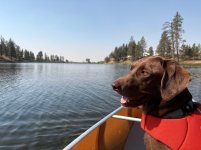
Experimented with it this morning, solo in bow seat position as typical. Dog sat in opening directly behind “new bow” seat (shes 65 lbs), about 40 lbs. water weight opposite end from me. Very stable setup though she doesn’t move much.
So the canoe came with bent shaft paddles, shortest one still 2” longer than my recommended. Due to the width of boat at that position, I noticed the bent shaft blade often angled down, stroke wasn’t strong, had to feather the blade basically every stroke to stay on track. (Yes, I know such a short canoe sucks at tracking anyway)i wondered if a kayak paddle would have been more efficient in this position? Thoughts?
Then went to shore, transferred water weight to the normal bow position, dog behind the bow seat area, I paddled from normal stern seat with the bent shaft. Stroke efficiency increased, easier to stay on course, relative to a fat short canoe. Less stability with my weight now being at true stern, thought of increasing water ballast to say 65 lbs?
So my questions, straight paddle be better, either position? Or still have issues using bow seat due to width?
Kayak paddle?
Increase water weight?
General comments?IMG_4355.jpeg
 
I've never paddled a 14' tandem from the stern seat, but I paddle all my tandems from that seat. No ballast needed, but I put in about 25 lbs. for a little more stability. If it works for you, stick with it. Only add more weight if you need more stability. You hit the nail on the head regarding increased stroke efficiency and less yaw. (staying on course)

I use straight shaft paddles but a bent should give the same results.
 
I've never paddled a 14' tandem from the stern seat, but I paddle all my tandems from that seat. No ballast needed, but I put in about 25 lbs. for a little more stability. If it works for you, stick with it. Only add more weight if you need more stability. You hit the nail on the head regarding increased stroke efficiency and less yaw. (staying on course)

I use straight shaft paddles but a bent should give the same results.
I did figure out I have a 250 cm kayak paddle, might take it along.
This is first bent shaft paddle Ive used, wasn’t very partial to it, used to doing a J stroke without thinking about it.
 
It's been a while since I had the Fisherman, but I think I can still comment.

Because it's so short and wide, I don't think you can get a good vertical forward stroke with a bent shaft as you will need to avoid yaw - and especially from either seat. When I paddled the Fisherman solo, I found that it was best to kneel in a chine behind the yoke and let the boat heel some. That narrows the waterline and allows an easier reach for a vertical paddle closer to the virtual centerline of the canoe. Another option that works but not as well is to paddle from whichever seat with the narrowest straight blade you can find. I like a modified ottertail.

I found the Fisherman to be most manageable when paddling from behind the yoke, kneeling in the chine, with my modified ottertail. That way I could keep the top of the blade close to the boat but parallel to the keel line, while the tip of the long narrow blade angled closer to the virtual center, even under the boat.

Heeled that way, of course the waterline is shorter and the Fisherman is even more sensitive to yawing forces. But it's also more sensitive to correction, thus requires less. Admittedly, that also reduces your theoretical hull speed, but it takes less effort to move the canoe at a reasonable speed.
 
It's been a while since I had the Fisherman, but I think I can still comment.

Because it's so short and wide, I don't think you can get a good vertical forward stroke with a bent shaft as you will need to avoid yaw - and especially from either seat. When I paddled the Fisherman solo, I found that it was best to kneel in a chine behind the yoke and let the boat heel some. That narrows the waterline and allows an easier reach for a vertical paddle closer to the virtual centerline of the canoe. Another option that works but not as well is to paddle from whichever seat with the narrowest straight blade you can find. I like a modified ottertail.

I found the Fisherman to be most manageable when paddling from behind the yoke, kneeling in the chine, with my modified ottertail. That way I could keep the top of the blade close to the boat but parallel to the keel line, while the tip of the long narrow blade angled closer to the virtual center, even under the boat.

Heeled that way, of course the waterline is shorter and the Fisherman is even more sensitive to yawing forces. But it's also more sensitive to correction, thus requires less. Admittedly, that also reduces your theoretical hull speed, but it takes less effort to move the canoe at a reasonable speed.
That could be, the blade width. One I was using was 8” wide, it seemed to be to wide for the beam, making me either lean the paddle more, or I leaned outward more.
 
Back
Top Bottom