I have 8 headlamps hanging by the front door ( I just walked over and counted them) and one hanging on the mirror in my truck. I use them often around the house for fixit tasks and walking the dog before sunrise/after sunset. My favorite is a Black Diamond that I picked up at a Sierra Trading Post for around $20 or $30 a few years ago. It’s a rechargeable that I’ve been using for 3 or 4 years at least. I use it every evening walking the dog, around the house for chores and ‘fixit’ jobs and most enjoyably around camp. I always thought the rechargeable headlamps were a bit gimmicky-turns out I was wrong. This one has the option of using AAA batteries if the rechargeable battery is discharged. I’m not certain how many dollars I’ve saved over the years, but the number of Lithium ion batteries not used has more than paid for the headlamp. If the rechargeable battery does go “toes up” on a trip, I can always pull out the rechargeable battery and insert 3 AAA.

-
Happy National Sober Day! 🚫🍸🍺🍷🛑
You are using an out of date browser. It may not display this or other websites correctly.
You should upgrade or use an alternative browser.
You should upgrade or use an alternative browser.
Headlamps. Do you guys use 'em?
- Thread starter Patrick Corry
- Start date

- Joined
- Nov 30, 2017
- Messages
- 1,283
- Reaction score
- 4,404
I have a Nitecore headlamp a half dozen years ago. It is rechargeable, which I like because the point for me was to be light weight. It only weighs about an ounce. I just looked at the Nitecore website and they don't seem to make this anymore, which is good. The brightest setting is just barely useful outside on a really dark night. Newer ones appear to have much more light.
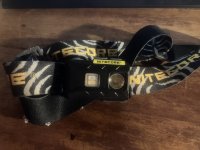
I also carry a Luci Light and a small backup battery flashlight.
This assortment works well. I'm not up much after sundown anyway.
I also carry a Luci Light and a small backup battery flashlight.
This assortment works well. I'm not up much after sundown anyway.
The original posting in this thread came at just the right time for me - thanks! Last weekend I was canoe camping and my primary headlamp, an older Black Diamond Spot, was slipping too much even after tightening the band. I decided that when I got home I'd need to make a point of finding some new elastic. I didn't even think about finding complete replacement headbands available and then the first thing I see when checking CT is a headband source - exactly what I need!
Speaking of headlamps, a lesson learned this weekend is that I need to check spare batteries and not just assume they are good because they came out of a package advertising a 10 year shelf life. Turned out that at least one of my spare AAA batteries was dead. After changing batteries my headlamp didn't turn on. I thought the lamp was broken until I got home and checked the battery voltage.
Speaking of headlamps, a lesson learned this weekend is that I need to check spare batteries and not just assume they are good because they came out of a package advertising a 10 year shelf life. Turned out that at least one of my spare AAA batteries was dead. After changing batteries my headlamp didn't turn on. I thought the lamp was broken until I got home and checked the battery voltage.
Those cheap Ray-o-Vac headlamps work fine for around camp to fix a meal or dig for something in a gear bag but are nearly useless for picking a route through a field of snags on a dark night. I'd bought one and tossed it in my thwart bag as a spare. A few years ago a few of us were doing an exploratory paddle on a flooded creek/bayou. Even at normal levels there were probably some braided channels but at this time there was water flowing through trees everywhere so it was easy to lose the channel. It was a great paddle but progress was slow; we didn't make it to the take-out before dark. As daylight was fading the first headlamp I came to in my thwart bag was the Ray-o-Vac so I pulled it out just to make sure I had a light within reach before it became too dark. We hadn't quite made it to a clear channel when dusk turned to dark. We were paddling through a field of stumps and snags sticking up but they weren't visible in the dark. The non-focused Ray-o-Vac didn't shine enough light far enough ahead to see the obstacles before running into them so I soon dug out my BD Spot which worked well for navigating among the snags.Oddly, a big box home improvement store carried cheap Ray-o-Vac headlamps for sometimes as low as $7.99, otherwise regularly priced at $9.99, and they work and seem to last as long as as much more expensive name brands.
Love headlamps, hundreds of times better than holding a light in my mouth. One in every vehicle, extra hanging by the doors in house. One in my bino pack... I will keep the replacement band option in mind, some of mine i use in the garage or truck are getting really dirty and stretched out.

I have used headlamps for decades for hiking, backcountry skiing, mountain and road biking, canoeing, and camping. For biking and ski descents, I've used halogen, HID, and now high-power LED lights, otherwise I've used Petzl Tikkas & Black Diamond Spots. They are transformative for backcountry pursuits, as they no longer make darkness a consideration for turn-around times. Headlamps are, I argue, the single most important safety gear in the ten essentials, with the exception of a PFD when paddling. If you're doing serious backcountry adventures, carry a backup. A backup set of batteries are not enough, especially in cold weather.
That said, I have only paddled small lakes/large ponds at night, I would be reluctant to do big water crossings and whitewater with headlamps. If I were doing a big water crossing in the dark, I'd want to keep a close eye on my heading and make sure that it lined up with a pre-planned bearing.
That said, I have only paddled small lakes/large ponds at night, I would be reluctant to do big water crossings and whitewater with headlamps. If I were doing a big water crossing in the dark, I'd want to keep a close eye on my heading and make sure that it lined up with a pre-planned bearing.

Yes, a headlamp or other light, but if you have ever tried to change dead batteries on a long night trip, after that you will always carry a spare lamp source or for to provide light for changing the batteries in the other light. I find that rechargeables do not last long enough for a marathon night trip. Same problem while on the southern portion of Yukon River race, which requires a boat light to be fixed on the bow, in addition to headlamps on each paddler during the few "night" dusky light hours.
Having said that, paddling in complete darkness on calm water is a pleasurable experience not to be missed. I have many times (13, so far) paddled the Adirondack "Cannonball-90" miler. it is the full 90-mile full traditional route canoe race all done within a single 24 hour period (the actual official September 90-mile race is staged over 3 separate days). I've done it both solo and with a, C2, C4, or voyageur team. The Cannonball is done for fun, not as a race with anyone else, other than against the clock. I like best to begin in Old Forge at the stroke of midnight, which normally puts me at the finish in Saranac Lake village well before sunset on that same day. The best date is at or near the summer solstice for maximum hours of daylight.
We paddle the first few larger lakes in complete darkness. On a clear windless night there are as many bright stars shining on the surface of the water as there are in the sky above, which all provide enough light to navigate the familiar route with dark-adapted eyes, even in broad water. Just pick your favorite star in the right direction and paddle toward it. Headlamps are used only on the carries. Upon reaching the start of Brown's track carry, the northeastern sky horizon ahead is just beginning to turn pink. Early sunrise and brighter sky begin just as I arrive at the end of Brown’s to enter the big wide open water of Raquette Lake. Perfect timing.
The only bad part is when there is the common clear sky radiational night cooling causing early morning dense fog in Brown's Tract with the beaver dams to negotiate and the barely submerged stumps to avoid at the end of 7th lake with lights on. Every paddle stroke puts my paddle grip hand directly in the bright beam of the light and I am temporarily blinded for a few critical seconds.
Having said that, paddling in complete darkness on calm water is a pleasurable experience not to be missed. I have many times (13, so far) paddled the Adirondack "Cannonball-90" miler. it is the full 90-mile full traditional route canoe race all done within a single 24 hour period (the actual official September 90-mile race is staged over 3 separate days). I've done it both solo and with a, C2, C4, or voyageur team. The Cannonball is done for fun, not as a race with anyone else, other than against the clock. I like best to begin in Old Forge at the stroke of midnight, which normally puts me at the finish in Saranac Lake village well before sunset on that same day. The best date is at or near the summer solstice for maximum hours of daylight.
We paddle the first few larger lakes in complete darkness. On a clear windless night there are as many bright stars shining on the surface of the water as there are in the sky above, which all provide enough light to navigate the familiar route with dark-adapted eyes, even in broad water. Just pick your favorite star in the right direction and paddle toward it. Headlamps are used only on the carries. Upon reaching the start of Brown's track carry, the northeastern sky horizon ahead is just beginning to turn pink. Early sunrise and brighter sky begin just as I arrive at the end of Brown’s to enter the big wide open water of Raquette Lake. Perfect timing.
The only bad part is when there is the common clear sky radiational night cooling causing early morning dense fog in Brown's Tract with the beaver dams to negotiate and the barely submerged stumps to avoid at the end of 7th lake with lights on. Every paddle stroke puts my paddle grip hand directly in the bright beam of the light and I am temporarily blinded for a few critical seconds.
Last edited:
- Joined
- Nov 30, 2017
- Messages
- 1,283
- Reaction score
- 4,404
I love paddling the southern swamps lit only by moon and stars. Of course I have flashlights. One night I will never forget. A whole flock of a dozen or more roseate spoonbills spilled out of the sky looking like they were sliding down moonbeams.

I carry two, and extra batteries, used one yesterday for painting the hallway. Don’t leave home without!

Headlamps are one of those things I can never keep track of. Which is to say I've got a bunch but I have no idea where they are. That said, I can always lay my hands on at least two: one by the back door that I use for fetching firewood at night and one in my daypack for emergency lighting along with other emergency essentials. I assume there's also one in my ditch bag, but will check before I go for a paddle. Been a few months. 
- Joined
- Nov 30, 2017
- Messages
- 1,283
- Reaction score
- 4,404
I often bring a lot of light sources, including headlamps, flashlights, luci lights, etc. And I spread them out among bags. I don't want to lose a bag and not have a light.Headlamps are one of those things I can never keep track of. Which is to say I've got a bunch but I have no idea where they are. That said, I can always lay my hands on at least two: one by the back door that I use for fetching firewood at night and one in my daypack for emergency lighting along with other emergency essentials. I assume there's also one in my ditch bag, but will check before I go for a paddle. Been a few months.
However, when I want to find one in a hurry, it's a struggle.

That said, I have only paddled small lakes/large ponds at night, I would be reluctant to do big water crossings and whitewater with headlamps.
In my youth, I was a part of a camp trip heading towards the Allagash or Webster Brook, from Chesuncook. I can't remember which, but imagine it was the latter. We had this foolish notion of something called the "million dollar day," which was completing two days worth of our travel itinerary in a single day, with Mud Pond portage smack in the middle of that stretch. In doing so we planned to earn ourselves a day off, and I think we were aiming for the Gravel Beach campsite on Chamberlain, which is a great site for a big group. Whereas camping at Mud Pond is no fun.
Anyhow, Mud Pond carry (I'm trying new words that I've learned here on CT.net) absolutely ate us alive and we didn't set out across the pond until after dark. It was a clear and still night, and I'll never forget paddling across the perfect mirror of the stars above. [Although honestly "paddling" mud pond is a bit more like poling with a paddle, because every stoke dips your paddle blade directly into the muck right below the surface.] On the other side of Mud Pond, the outlet stream is shallow and narrow, with lots of bends and overhanging tree fall. We shot it with headlamps and a few mouth-mounted flashlights, and it felt FAST in the dark, like we were on a toboggan ride at a theme park! As we passed under one overhanging tree, I laid back to avoid the branches and briefly lost my headlamp into the shallow water. Remarkably the light stayed on and we managed to recover it in the shallow water. I think we pulled into our campsite close to midnight.
The whole thing was certainly a terrible idea but also one of my most fond memories. As I understand it, the counselors are no longer allowed to attempt the "million dollar day."
One Luci and 2 Petzl's
The only thing as good as headlamps, are a few cheap solar lights for around camp. Then nobody stumbles around and trips on things. Not so important in summer, but really helpful for off season trips with less daylight.
When you wear a headlamp, remember not to shine it in the eyes of your companions.
When you wear a headlamp, remember not to shine it in the eyes of your companions.

I did a ton of frog hunting by canoe in my younger years. It’s less frequent now, but I love that headlamps have improved enough so that a frog can be spot lit. Before they got this good, we had to balance the gig on a large flashlight and hold it all steady long enough to get the frog. Much simpler now. Even more convenient when wading.

I have several Black Diamond and have used Petzl, really like them both. I have their Spot and Storm models. They hold up well for how I use them and have for many years. I use Panasonic Eneloop Pro rechargeable batteries and they seem to work well for me.
I’ll take a look at that company, cool find
I’ll take a look at that company, cool find
- Joined
- Oct 6, 2025
- Messages
- 18
- Reaction score
- 185
I'm due for a new one too, hope to get one that is usb-c rechargeable with the option for aaa batteries in a pinch.

I carry two, usually BD. On canoe trips, one tends to stay in the tent and one in my pack. Hiking, both in pack. Plus xtra batteries of course. So many here seem to prefer Petzl that I may try one again...
Yeah, mine are BD storms as well. I used a candle lantern for years, and still miss that soft light and gentle warmth. Just too heavy.
Similar threads


- Replies
- 15
- Views
- 3K


- Replies
- 30
- Views
- 9K