• Happy Mountain Day! 🇯🇵 🏔️🌄

First Canoe

If the canoe will not be lighter, I can just quit now.
I think there are still many ways that you can reduce final weight. 4 oz glass will be lighter than 6 oz and s-glass is stronger than e-glass. I usually use 4 oz e-glass on the whole hull with an extra layer (also 4 oz) on the football (e-glass inside, s-glass outside)

You can reduce further by reducing gunwale size, eliminating decks, placing the seat on tabs and eliminating a thwart... stuff like that.

I also don't know if people try to distinguish their first build or if they're just trying to build the boat they want.
Personally, I didn't know what I wanted in a solo canoe so I built what was recommended to me. After the first, I was able to describe what it did well vs what it needed to do better and I was able to pick hulls that more closely matched by needs.
 
The amidships depth of this model is 14.5" and I figured shaving some off of that wouldn't be too impactful overall.

I totally agree that given the sheer size of the selected canoe, weight is going to be an issue. That in turn puts emphasis of making careful build decisions, where weight is involved.

A good example IMO is to consider the suggestion to move from 6 oz to 4 oz glass, This will yield a modest weight savings, mostly just the glass weight difference of around 1 pound. Moving to S glass to keep strength is viable, but as stated, it is modest weight reduction for the additional expense.

The largest portion of weight is in the epoxy used for wet out, not the actual glass weight. Simply using a careful dry layup vs wet layup will net 3-4 pounds weight saving, in reduced epoxy application. This saves both epoxy and weight, so how you apply the epoxy/glass sheath can actually save more weight, than higher performance materials IMO.

Obviously, combining both nets the most savings, but the point I am making is that when weight enters the room, the conversation needs to shift a bit, to consider more parameters. In this case, it isn't just the materials of the glass/epoxy sheath, it is how you use them that yields the best weight performance.

Brian
 
Thanks, Brian. Your weight calculations and possibilities (for hard work on my part) are reassuring and I can assure you that I will do that work to keep weight down.

The CLC instructions do not mention a seal coat. This seems odd considering their weight claim and the known weight savings of a seal coat. It's not just this forum, both books here suggest seal coats. (Schade 2009 & Gilpatrick 2010)

Thanks also, Glenn. I will have to admit to mission creep. The original purpose was lakes and quiet water although a plan for a solo 2 nights was the straw that sank my current boat. I travel backpack-light. That plan has been for Attean pond and some of the Moose river that flows through it. There's a longer Moose River loop that I think is still within the capabilities of this boat with low freeboard.

I saw that it had low freeboard and that helped me believe the 42-pound weight.

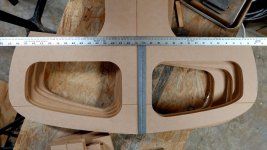
The Mystic River does not have a center form, but 2 forms a foot apart. This is one of those 2 center forms which looks like 1' from the lowest of the bilge inside to the gunwale. About 8" freeboard from the 4.5" waterline. My meter-stick bends down so the inch marked edge is at sheer height.

Freeboard.JPG

The more I read here, the more I can accept a shorter canoe but still have trouble with anything under 16'. The NewFound Boatworks 16' Chestnut Kruger is 55 Lbs and a $1,000 more.

But I'll be posting about price vs. value.

$2200 for 200 hours of entertainment is just $11 an hour. Far less than golf according to some random AI that answered for me.

Dave
 
Last edited:
The puzzle-piece strongback from CLC seems clever. Scarf joints are not rocket science. I may have mentioned that I'm being very lazy here.

The instructions say to first join the puzzle pieces to make 4 long boards then glue up the 4 long boards into a strongback. The top of the strongback is widest and the thing is assembled upside-down.

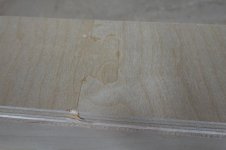
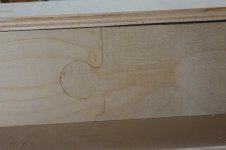
Here are the interlocking parts of the bottom and side boards. I suppose you could go wrong if you tried but they're tight, different, and easy to check for flatness.
BottomPuzzle.JPGSidePuzzle.JPG

The top has a long groove for the side pieces and there are mortises top and bottom and tenons on the sides. The big mortises are easy to see but there's a little one below it. The mortises all have radiused corners. They line up perfectly.

GoodMortiseTenon.JPG

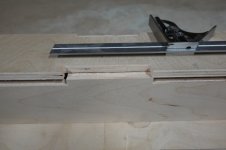
All except one line up perfectly. The mortises are square to the board. The one tenon is off by 0.11" or so. The combination square was a good idea but maybe not the best photo.

OddMortiseTenon.JPG

It was an easy fix with a saw and chisel.

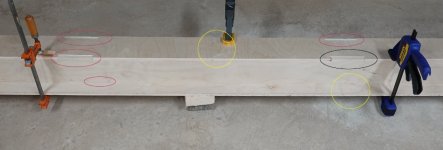
Here's a group portrait with mortises in red ovals, interlocking puzzle connections in yellow circles, and the "fixed" odd mortise in a black oval. If this tenon is wrong because of something I did, I just don't see it. Everything lines up end-to-end except this one tenon.

GroupPort.JPG

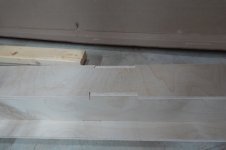
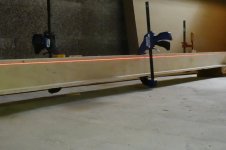
The box looks straight enough. I've looked along the plies, used winding sticks, and the laser level. Seems like an OK box.

IsThisStraight.JPG

Will glue up soon.

Dave
 
Last edited:
That's quite deep. Just curious, where do you see that spec, Brian?

I didn't check it as thoroughly as I should have Glen, Nick doesn't list the value anywhere and Google initially gave me the 14.5", then when pressed, corrected to 12.5" and then to 12", so I am thinking sending a note to Nick may be the only way to get the correct value.. it is curios that the value seems to be absent in all the canoes I checked on his site.

Or we could just ask Dave here, since he has the plans .... Dave ?
 
Last edited:
Dave, I posted this link from Laughing Loon in my last build.

Rob Mack is giving what amounts to a treatise on epoxy use and application for strippers, it was a very enlightening read for me and triggered a deeper understanding of epoxy in general. If you haven't already read it, I think it is worth the few minutes to go over it a few times ...


Brian
 
Seal coat or not ?

Which actually requires the least amount of resin ?

First off I'm confused at how much resin they sent you !

MAS, is a 2 to 1 mix ratio, If I'm not mistaken.( At Least the last time I used it ).

1.5 gal., of resin, and a 1 gal hardener, doesn't add up..

Back to seal coat.

I seal coated for years, got talked into skipping it. Now I rarely seal coat.
Having said that ? I'm experienced enough, to skip the seal coat, it saves time.

Beginners will find it easier to seal coat, and then wetting out the cloth, the seal coat, makes it easier.

In reality, there is little difference in the amount of resin to do either.

Seal coating has it's share of precautions. Be sure there are no dust particles, or loose strands of cloth, under the main layer of cloth. These will lift the cloth from the hull. Resulting in sanding through the cloth. Not good. Done that enough myself !

Please sort out the resin quantity for me.

Jim
 
Brian, I posted a pic of one of the 2 center forms in #25, above. From the top of the gunwales to the bottom of the form is 12". The 1/4" of cedar plus the glass add slightly more depth. The center of the hull is between these 2 forms and may be 1/16" deeper.

I have read extensively on Rob Mack's site. Of particular interest were his notes about temperature. If the boat is warming up during cure, it will exude air bubbles. If the boat is cooling down, it will suck in epoxy. All his notes about getting a clear layup were interesting.


Jim. Flooding the glass requires slow hardener and the dry cedar is free to absorb the liquid epoxy for a long time. By using a seal coat with faster hardener and a limited amount of epoxy, the wood cannot absorb as much epoxy. Less epoxy, less weight. I want to give the seal coat a try. I think I have the time to save weight here. Book knowledge but seems reasonable.

CLC did send 1.5 gallons of resin and 1 gallon of hardener. The CLC instruction book says mix them 1:1 which does sound odd. The resin bottles say 2:1 and the hardener bottle says 1:1. Could be 2:1 and CLC expects the hull to use 1.5 gallons resin and 0.75 gallons hardener so these bottles are close enough. I will spend some time reading on the MAS site.

Dave
 
Last edited:
Ashstillwaterboats has the canoe weight calculator you might play with WW.
It can help show you how or what factors in for weight.
Thanks Fourbtgait,

The ashes weight calculator looks useful. It doesn't allow for the exact mix of woods in the MR Canoe kit. For example it assumes the decks are made from the "fittings" species. (Or I think it does.) The kit fittings are ash and sapele but the decks can be cedar. The options for stems are hardwood or none while the kit came with spruce.

The ashes calculator says MR Canoe kit as delivered is between 55 and 56.5 Lbs.

Easy enough to change this to 47.5 Lbs still using cherry gunwales and fittings.

All sitka spruce brings it to 45.33. IDK that I've ever handled sitka lumber. I will need to take a trip out to Woodworker's Paradise in Rumford, ME. I have boards of straight-grain cherry and douglas fir that would make better gunwales than the kit has. The douglas fir is lighter by a bit. Is it hard enough? These questions are still rhetorical at this point.

Even if the calculator makes only estimates, it's a useful look at the possibilities and consequences of each decision. Thanks.

Dave
 
Back
Top Bottom