- Joined
- Apr 28, 2024
- Messages
- 11
- Reaction score
- 131
My name is Nick Dennis and am based in Norfolk in the east of the UK close to the Norfolk Broads which are colloquy known as Britain's Magical Waterland a network of flooded medieval peat diggings connected by an artery of rivers and dykes. I became facinated by wooden canoes marvelling at how they were constructed and how beautiful they were. The popularity of recreational canoing here in the UK from the late 1800's through the 1930's meant that some beautiful North American and Canadian Canoes made their way across the pond. I am often asked by American canoeing friends why there are so many beautiful and top grade canoes in the UK. The answer is simple; if you have the money to buy and pay to ship a canoe 4000 miles you might as well ship a quality canoe. I now head the UK Chapter of the Wooden Canoe Heritage Association and in 2024 I joined the Board of the WCHA and was appointed Vice President of the organisation this year.
My canoe history includes:
1950s Chestnut Playmate
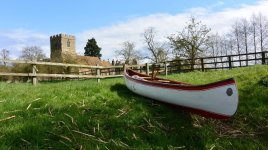
1911 Old Town Charles River AA Grade
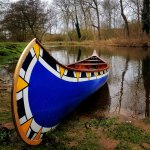
!930 Peterborough 16S
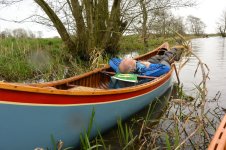
An 1890's English Turks canoe

Those in my current fleet are:
1900 Peterborough Cedar Rib

1978 Chestnut Deer

2016 Stewart River designed Pal

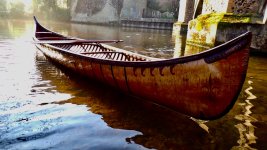
Four years ago during one of UK Chapter gatherings we found out about a birchbark canoe which was hanging yards away from us in a boathouse doing nothing. We got it out and did some examination. I then put my best Sherlock Holmes hat on and started some investigations over the next year or so. It transpired that a well known City of London property developer was fascinated by canoes and decided he wanted a birchbark. He and an architect acquaintance travelled to the US to see Henri Vaillancourt in Greenville NH. Three canoes were ordered at that time, one stayed in the US at the property developers' home in Pennsylvania whilst the other two came to the Thames west of London. We had found one of the two.
Henri through the power of Social Media and out of the blue, engaged with me mostly about how we should repair the Boathouse canoe. I put he and the new owners of that canoe, in touch with each other. In one exchange he then let out that in fact FOUR canoes were ordered and THREE sent to England in 1987. It transpires that a friend of the property developer and architect thought “if they have one, I must have one too!” He ordered a canoe too in 1987 . To illustrate how much ££ was floating about, on the trip back from the initial canoe buying trip, the original air tickets were binned at the airport and they flew back to the UK on Concorde!
Fast forward to October 2025. I was recounting this tale at a WCHA event on the Thames and the owner of the Boathouse canoe exclaimed “I know that friend he lives over there on the island you must meet him”. So I did. He had a whole selection of canoes of all sorts just gathering dust partly because the Henley River & Rowing Museum had just closed and he had to remove craft which were on loan to them and secondly, life events meant that he had fallen out of love with both the river and canoes. He took me to a barn and we pulled the dust and bird poop encrusted birchbark out ( it had been in their unused for 15 years). It was FANTASTIC as all of Henri’s canoes are. There was no way I could afford such a canoe. The owner then floored me by saying “ Would you please do me a favour and just take the canoe away, I want to give it to you as you are clearly more enthusiastic than I am” . He asked me to put the canoe on the car and take it away there and then. So I did.

So that's how I am the custodian of one of the most beautiful canoes ever built by a man who is one of the finest self taught builders of birchbark canoes.
The canoe was dry stored in a barn for 15 years so a drive home in torrential rain did it a power of good..
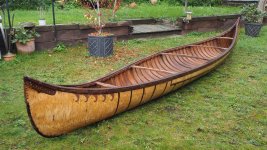
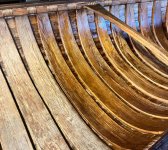
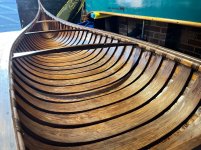
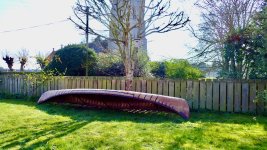
Below are some photos but on my initial assessment what I can see is:

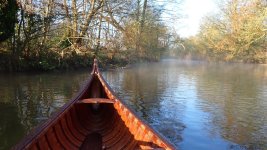
After a couple of weeks stusying the canoe I grabbed a "window of opportunity" and loaded the canoe and took it down to the disused mill pool at the bottom of the lane. I deliberately didn't take my pfd or a paddle otherwise I would have been too tempted too early. I need to get 15 years of dryness out of the canoe and its fabric.
I tied a painter too the thwart (not really needed as the canoe sat happily in the eddy) and put the canoe in and left it there for 15 minutes to see if there was any seepage. There was none.


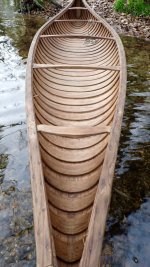
So next stage, I staddled the canoe and applied nearly 300lbs of downward pressure ( I blame the steak & ale pies at the Swan Inn!) first at the centre and then over each quarter thwart in turn and sat there for a few minutes. This sight was much to the amusement of passing dog walkers! Not a fully laden test I know but still nothing came in. I then heeled the canoe over to each side and repeated. Again nothing. So,after about 1 1/2 hours knee deep in water nothing had come through. My cedar rib canoe would always seep unladednuntil she had "taken up" so I am encouraged by these initial but not conclusive tests on the birchbark.
Whilst away in Germany the previous week where spuce is plentiful, i pulled a few roots up and examined the sap on the trees. I can get neither in eastern England so my thought is to go with 5mm rattan basket weaving lapping cane for the lashings and a smaller 3.5mm cane for some of the finer decorative work. Soaked it will be nicely piable and with the bark still on will match in quite nicely with the original.
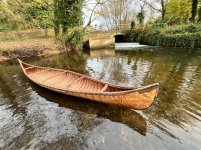
I arranged and had an hour long trans-atlantic telephone chat with Henri Vaillancourt who built my canoe. Coincidentally, I am also reading John McPhee's book "The Survival of the Bark Canoe" of which henri was quite dismissive and is now writing his own version from his POV.


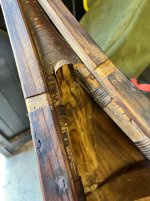
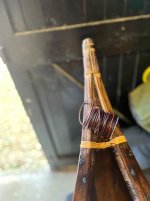
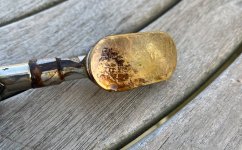
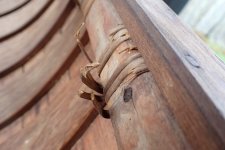
Lashings missing (above)
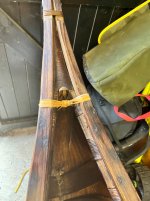
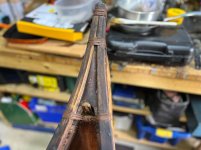
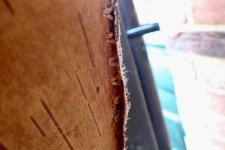
Cloth and gum coming adrift at stem (below)
Henri and I had a good chat and covered a lot. The pertinent points being:
•The canoe is in excellent shape overall.
•The woodworm treatment is good.
•The broken lashings are mostly superfluous and can be glued down or replaced where accessible.
•The inside woodwork can be oiled with Tung oil.
•The wood and bark can be rubbed over with clear polyurethane to improve and give life back to the finish. That's what he does.
•A tin of tempered and colour-matched gum can be sent to me from New Hampshire to cover the stems and gores externally.
•The canoe should be kept out of sun and rain and stored in an unheated building if indoors.
•The canoe should be used but not abused.
He now uses square hand forged nails to fix the cappings and gunwales together rather than wooden pegs which he used initially. The former would shrink and loosen with use of the canoe causing the canoes to go out of shape. He confirmed that getting the cappings off without breaking them would be impossible. Beneath the cappings the bark skin is folded over clamped and nailed between the gunwale rails so even without complete lashings, it's not going anywhere.
A good positive conversation which will enable me to move forward with the repair with far less work than I originally anticipated. Limited materials now ordered. It's raining here so moisture both in the atmosphere and our depleted rivers in Eastern England is a good thing. I will update this thread when progress is made. Welcome along for the ride!
Cheers,
Nick
My canoe history includes:
1950s Chestnut Playmate
1911 Old Town Charles River AA Grade
!930 Peterborough 16S
An 1890's English Turks canoe
Those in my current fleet are:
1900 Peterborough Cedar Rib
1978 Chestnut Deer
2016 Stewart River designed Pal
Four years ago during one of UK Chapter gatherings we found out about a birchbark canoe which was hanging yards away from us in a boathouse doing nothing. We got it out and did some examination. I then put my best Sherlock Holmes hat on and started some investigations over the next year or so. It transpired that a well known City of London property developer was fascinated by canoes and decided he wanted a birchbark. He and an architect acquaintance travelled to the US to see Henri Vaillancourt in Greenville NH. Three canoes were ordered at that time, one stayed in the US at the property developers' home in Pennsylvania whilst the other two came to the Thames west of London. We had found one of the two.
Henri through the power of Social Media and out of the blue, engaged with me mostly about how we should repair the Boathouse canoe. I put he and the new owners of that canoe, in touch with each other. In one exchange he then let out that in fact FOUR canoes were ordered and THREE sent to England in 1987. It transpires that a friend of the property developer and architect thought “if they have one, I must have one too!” He ordered a canoe too in 1987 . To illustrate how much ££ was floating about, on the trip back from the initial canoe buying trip, the original air tickets were binned at the airport and they flew back to the UK on Concorde!
Fast forward to October 2025. I was recounting this tale at a WCHA event on the Thames and the owner of the Boathouse canoe exclaimed “I know that friend he lives over there on the island you must meet him”. So I did. He had a whole selection of canoes of all sorts just gathering dust partly because the Henley River & Rowing Museum had just closed and he had to remove craft which were on loan to them and secondly, life events meant that he had fallen out of love with both the river and canoes. He took me to a barn and we pulled the dust and bird poop encrusted birchbark out ( it had been in their unused for 15 years). It was FANTASTIC as all of Henri’s canoes are. There was no way I could afford such a canoe. The owner then floored me by saying “ Would you please do me a favour and just take the canoe away, I want to give it to you as you are clearly more enthusiastic than I am” . He asked me to put the canoe on the car and take it away there and then. So I did.
So that's how I am the custodian of one of the most beautiful canoes ever built by a man who is one of the finest self taught builders of birchbark canoes.
The canoe was dry stored in a barn for 15 years so a drive home in torrential rain did it a power of good..
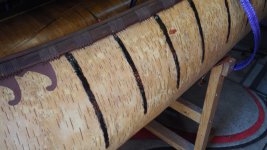
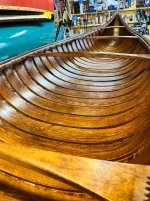
Below are some photos but on my initial assessment what I can see is:
- Minor woodworm to the rails
- Some of the lashings have snapped
- A couple of ribs at either end have moved as you can see ghosting on the planking. The ribs are however tight.
- Tape and gum/sap resin at ends lifting in places
- Gum/ resin over the gores is cracked?

After a couple of weeks stusying the canoe I grabbed a "window of opportunity" and loaded the canoe and took it down to the disused mill pool at the bottom of the lane. I deliberately didn't take my pfd or a paddle otherwise I would have been too tempted too early. I need to get 15 years of dryness out of the canoe and its fabric.
I tied a painter too the thwart (not really needed as the canoe sat happily in the eddy) and put the canoe in and left it there for 15 minutes to see if there was any seepage. There was none.
So next stage, I staddled the canoe and applied nearly 300lbs of downward pressure ( I blame the steak & ale pies at the Swan Inn!) first at the centre and then over each quarter thwart in turn and sat there for a few minutes. This sight was much to the amusement of passing dog walkers! Not a fully laden test I know but still nothing came in. I then heeled the canoe over to each side and repeated. Again nothing. So,after about 1 1/2 hours knee deep in water nothing had come through. My cedar rib canoe would always seep unladednuntil she had "taken up" so I am encouraged by these initial but not conclusive tests on the birchbark.
Whilst away in Germany the previous week where spuce is plentiful, i pulled a few roots up and examined the sap on the trees. I can get neither in eastern England so my thought is to go with 5mm rattan basket weaving lapping cane for the lashings and a smaller 3.5mm cane for some of the finer decorative work. Soaked it will be nicely piable and with the bark still on will match in quite nicely with the original.
I arranged and had an hour long trans-atlantic telephone chat with Henri Vaillancourt who built my canoe. Coincidentally, I am also reading John McPhee's book "The Survival of the Bark Canoe" of which henri was quite dismissive and is now writing his own version from his POV.
Lashings missing (above)
Cloth and gum coming adrift at stem (below)
Henri and I had a good chat and covered a lot. The pertinent points being:
•The canoe is in excellent shape overall.
•The woodworm treatment is good.
•The broken lashings are mostly superfluous and can be glued down or replaced where accessible.
•The inside woodwork can be oiled with Tung oil.
•The wood and bark can be rubbed over with clear polyurethane to improve and give life back to the finish. That's what he does.
•A tin of tempered and colour-matched gum can be sent to me from New Hampshire to cover the stems and gores externally.
•The canoe should be kept out of sun and rain and stored in an unheated building if indoors.
•The canoe should be used but not abused.
He now uses square hand forged nails to fix the cappings and gunwales together rather than wooden pegs which he used initially. The former would shrink and loosen with use of the canoe causing the canoes to go out of shape. He confirmed that getting the cappings off without breaking them would be impossible. Beneath the cappings the bark skin is folded over clamped and nailed between the gunwale rails so even without complete lashings, it's not going anywhere.
A good positive conversation which will enable me to move forward with the repair with far less work than I originally anticipated. Limited materials now ordered. It's raining here so moisture both in the atmosphere and our depleted rivers in Eastern England is a good thing. I will update this thread when progress is made. Welcome along for the ride!
Cheers,
Nick
Last edited: