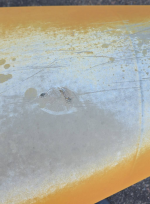
• Happy National Paranormal Day! 🔮👻👽

Canoe cover for epoxy canoe with no gelcoat?

Glenn MacGrady

Administrator
Staff member
Joined
Oct 24, 2012
Messages
6,815
Reaction score
13,585
Location
NW Connecticut
I've bought a new Savage River Illusion canoe, which cost more money than I ever imagined I would spend. To lighten the weight, which was one of my primary objectives in getting the canoe, it's made of Textreme carbon and Kevlar with an outer layer that is a so-called skin coat—i.e., no gelcoat. The resin used in the laminate is all epoxy, which is subject to UV degradation.

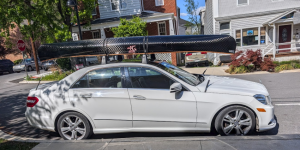
I often leave my canoe on top of my vehicle for weeks at a time during the warm season, such as here in Berkeley Springs, West Virginia.
1777562768836.png

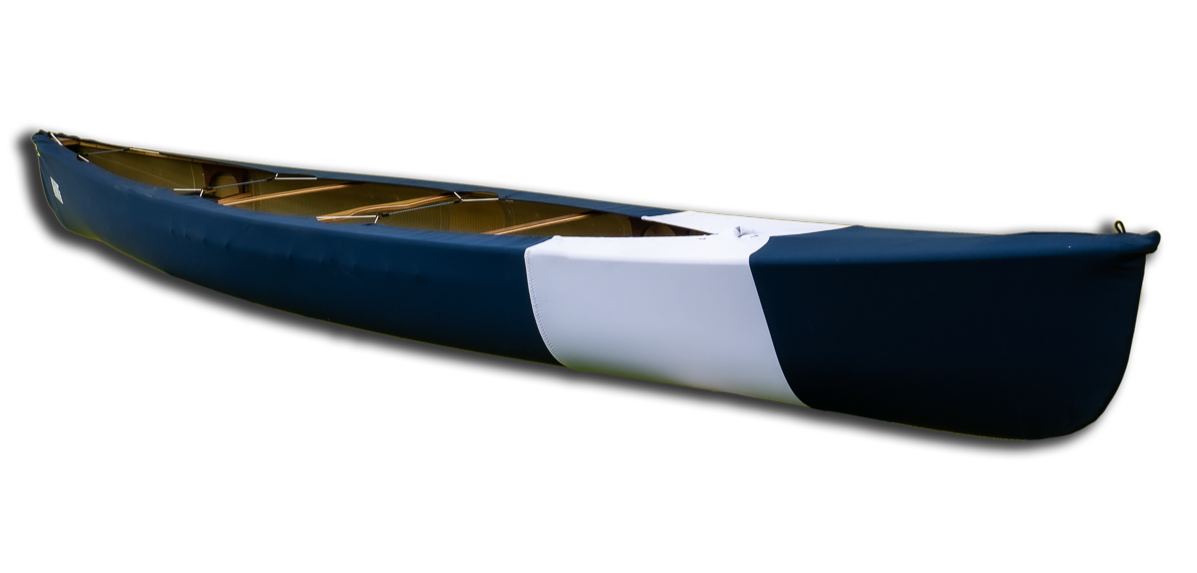
Because I've never had an expensive, skin coat, epoxy canoe among my large lifetime fleet, I'm a bit worried about UV damage for appearance and resale value. I'm therefore thinking about whether a custom travel cover would be a worthwhile investment for when the canoe is on top of a vehicle for several weeks from spring to fall. On the other hand, I wonder whether the UV risk is overblown in my mind for a northeast canoe that's stored indoors when not being cartopped, and which can be coated periodically with a UV inhibitor such as 303 Protectant or marine wax.

Any thoughts, opinions or actual experience with using or not using a travel cover for such a canoe would be appreciated.
 

Pretty cheap insurance. And a GREAT company.
 
I don’t leave my canoe on my car so I’m content with just using the 303. But since you’re leaving it up there, I would get the cover that Tryin linked. Compared to the cost of the canoe it seems like a relatively inexpensive precaution.

Do you take any other precautions leaving your canoe car-topped like that? Loosening straps, locks, ect?
 

Pretty cheap insurance. And a GREAT company.
I'll second that. While I don't use a cover, if I was leaving my epoxy boat outside for weeks at a time, I certainly would. Other products I've gotten from Redleaf have been outstanding, and they are fantastic to work with.
 
I have Bag Lady/RedLeaf custom covers for my Morris wood-canvas canoe and my Swift Keewaydin 15 because those covers came with both canoes when I bought them on the used market. However, I've only used those covers for storage purposes and have never used them for cartopping travel. The Morris is not a canoe I leave outside on a vehicle or its trailer. I have left my Kee on top of my car for extended periods, but I don't worry much about UV because it has a gelcoated bottom.

Yes, I'm weighing the cost, weight, travel noise potential, and on-off inconvenience of a fabric cover vs. doing nothing except 303 and more frequent warm season garaging than usual, since I now no longer have a dedicated canoe vehicle that is functional.

In short, it's the cost of expensive insurance vs. the risk. I know the exact cost of the insurance. What I don't know and can't quantify is the risk of actual UV damage over my expected lifetime usage of the canoe, which ain't what it used to be.
 
I took a look around, and I couldn't find anything solid.

  1. I remember there being some posts here on CTN some years back that talked about people in either the Southwest or Florida (possibly both) losing structural integrity in an unprotected epoxy hull (I think these were strip builds) within a season or two. I could not find the posts, and heat may have been a factor.
  2. I found This study on the effects of UV on epoxy, but I'm having a hard time equating it to real-life sun exposure. The test appears to be artificially accelerated, perhaps up to 2x natural UV exposure. Still, it shows what long-term UV does to epoxy. Primarily, it discolors and hardens the upper surface, not doing much to the substrate.
Some napkin math that you may or may not have done: If you assume 8h a day "full sun", 180 days on the cartop will give you 1440h of UV exposure. You are probably better able to scale this to your local climate than I am.

It also makes a difference if SR used a modified, UV-resistant epoxy in the build. (This is probably listed in your correspondence, it's not shown on their site.)

I'm actually more worried that the black hull is going to broil in high summer and degrade from overheating.
 
Do you take any other precautions leaving your canoe car-topped like that? Loosening straps, locks, ect?

Good points. Yes, I do lock and even double lock my seat and/or thwarts onto my racks when away from home. I never thought about loosening the straps a bit, but that seems like a reasonable precaution.

I'm actually more worried that the black hull is going to broil in high summer and degrade from overheating.

Another interesting point. I wonder if a canoe cover makes that possibility better, worse or no difference.
 
I had bag lady covers for my old racing canoes. Pretty much everyone else at the races did as well. We all traveled with them installed. It took virtually no time to take them on/off and there was never an issue driving with them installed.

Alan
 
Those canoe covers look great. But in Florida, there would ants’ and wasps’ nest built inside them within a few days. An unpleasant surprise when one removes the cover.
 
I keep my canoe on my car all through summer and fall. It's burgundy red so the paint protects the epoxy from most of the UV. It does not protect the canoe against heating up in the sun which, with epoxy, is not very good either. I have bought thin silvery fabric and will try and sew a cover for it when I get around to it. I think it's worth considering the heat issue though so if you are going for a cover then a brighter color is probably the best way to go. Brighter colors will reflect more UV and will not heat up as much. That black canoe is stunning, but heat and UV could be a problem if you just leave it like that out in the sun for days and weeks on end.
 
I'm actually more worried that the black hull is going to broil in high summer and degrade from overheating.

That black canoe is stunning, but heat and UV could be a problem if you just leave it like that out in the sun for days and weeks on end.
I can't think that a cover would possibly hurt but I'm curious what the epoxy manufacturer would say about the solar heating. I had contacted Raka previously and they had some interesting things to say as far as heat curing.

Without going into all of it again, here's their take (relative to hot water)


I'd be very interested in what other manufacturers say about sunlight on dark hulls.
 
I'd ask Savage River. If anyone has access to an expert that can give some insight into the specific materials in your boat I'd think they would have the key contacts at their suppliers. You might ask Souris River too...some if the boats they sell to outfitters must spend significant time in the sun. I doubt you can assume that all epoxies are alike but if you got similar feedback from both SR's it would give confidence.

It would also be nice to know more about 303 or perhaps Boatguard SPF50 - like how much they help. SPF50 seems like good protection.
 
I had bag lady covers for my old racing canoes. Pretty much everyone else at the races did as well. We all traveled with them installed. It took virtually no time to take them on/off and there was never an issue driving with them installed.

Alan
Why did everyone use covers?
 
I asked Northstar about this because my canoe was going to be on the roof for a 2 month trip out west and a 3 month trip to Florida. They basically told me not to worry about it. I sprayed it with 303 protectant the same way I do for my wife's plastic kayak.
 
I would absolutely order a cover from Red Leaf if you are leaving it on your car for extended periods. I do not find that 303 or other products hold up that long and the cover offers some additional protection from flying objects. Also, that is a extremely flashy canoe and a cover may just keep someone trying to make it disappear permanently!
 
Why did everyone use covers?

All the boats were ultra lightweight layups with no gel coat and spent a lot of miles on the road. Apart from UV protection the covers also provided insect protection. No one wants to scrub dead bugs off their hull before a race.

Alan
 
Thanks. I never
All the boats were ultra lightweight layups with no gel coat and spent a lot of miles on the road. Apart from UV protection the covers also provided insect protection. No one wants to scrub dead bugs off their hull before a race.

Alan

I never quite understood covers...due to ignorance. Bag Lady covers were popular on Loonworks boats that didn't need UV protection but I passed and never regretted it. I'm just curious if anyone has ever seen a case of UV degradation from normal use.

Can bugs stick to the knife edge front of race boats? When I travel the bugs end up on the vertical surface of the rear flotation chamber. :)
 
I'm just curious if anyone has ever seen a case of UV degradation from normal use.

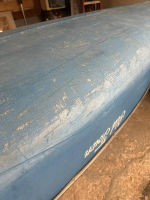
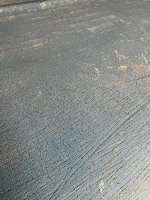
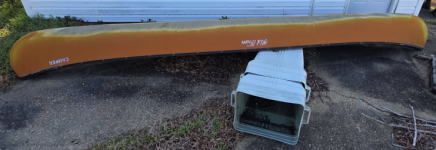
I guess that depends on your definition of 'normal use.' There are lots of real disaster canoes that show up for sale after being left outside for years. They often appear later in a Facebook canoe group with someone asking 'how can I fix this?' Two examples that I could find quickly are shown below. (I realize that these aren't epoxy but the issue is similar.)

Benson


1777734523373.png

1777734761031.png

1777735665411.png

1777735727554.png
 
Last edited:
Thanks. I never

I never quite understood covers...due to ignorance. Bag Lady covers were popular on Loonworks boats that didn't need UV protection but I passed and never regretted it. I'm just curious if anyone has ever seen a case of UV degradation from normal use.

Can bugs stick to the knife edge front of race boats? When I travel the bugs end up on the vertical surface of the rear flotation chamber. :)

Good question. It's entirely possible they served no true purpose and the only reason everyone used them is that a few of the cool kids started using them and everyone else followed suit. Kinda like bent shaft paddles. ;)

Alan
 
Back
Top Bottom