
I should also have mentioned a hidden rock in standing waves.Now I only fear pinning my boat, getting beat up swimming a long rocky rapid or drowning.

I should also have mentioned a hidden rock in standing waves.Now I only fear pinning my boat, getting beat up swimming a long rocky rapid or drowning.

I'd say 2+. A 3 was considered, but I chose to line around it.1. What was the highest class WW you've paddled thru on a wilderness trip?
Capsized, yes. Injured or damaged, no.Have you ever capsized in a rapid/had injuries or canoe damage?
I've seen it said that anything less than 3 isn't really whitewater. By that standard, I have never been in whitewater on a solo trip. Neither have I had what I would call formal instruction. I'm unlikely to run anything higher than 2 when solo with a tripping load.2. Did you have any instruction before going on your 1st solo back country trip with WW?
Thanks Steve, for providing your thoughtful input.Whitewater doesn't scare me. It's the rocks and trees that are hiding in that water (very common around here) that scare me. That was the demise of Walt Blackadar on the nearby south fork of the Payette. If you don't know who that is, you should, and it should give you pause.
I have a rule about not paddling anything I'm not willing to swim in. Age and injury have resulted in me not being the strong swimmer I once was, so that has me staying out of anything greater than class 3. And even some of that is sketchy.
Some good questions...
I'd say 2+. A 3 was considered, but I chose to line around it.
Capsized, yes. Injured or damaged, no.
I've seen it said that anything less than 3 isn't really whitewater. By that standard, I have never been in whitewater on a solo trip. Neither have I had what I would call formal instruction. I'm unlikely to run anything higher than 2 when solo with a tripping load.

It is definitely the unseen obstacles that prowl my nightmares.Whitewater doesn't scare me. It's the rocks and trees that are hiding in that water (very common around here) that scare me. That was the demise of Walt Blackadar on the nearby south fork of the Payette. If you don't know who that is, you should, and it should give you pause.
 . According to the accident report of his death, there were known additional risks. They were warned of an obstruction in the rapids, but did not scout it. Walt was still recovering from shoulder surgery; his strength and mobility were impacted.

St Croix is a bunch of fun - quick trip, good fishing, plenty of camps, low-consequence little rapids. St John was a bit dull - pretty, remote, much longer - but, ultimately, dull. Two rapids on the whole 7-8 day trip. Happy to provide details if interested.For me, at least up till now, whitewater paddling and wilderness tripping have been two different things. I really haven’t been on a trip where the two overlap. I regularly paddle class II/III rivers solo in my whitewater boat, and tandem in my tripping boat (float bags, not gear). The biggest river I have done in the tandem is the Dead at 1800 (class II/III), and we made it down fine.
Of course, taking out the float bags and filing the boat up with gear makes a huge difference. I’ve done some quickwater/easy class I in a loaded boat, but that is about it. It’s hard enough to recover a tripping boat with float bags in it, I can’t image trying to recover one filled with gear in a significant rapid.
Hopefully that will change this year. I’d really like to do the St. John this spring – two class III rapids. I’d also like to do the St. Croix which has smaller rapids, but more of them – at least from what I hear.
We'll see...
It is good to take the rapids slowly and methodically – moving back and forth across the river to find the shoots and deep water channels (Bill Mason style). Sometimes, easier said than done.I think you need to change more than your gear. You'll need to change how you run rapids, by doing back ferries and going slower than the current and avoiding the big stuff. I think that when you make not flipping your highest priority that you won't flip, at least with your skills.
St Croix is a bunch of fun - quick trip, good fishing, plenty of camps, low-consequence little rapids. St John was a bit dull - pretty, remote, much longer - but, ultimately, dull. Two rapids on the whole 7-8 day trip. Happy to provide details if interested.

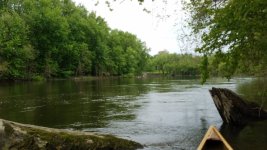
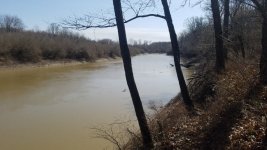 al reporter told me the current "didn't look too bad" to her. Second pic shows the Big Muddy running around 5 mph looking nice and smooth. I would not get on that river in a raft and taking the picture made me uncomfortable. I've seen trees shooting down the Mississippi at 10+ mph in Cape Girardeau and it isn't whitewater that makes that river the top killer in the U.S.
Good points. The mostly flat stretch of our local Snake River from Swan Falls dam to Walters Ferry has claimed a lot of lives. Though flat and wide, it's pushy and littered with strong eddies, boils, seams, and sucky whirlpools. Not a good place to swim. I don't fear it - maybe I should - but I think a healthy respect is in order.Tangential comment but I really wonder about the usefulness of trying to distinguish between whitewater and not whitewater; in my limited experience there is zero correlation to danger (and I'll mention that 80% of deaths are in moderate current). One time I swamped and sank a boat in Delhi Rapids (Ann Arbor) and the swamped boat ran me over and hit my head. Nice lesson and no big deal...narrow river and lots of kayakers around to help me. Sometimes very shallow water gets frothy yet you can just get out and walk through it. I don't mean to imply that Class VI and going off waterfalls is safe.
First pic below is 4 mph current on the St Joseph in a spot where a woman lost her life. If you go in it will be hundreds of yards best case before you might get out even if you choose the right bank to swim towards. The average American can't swim 100 yards in a pool. A locView attachment 151872View attachment 151873al reporter told me the current "didn't look too bad" to her. Second pic shows the Big Muddy running around 5 mph looking nice and smooth. I would not get on that river in a raft and taking the picture made me uncomfortable. I've seen trees shooting down the Mississippi at 10+ mph in Cape Girardeau and it isn't whitewater that makes that river the top killer in the U.S.
It seems as simple as always respecting the water while trying to gain enough experience to know when you are dangerously close to the limits of your experience and capabilities.
I believe the statistics show that the vast majority of deaths come from beginners, just like motorcycles.
 waterdata.usgs.gov

another thing is to practice in the clothes you'll actually be wearing- around here the schools did their swim tests in bathing suits. In my tests they had to come dressed in their regular tripping clothes- every kid was amazed at how hard it was to swim in a sweatshirt and jeans...I made the point about not losing your fear. The second part is become a good swimmer and practice rescues, all the time. You need to get the rest of your crew in the water. Have people capsize boats on purpose and practice rescues. Do some swimming in safe rapids. Practice belaying and throwing and packing rescue ropes. Learn how to use a Z drag to unpin boats.
If you have knowledge and your crew doesn't, no is going to rescue you.
Last comes good equipment and a quality PFD and dressing for immersion. Wet suits, dry suits, etc.
Yesterday we had a fatal on the Truckee River above Reno. A guy was rowing a raft and took a swim. He probably had no protection from the 40 degree water.


