• Happy National Cognac Day! 🍾🍷

Strap-in or Lash-in your gear

Joined
Oct 9, 2016
Messages
387
Reaction score
2,011
Location
Woonsocket, RI
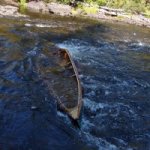
Until my trip on the West Branch of the Penobscot this was a theoretical question. This is not a place where you would expect to have a swim since it is almost all flatwater, but we did. There is a short section of quickwater toward the end of Big Island. We went up on a rock, and over we went. First time I dumped with a loaded tripping boat.

I was in the stern and was able to quickly flip the boat over gear and all and wade it to shore. My partner in the bow had a little tougher time bouncing off rocks, but he eventually got to shore. I did have to unload the boat to get it empty, but we were quickly on our way.

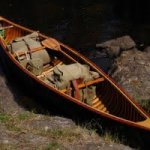
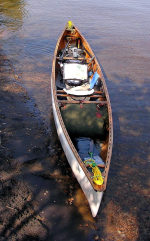
Back to the original question, do you strap in or lash in your gear. We had the gear strapped in, and it did stay in place providing some floatation and making it easy to flip the boat back over. If lashed gear started floating out of the boat it would have been a lot more difficult. At least on rivers, I am now clearly in the camp that says strap-in your gear.

Not sure what is better on a lake. With the gear strapped in you can probably get the boat flipped over, but then what do you do? Tow the boat and paddlers to shore, try to paddle the swapped boat, try to empty it and bail it out? I guess it depends on where you are in the lake, but none of it sounds easy.

What do you do - strap-in or lash-in?
 
Last edited:
Maybe it's because I started out as a whitewater paddler but I've always strapped gear into the bottom of the canoe. I've never actually capsized a canoe on a trip but we did get swamped by big whitecap waves on a reservoir of the Columbia River once and we just barged our way to shore and dumped out the water and kept going. Happened several times until we reached the take-out. I'm convinced that having the flotation of the packs & dry bags strapped into the canoe kept us from actually tipping over, with all our gear floating around in the lake.
 
I rarely strap my gear in except in lake crossings. virtually everything is in a dry bag and if you z-fold the top before rolling the excess very little (if any) water can get in- I proved this to a class that didn't believe me by filling the bottom of a 30L dry bag with a sleeping bag then piling my kitchen gear on top, doing a z-fold, and then rolling the last 4-5 inches- that bag floated in a small pond with the opening down from breakfast until dinner and the sleeping bag was still bone dry.
On rivers or small ponds with no current I don't tie in because I'd rather pick up a yard sale than fight to upright and bail a canoe full of gear- in a river the gear eventually grounds itself or snags along the shoreline and is easily retrieved, in a pond it generally stays in close proximity or slowly drifts down wind. I do generally tie small, lightweight gear to a larger pack and ALWAYS have my spare paddle tucked under bungees because it's no fun chasing your paddle when you're up the creek without one...
 
On any whitewater trip, I securely strap my gear into the canoe so that everything remains a solid unit in any capsize. That has served me well through countless flips and swamps. I remember a Bill Mason video in which he extolled the virtues of a loose lashing, because it allowed him to easily empty a swamped canoe by letting his packs float in the water, next to the boat and attached by lashing, as he turned over the boat to empty it, but the risk of entanglement freaks me out too much. Getting a leg wrapped in a lashing seems like a good way to drown.

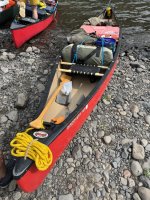
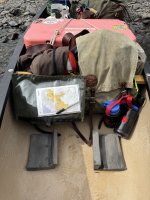
Oftentimes, I end up paddling a borrowed or rented canoe that I can't outfit exactly as I would like, so I rely on the seats and thwarts as the attachment points. Here's how I strapped in my gear on a recent trip with a borrowed canoe:

IMG_2123.jpeg

In the stern, the attachment to the rear thwart is hidden by my pack flaps. The brown pack is a resolute and lovely one made by @Art D
IMG_2126.jpeg
Over 50 miles of regular Class III rapids on the Grand Ronde, we flipped twice and fully swamped twice but didn't lose anything.

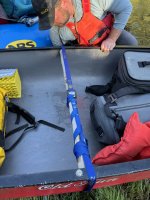
In my own canoes, I like to glue D-rings into the bottom of the boat, so that I'm not putting undo pressure on the thwarts and seats. Fair warning: one of our other boat's lost their yoke in a capsize, presumably because the gear lashings pulled it out. In the photo below, we've begun implementing a makeshift repair with a piece of driftwood. We later wrapped the yoke it with gorilla tape and also taped the strap to the underside of the boat to reduce the risk of it snagging. It lasted the rest of the trip and perhaps the next.
IMG_1792.jpeg

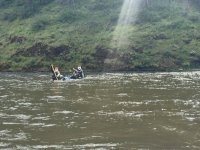
Yes, you can paddle a completely swamped canoe more effectively than you might think. I've edited the canoeists faces to protect the innocent, but here's a good example. They were laughing their heads off the whole time!
IMG_1743.jpeg

On a lake crossing, I would use the lashing strategy because, at least in theory, one could right an empty boat with less water therein and then determine whether or not you can retain any gear. That said, if you capsize or swamp a canoe with a tripping load in the middle of a lake, the conditions that caused said calamity likely preclude you from any real self rescue aside from swimming. I've lost gear that way before.

I've been burned on Chesuncook. Twenty-one years ago, I was a young man who didn't know any better and we were a big group, setting out across the lake from the Village, having just snacked on some of their legendary fudge. We were "supposed to" camp on Gero island but never should have left shore given how the wind was coming up. About halfway across, canoes started swamping and we did our best to tee rescue one another until we were all too swamped to help anymore. Thankfully, someone from the village had their eyes on us and came out in a power boat to save us, one boat after the next. The calamity divided our group on each side of the lake, with half of us camped on Gero Island for the night and the rest back at the village with tents pitched on someone's front lawn. I lost my own bag of personal clothing and did the rest of the trip (through Chamberlain, Telos and Webster Brook to Mattagamon) with little more than the shirt on my back and a few precious borrowed items. Learned more than a few lessons that day!
 
I feel like there's another thread like this, but I can't find it.

I lash my gear in the canoe. The gear is carried in waterproof containers and serves as flotation. We've practiced righting the loaded canoe and climbing back in.

I'm always torn on what to do with the crash bag. I don't lash it. I figure a pin kit isn't much good if it's lashed in the canoe that's pinned. Nor do the emergency cloths help if they're lashed right beside your regular gear. But I do have to worry about the crash kit floating away.

That BWCA rescue was needed because they were unable to survive the temperatures without their gear, which was trapped in the canoe. But it sounds like they did the right thing in having a lighter or something to start a fire on their person.
 
I'm in the "don't tie anything in, just deal with the yard sale" camp. My trips involve several portages in the average day and tying & untying would really slow things down. I'd rather chase my crap around the lake or down the river if I dump (although I portage anything that looks sketchy and get off the lake if the water gets TOO choppy... going solo, you just don't take as many risks.
 
I guess it all depends on the water you frequent. In relentless ww settings, you want that stuff to stay together, and if you can, have enough rope to swim the rope to shore and then you become the anchor point for your boat which you can gradually haul in, or at least pivot into the shallows. That's if you have the presence of mind to grab the rope in the midst of the swim. But even if your stuff is strapped in, a good washing machine cycle can thrash it out. I've chased strapped down gear for miles (and days) before getting it back (or not). I have d-rings glued to the bottom and sides of the inside of the hull and everything gets clipped in and down, and together, with carabiners - which makes getting it out a bit easier than a spiderweb of straps and ropes. The thwarts and a permanent strap addition serve as keepers. I'm also a fan of the battery operated bilge pump which I built into the bottom of my tripper's saddle.
 
I never strap or secure my packs, just my little tackle bag looped around a thwart. But, I seldom if ever attempt any moving water anymore
Years ago, solo west of Temagami I was floating down stream when I took my eyes off the water and got flipped right out of the canoe by a rock just under the surface. The water was waste deep so I managed to remove my two Duluth Packs as the canoe began to wrap around the boulder. They floated downstream into a lake which I managed to swim out to later to retrieve them.
In hindsight I could have peeled back some canvas and removed some planking to relieve the pressure to unpin the canoe but I think I was in a somewhat in a state of shock and just gave up. She was pretty well twisted.

canoeatportage2_zps4c968210_Original.jpegbrokenchum_zps3f1933c0_Original.jpeg
 
Yes. Secure your equipment.
Famous last words. "I didn't think we could get any water in the boat."\
I have had people with wet sleeping bags because they did not secure their dry bags.
We had a canoe capsize in Oregon and the wise guy did not secure any of his equipment. We were eddy shopping for 3 days.
Some people are hard to convince.
 
I converted what was intended to be air bag cages to gear cages (using quick release buckles. This holds whatever is in the bow or stern sections securely "locked" to the boat. In the "cockpit" section I usually have a 110L dry bag which is tightly tied to the floor of the boat using cords and the d-rings which were part of the air bag cages. The rest of my "danglers", Pelican box(s), day snack pack, bilge sponge etc are loosely attached to a d-ring on the floor (d-ring is for thigh straps that I almost never use for that purpose), this stuff will float but not be separated from the boat.

With the amount of restrained gear it is relatively easy to stay upright and paddle with water up close to the gunnels. If I land and remove the gear there is usually only about 3 inches of water remaining the rest has been displaced by the gear.

While there is risk in having everything attached to the canoe should it go on a LONG run downstream (some places I paddle an unattended canoe could float many km's) at least one is only looking for one large object rather than a dozen different small items floating off in all directions (oh look there is my "fill in the blank", too bad it's in an eddy on the other side of a 500 metre fast moving river).
 
Back
Top Bottom