• Happy Birthday, Yul Brynner (1920-85)! 👑➕ℹ️

Moving and turning a canoe left and right with balanced and unbalanced side slips

Glenn MacGrady

Administrator
Staff member
Joined
Oct 24, 2012
Messages
6,943
Reaction score
14,289
Location
NW Connecticut
That's not the title of Marc Ornstein's most recent single blade technique article, but it could be. Marc characterizes the hydromechanics of draws, pries and side slips this way:

" . . . bow and stern, draws and pries are essentially 'unbalanced' side slips, as you might say. Whereas a conventional side slip moves the entire canoe laterally (without turning it) bow or stern draws and pries are simply side slips that act primarily on the individual end of the canoe."

The actual title and the article itself can be found at this link:

 
There is something so satisfying about executing what is being described smoothly - moving and slipping among obstacles. Just to witness someone else do it skillfully conjures admiration.
There is one thought that I have that I wonder if others experience. I will quote Marc Ornstein's linked article to help set it up.

"For this discussion we will assume that all maneuvers are forward, defined as moving downstream, with some forward speed, relative to the current.
Let’s begin with side slips. By definition, sideslips move the canoe laterally. They do not cause the canoe to turn. We further break down side slips to static and dynamic. Static side slips convert the canoe’s forward momentum to lateral forces. Dynamic side slips require the paddle to be sculled, forward and back, creating drawing and prying forces."

So I'm thinking about executing a side slip with some forward speed. And let's say I want my canoe to slip sideways either as far as possible or as quickly as possible, or whatever combination of both. Maybe the right words are as effectively as possible given what is necessary. Let's say I'm moving directly into the center of something, and I have to slip a couple to several feet to avoid it.

1. My canoe slips perfectly perpendicular to it's forward glide. This is likely fine and effective, but we all know the realistic chances of maintaining this perfectly perpendicular movement in a fluid environment. Meaning our forward glide is likely at least somewhat in the direction we're trying to slip, or somewhat in the opposite direction we're trying to slip, when we execute it as close to perpendicular as possible.

2. My canoe's glide is at least some small degree towards the direction I'm trying to slip. This is great. For all practical purposes, I'm executing an effective sideslip, and the direction of my glide and direction of my slip are working together.

3. My canoe's glide is at least some small degree away from the direction I'm trying to slip. So I was moving directly into the center of something, needing to slip several feet. I place my paddle on the left to draw my canoe to the left of it. But my glide, although it seems about neutral, is ever so slightly aimed to move the canoe to the right in relation to the object. This has the glide of the canoe working against the slip. The slip seems less effective than it should.

I don't remember this ever being taught to me. So please tell me if you disagree. But I think it's actually quite important to make sure the glide of your canoe is at least some minimal degree in the direction of your intended slip. Even if the idea is to model a perfectly perpendicular side slip, you want to err at least slightly on the side of never fighting the direction of glide. I feel like even a small degree of opposition turns what could be a "Wow!" sideslip into a "That didn't work well at all!" sideslip. Does anyone else find this an important point, or do you find that it's not really that big of a deal. Is this an important piece of the hydromechanics of draws?
 
But I think it's actually quite important to make sure the glide of your canoe is at least some minimal degree in the direction of your intended slip. Even if the idea is to model a perfectly perpendicular side slip, you want to err at least slightly on the side of never fighting the direction of glide.

Chris, I'm glad the article caught your technical attention.

What you're asking is essentially how, technically, to execute a static side slip. That's not the focus of the article, but "how to do it" is a very important technical question for all paddling control moves. If folks want to discuss that instructional side slip question in this thread, or in another thread, either is okay with me.

I'll briefly address your question, using the "balanced/unbalanced" terminology of Marc's linked article. A static side slip will be balanced if it indeed moves your canoe perfectly sideways laterally with no turning of the bow left or right. If you introduce a slight turn to the left or right, as you seem to be asking about, you would then be unbalancing the side slip with a slight draw or pry component.

How to execute a perfectly balanced side slip is perhaps easier to learn with some instruction than to describe with words.

To attempt a description, I'll use Pat Moore's mental image of a "fulcrum ray" projecting outward from the face of your paddle, like a kid's suction cup arrow stuck on the face of the paddle blade. To execute a balanced drawing side slip (toward the paddle side), the paddle must be placed at an angle behind the canoe's pivot point with a blade angle such that the fulcrum ray intersects the canoe's pivot point. To execute a balanced prying side slip (away from the paddle side), the paddle must be placed ahead of the pivot point at a blade angle such that the fulcrum ray intersects the pivot point. If you do that, your side slip will be perfectly lateral with no left or right turning component. (This is all assuming no force influences from wind, waves or current swirls.)

But where is the canoe's pivot point? It will be in different places in different canoes; and even in the same canoe, it will change its longitudinal position as the trim of the canoe is changed by body and gear load, and it will even move fore and aft a bit as velocity changes. Therefore, you just have to learn where the pivot point is "by feel" — that is, by how your canoe responds to different side slip paddle placements and angles.

In addition, as your canoe's forward velocity slows during a side slip, you may have to continuously move your paddle's fore/aft placement a bit and change the blade angle a bit as the slip continues and slows. You learn this by feel also.

If you really need to "juice" your static side slip to get far enough over to miss the rock, you can do so by incorporating more of a dynamic draw-pull or pry-push, laterally, with your paddle.

All these static paddle placements and angles, and changes thereto, and additions of dynamic draw and pry components, become automatic and seamless with sufficient practice. Paddling a canoe with a single blade is all about learning how to automatically adjust the hull direction in response to the feel of the water on your paddle blade.

Well, I'm not sure my words have cleared much up, but other descriptions are welcome as would be any available videos.

 
I'm curious as to why the pivot point moves as velocity changes. I've noticed this "by feel", as you say, but would like to know the technical explanation.

Search in the AI world for a boat's "peripatetic pivot point". You can then report the answer to your question on this site, but start a new thread. Although the phenomenon relates to velocity slow downs during side slipping, a full technical discussion with the new source material available deserves a separate thread, so as not to draw or pry this one too far off course.
 
I like that fulcrum ray projecting outward from the face of your paddle, and the blade angle such that the fulcrum ray intersects the pivot point description. Actually Glenn, I think your whole description seems really helpful, especially including the part of the pivot point gradually shifting forward as the canoe gradually slows, as well as canoe differences, load differences, trim differences.
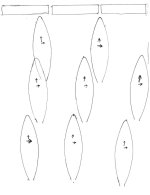
I may be showing how simple-minded I can be here, but my thoughts were coming from a bit different perspective. Instead of from the perspective of how to execute the perfect sideslip, meaning the canoe shifted perfectly perpendicular to the right versus the direction of my canoes glide/the direction it's pointing as it's gliding forward, I was thinking from the perspective of why, when gliding through the water, one sideslip can seem wildly more effective than the other when it seems they've been executed the same. I brought it up because to me, it doesn't always seem all that subtle in practice. In drawing out the below, I think it helped me see why it sometimes doesn't seem subtle to me. On the drawing, there is an obstruction, and then the canoe as it progresses forward in the direction of the arrow, and sideslips to the right in the direction of that arrow. It's a canoe's progression illustrated by 3 forward moving positions from furthest from the obstruction moving towards the obstruction. The one to the left doesn't clear. The one to the right clears right off the page.
A practice or demonstration scenario might be illustrated below. Let's say everyone perfectly understands the descriptions of a sideslip, the how to execute a sideslip, and they all execute it perfectly and exactly the same. Except, there is an, in the fluid moment, almost indistinguishable difference in how the canoe is pointed in relation to the obstacle. Each time the canoeist sees themselves coming right at the center of the obstacle. Each time the canoeist attempts to slip to the right of the obstacle. The efficacy here is determined by the obstacle, not whether or not the canoe actually did slip sideways. But from a casual observer, you might watch all three and assume that the canoeist on the right executed a much more effective sideslip, and the canoeist on the left did not. Even though they technically executed exactly the same - other than the subtle difference in angle.
Each canoe shows the arrow of direction of travel towards the obstacle, and the direction of sideslip. And then I drew in what I think might be the result of the sideslip in relation to the obstruction. The one on the left fails, the one in the middle just makes it, and the one on the right easily clears. I think in practice, I tend to pay more attention to where I'm trying to go - focusing to the right of the obstruction - than making sure my canoe is aimed perfectly perpendicular to the obstruction, so I think the natural variance in angle might reasonably go unnoticed for me. I think for me personally, this concept in action has left me wondering why one sideslip didn't seem to work, one did - barely, and one seemed like I knew what I was doing.
For the one on the left, if I execute my sideslip in relation to the obstruction, the natural glide of the canoe is trying to move me to the left in relation to the obstruction while I'm trying to sideslip to the right. And even if I execute my sideslip in relation to the canoe, if I look where the canoe was actually pointing at the start point and draw a line from the starting point to the obstruction - I actually have to sideslip significantly further to clear it. And so on and so forth with the middle example and the example to the right where my canoe has slipped right off the page.


Sideslip.jpg
 
Back
Top Bottom