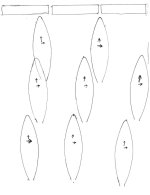
But I think it's actually quite important to make sure the glide of your canoe is at least some minimal degree in the direction of your intended slip. Even if the idea is to model a perfectly perpendicular side slip, you want to err at least slightly on the side of never fighting the direction of glide.
Chris, I'm glad the article caught your technical attention.
What you're asking is essentially how, technically, to execute a static side slip. That's not the focus of the article, but "how to do it" is a very important technical question for all paddling control moves. If folks want to discuss that instructional side slip question in this thread, or in another thread, either is okay with me.
I'll briefly address your question, using the "balanced/unbalanced" terminology of Marc's linked article. A static side slip will be balanced if it indeed moves your canoe perfectly sideways laterally with no turning of the bow left or right. If you introduce a slight turn to the left or right, as you seem to be asking about, you would then be unbalancing the side slip with a slight draw or pry component.
How to execute a perfectly balanced side slip is perhaps easier to learn with some instruction than to describe with words.
To attempt a description, I'll use Pat Moore's mental image of a "fulcrum ray" projecting outward from the face of your paddle, like a kid's suction cup arrow stuck on the face of the paddle blade. To execute a balanced drawing side slip (toward the paddle side), the paddle must be placed at an angle
behind the canoe's pivot point with a blade angle such that the fulcrum ray intersects the canoe's pivot point. To execute a balanced prying side slip (away from the paddle side), the paddle must be placed
ahead of the pivot point at a blade angle such that the fulcrum ray intersects the pivot point. If you do that, your side slip will be perfectly lateral with no left or right turning component. (This is all assuming no force influences from wind, waves or current swirls.)
But where is the canoe's pivot point? It will be in different places in different canoes; and even in the same canoe, it will change its longitudinal position as the trim of the canoe is changed by body and gear load, and it will even move fore and aft a bit as velocity changes. Therefore, you just have to learn where the pivot point is "by feel" — that is, by how your canoe responds to different side slip paddle placements and angles.
In addition, as your canoe's forward velocity slows during a side slip, you may have to continuously move your paddle's fore/aft placement a bit and change the blade angle a bit as the slip continues and slows. You learn this by feel also.
If you really need to "juice" your static side slip to get far enough over to miss the rock, you can do so by incorporating more of a dynamic draw-pull or pry-push, laterally, with your paddle.
All these static paddle placements and angles, and changes thereto, and additions of dynamic draw and pry components, become automatic and seamless with sufficient practice. Paddling a canoe with a single blade is all about learning how to automatically adjust the hull direction in response to the feel of the water on your paddle blade.
Well, I'm not sure my words have cleared much up, but other descriptions are welcome as would be any available videos.