• Happy 2nd Nobel Prize, Marie Curie (1911)! 🥈⚛️🧪

Maps... I like maps.

iI have somewhere in the area of more than 300 USGS topographic maps, many that I inherited from a disbanded SAR team, others and duplicates I personally bought when they ran $4.50-$5 or less (now $15 or more). Mostly of the Adirondacks and adjacent areas of NY State. A few are from other states where I have been. When a SAR incident call-out comes, I can usually pull out the exact map that covers the area. Unfortunately, I feel true traditional land navigation (M&C) is becoming a lost art, as the NYSDEC rangers have even virtually completely ditched hand held GPS units and instead adopted Caltopo as the current default and the tiny cell phone display that it provides. It is assumed that everyone has and knows how to use the app in detail on their personal cell phone that “everyone” has or must have. I come from the time when a ranger would hand me a printed copy map of the area of search interest, and tell me to take my team to complete our assignment in “Block B” as was marked on the map. Map and compass accurately navigated me there and kept me there until that assignment is complete. Later when hand held GPS units came into play, they were handy, but still knowledge of the map and point plotting was required to get any use out of them. As a retired USAF navigator from the 1970's and 80's, I am certainly a dinosaur, since with rare specialized exceptions the USAF does not routinely train or use inflight navigators any more. Air navigation turns out to be not much different from land navigation in mental thought process and attitude, it's just a bit noisier.
 
Last edited:
iI have somewhere in the area of more than 300 USGS topographic maps, many that I inherited from a disbanded SAR team, others and duplicates I personally boughte when they ran $4.50-$5 or less (now $15 or more). Mostly of the Adirondacks and adjacent areas of NY State. A few are from other states where I have been. When a SAR incident call-out comes, I can usually pull out the exact map that covers the area. Unfortunately, I feel true traditional land navigation (M&C) is becoming a lost art, as the NYSDEC rangers have even virtually completely ditched hand held GPS units and instead adopted Caltopo as the current default and the tiny cell phone display that it provides. It is assumed that everyone has and knows how to use the app in detail on their personal cell phone that “everyone” has or must have. I come from the time when a ranger would hand me a printed copy map of the area of search interest, and tell me to take my team to complete our assignment in “Block B” as was marked on the map. Map and compass accurately navigated me there and kept me there until that assignment is complete. Later when hand held GPS units came into play, they were handy, but still knowledge of the map and point plotting was required to get any use out of them. As a retired USAF navigator from the 1970's and 80's, I am certainly a dinosaur, since with rare specialized exceptions the USAF does not routinely train or use inflight navigators any more. Air navigation turns out to be not much different from land navigation in mental thought process and attitude, it's just a bit noisier.
Three Québecois foresters found out I was using a map and compass instead of GPS, they were astounded. They had never met anyone navigating back country except with GPS. They seemed to think it was something akin to navigating by the stars.
 
I like maps, too. I used maps extensively for my job and my love of maps goes way back, when I'd go into old drugstores or hardware stores to see if they had any old (pre-1950's) USGS maps. Those had all kinds of now-lost information about homesteads, camps, single-room schools, lookout towers, small cemeteries, all kinds of stuff. Fortunately USGS now offers download versions of their topographic map series, including many of those old issues.

I made the frame from re-purposed pine salvaged from my farmhouse kitchen which I remodeled a couple of years ago, with a shadow frame on the outside made from an off cut when creating new Spruce inwales for a current 1938 Old Town canoe restoration.

I enjoy seeing a good cartographer's map and a hand-drawn map can be like a work of art, worth putting in a nice frame like you did. I don't have any old maps on the wall but I do have a Raven Maps satellite imagery map of North America hanging in one room. I can stand there and pore over that map for an hour or more.


I think cartographic artistry holds true for modern digital maps as well; the quality of the map is very much dependent on the digital cartographer's skill in conveying lots of information that's clearly discernable and pleasant to look at.
 
Last edited:
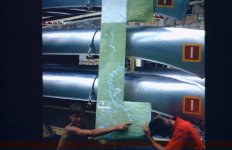
A number of you fine folks have shared your map interest-thank you. In a continuation of the thought about my Allagash map I thought I'd include this photo from 1967 illustrating the taped-together topo maps we used. I don't think there was an official Allagash route map at the time. That's a much younger me on the left, pointing to the starting point on Telos Lake. The canoes are the Grumman aluminum canoes belonging to our Boy Scout troop; many of which are still used by the troop all these years later.
PICT0041.jpeg
 
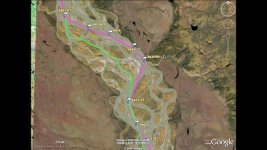
I used Google Earth to create and plot my Yukon River race route, both the YRQ 440 mile race and the 1000 mile race. Having passed through on five races I was able to modify and correct my route for best and fastest current and distance passage around shoals, islands, shortcuts and other obstacles, which may often change significantly from year to year. I printed each segment on regular computer paper, approximate ten-mile segments of the route (98 overlapping pages for the Y1K). Each page was treated on both sides with a waterproofing spray and inserted in plastic sleeves in a 3-ring binder. Both bow paddler (myself) and my stern paddler each had a copy in our voyageur canoe.

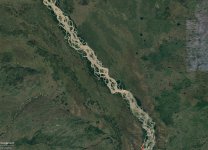
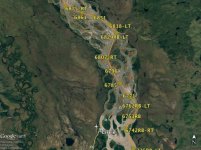
For example, here are different year segments near Circle, AK, with my routes and numbered waypoints (indicating miles in tenths from start) plus upcoming turn direction, which are loaded and displayed on my GPS. Alternate shortcuts are also shown, passage to be determined by visual inspection upon arrival. The first map image shows the complexity of planning a route through a braided river.

braided circle.jpegYukon Flats Circle.jpegFlats near Circle.jpeg

A better well behaved segment of the Yulkon:
17 mile.jpeg
 
Back
Top Bottom