• Happy Mountain Day! 🇯🇵 🏔️🌄

In defense of dams, which U.S. canoeists should worship!

Glenn MacGrady

Administrator
Staff member
Joined
Oct 24, 2012
Messages
6,982
Reaction score
14,536
Location
NW Connecticut
Dams have been unfairly and unwisely d*mned, including on this site.

Without dams, both the lentic and lotic canoeing waters of the USA would be impoverished.

Let's start with extreme lotic waters: whitewater rivers. Without dams, whitewater runs for normal paddlers would be limited to a narrow window between the gullywashing torrents of peak runoffs of spring and the bony rock gardens of summer and fall. Dam releases provide predictable and safe levels for whitewater canoeing throughout the year, all over the country.

The importance of dams for lake/lentic canoeing is even more dramatic. The only places in the USA that have a high percentage of natural lakes are the northern states that were glaciated during the last Ice Age and Florida. The rest of the USA's lentic canoeing waters rely on dams—from picturesque mill ponds, to swamps like Sparkleberry, to large lakes. In a 2012 assessment of 111,119 lakes in the USA, the U.S. Environmental Protection Agency estimated that 52% are natural and 48% are manmade.

Maryland has zero, zip, nada, no natural lakes. Texas has only one large natural lake. Delaware has at most two. Other than in the formerly glaciated northern tier of states and Florida, the vast majority of lakes in every state are manmade. DAM CREATIONS! Here is the EPA's distribution map of natural vs. manmade lakes in the USA's Lower 48:
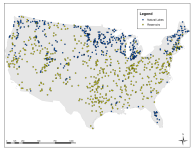
1786410471433.png

For lentic water paddlers who like to travel by bush plane, Alaska has about 3 million natural lakes. Hawaii has only five.

Virtually all the lakes and ponds I paddle in Connecticut are dammed.

For the dam busters among us (with all due respect to the RAF's Operation Chastise), remember that busting dams en masse will bust U.S. canoeing en masse.

Maybe that's why god invented Canada.
 
There are some undammed stretches of river that are canoeable most of the year, sometimes even in both directions. The Teton has no impoundment dams (well, we tried). I just got back from paddling some of the upper valley stretch, going upstream and down in late summer flows. I saw no evidence of high spring floods.

The Salmon (aka River of No Return) is navigable for the whitewater capable most of the year. The South Fork of the Payette runs all summer. Neither are controlled by dams.

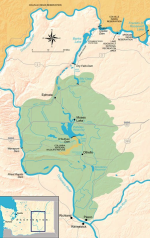
Large natural lakes...we have four. Pend Oreille, Bear Lake, Coeur d'Alene, and Priest Lake.

Three others are of significant size (4,000 to 6,000 acres) - Henrys Lake, Payette Lake, and Hayden Lake.

Besides that, the Snake River below Shoshone Falls is largely spring fed year-round, to the tune of about 5'000 cfs.

There are numerous other rivers with upper reaches that are navigable (especially if you're a poler) all through summer in most years
That's just Idaho. I know there are some as well in neighboring states. I'm not sure how much I would really miss dams in the PNW..... assuming we made up the loss with nuclear power.
 
Last edited:
Florida has a lot of natural lakes and many of the spring fed rivers are not dammed. Fisheating Creek is not dammed but only because angry citizens objected. The further south you do, the more dams and other impediments impair water flow.
 
Coal, steel, grains, gravel/sand, and other heavy materials still move around central US on large rivers and these remain navigable for barges most of the year only because of dams and locks.

I once took a river trip on the Scioto and Ohio rivers. Many large tows of barges on the Ohio and the shore has many terminals to transfer to and from railroads or other land transport.

OTOH, the map above shows 2 natural lakes in Ohio while Wikipedia lists 13 natural lakes larger than 100 acres. Maybe different criteria for "natural"?
 
I’ve been thinking about this while reading the other conversation about removing dams. Lake Nockamixon is my regular day paddle, a 1450 acre lake created by a dam. Without that getting in the water around here would be a challenge, particularly as the summer progresses and local rivers get low. And I very much enjoy lake paddling.

While I recognize that dams have been generally not great from an environmental standpoint, I selfishly don’t want my local spot to go away. And it does seem like the conversation can be a bit more nuanced than “dam bad get rid of dam.”
 
Without the system of dams on the Boise, this Treasure Valley community wouldn't exist. Much of the farmland that is being swallowed up by development lies in what was historically the seasonal flood plain. That farmland itself would be too dry for any significant production if not for the system of diversions and canals. I don't see any chance that Boise River dam removal will even come up in discussion here any time soon, but it's a shame there was never any consideration for spawning fish.

That has been the disaster to the steelhead and salmon fisheries brought by the Snake River dam complex. There is much talk about removing the dams on the lower Snake. It's highly controversial, because of their utility as power producers and inland navigation. It's pretty doubtful that I will live to see any of that resolved.
 
I'm very lucky living in Ontario with it's 250,000 lakes (about 95% natural), but most of the larger rivers themselves have at least one dam. In the 60's through to the late 90's our MNR were fairly progressive though, and insisted new projects must have well-engineered fishways- many are "pool and drop", with large 1000+ gallon holding ponds (off grade septic tanks) between 18-24" drops, as they work with all water levels unlike the old "fish-ladders" that needed a substantial flow to get enough depth to function. Many old dams were retrofitted at the same time. One easy fix for smaller flood control dams was to cut a window or slot through it that still allowed fish access while holding water back, and in fact, many are intentionally designed to plug with debris in a high water flooding situation. An added bonus was that many of the invasives don't have the stamina to fight the high volumes of water flowing through those windows.
Unfortunately in the late 90's MNR budgets were slashed meaning less boots on the ground to ensure that the actual installations met the submitted drawings, resulting in a lot of rubber- stamped designs that just do not function.
Although it still means portaging, the maintenance paths for the runs make nice wide, gentle portages because of the need to get small, heavy equipment in to remove debris or maintain the structures, and many are now favorite spots for lunch breaks. it's not uncommon to see a half- dozen canoe carts chained to trees or hidden in the bushes. One dam operator went so far as to put in a rail to lock your cart to...
it's a strategy that works while only creating a minor inconvenience to all users without singling out only one of them, and I really wish more US states would adopt similar legislation- maybe it's time to demand change in HOW the dams operate rather than the existing go/ no go mindset...
 
Your post makes the assumption that canoeing is a top priority, making human recreation the prime reason for keeping dams. I know you’re a smart guy, and I expected something more nuanced from you. Do you really think we should keep all dams because they give us a place to recreate?
 
Your post makes the assumption that canoeing is a top priority, making human recreation the prime reason for keeping dams. I know you’re a smart guy, and I expected something more nuanced from you. Do you really think we should keep all dams because they give us a place to recreate?
Relax. It's just a point for discussion.

I don't think anyone here believes we should keep all dams for recreational purposes - or any other reason FTM. Personally, I see both sides of the issue. As much as I would love to see a resurgence of free flowing rivers, I also recognize that there is a price to pay in human life issues.....food production and safe housing, for instance. I think we all realize that.

I live 15 minutes from a large reservoir with two dams and 15 minutes from a dam controlled river. I'm 30 minutes from another dam controlled river, and an hour from another. As a paddler, I benefit from a lot of dams. Would I miss them if they were removed? I don't know. Certainly not if they had never existed.
 
There are some undammed stretches of river that are canoeable most of the year, sometimes even in both directions. The Teton has no impoundment dams (well, we tried). I just got back from paddling some of the upper valley stretch, going upstream and down in late summer flows. I saw no evidence of high spring floods.

The Salmon (aka River of No Return) is navigable for the whitewater capable most of the year. The South Fork of the Payette runs all summer. Neither are controlled by dams.

Large natural lakes...we have four. Pend Oreille, Bear Lake, Coeur d'Alene, and Priest Lake.

Three others are of significant size (4,000 to 6,000 acres) - Henrys Lake, Payette Lake, and Hayden Lake.

Besides that, the Snake River below Shoshone Falls is largely spring fed year-round, to the tune of about 5'000 cfs.

There are numerous other rivers with upper reaches that are navigable (especially if you're a poler) all through summer in most years
That's just Idaho. I know there are some as well in neighboring states. I'm not sure how much I would really miss dams in the PNW..... assuming we made up the loss with nuclear power.

Both Lake Pend Oreille and Lake Coeur d'Alene have dams built to raise the original lake level higher, provide hydropower. I can only speak to Lake Coeur d'Alene as live near it. That dam will never come out because of lake front property owners, the cities, possibly the tribe. Avista who controls the dam, pays mitigation fees to the tribes for flooded land is my understanding.
It’s not just dams. It’s groundwater withdrawal. Last summer, the Spokane river went dry for a mile or so. Second time in current decade. The influx of people has lowered the water table that replenished the river in the summer. Any springs now, are further downstream. I was talking to an old boy one day at the river. He mentioned how theres very few red band trout, doesn’t understand it. Saying as a boy, they used to catch 30-40 trout every weekend right there….. huh, over fishing, less water
 
Throughout the Adirondacks, we have multiple dams and remnants of dams, but an odd treatment of them.
Some of these dams are within designated wilderness areas, which, according to the Adirondack Park Agency Master Plan, are to have NO man made structures. In fact, existing man made structures are actively removed when NYS takes ownership and designates the area Wilderness. ( For example, when NYS acquired Lake Lila and designated it Wilderness, the DEC burned and removed all of the structures from the great camp Nehasane.) This edict is enforced by NYS Department of Environmental Conservation (DEC)...sort of.
Some of the dams within designated wilderness areas were actively maintained by the DEC. The dam on Duck Hole is (was) an example. The DEC struggled to maintain it for years until it was taken out by the remnants of hurricane Irene. And Duck Hole, a nearly sacred place, became Muck Hole.
A dam on Cedar Lakes has been intentionally left to decay. The series of linked lakes are continually shrinking, eventually to become a much smaller lake and associated wetlands.
I paddled and carried in to both of those waterbodies and they were spectacular...
The dam on Henderson Lake, yes, holding back the Hudson River is in a designated wilderness area. Yet the dam remains and is actively maintained.

There was a dam on the Boreas River, Lester Dam, that was breached by stormwaters in the 70's. While this dam was in a designated Wild Forest and could have been repaired, it was not. I paddled Cheney Pond and Lester Flow before and after the breach, as well as the Boreas downstream from the former dam. I preferred the dammed section of the Boreas.

While I appreciate the paddling opportunities that these dams provide(d), I question the inconsistent enforcement of allowing some man made structures not only remain, but have efforts to maintain them, while other MUST be removed since they are non conforming structures.

Go figure...
 
Back
Top Bottom