Dams have been unfairly and unwisely d*mned, including on this site.
Without dams, both the lentic and lotic canoeing waters of the USA would be impoverished.
Let's start with extreme lotic waters: whitewater rivers. Without dams, whitewater runs for normal paddlers would be limited to a narrow window between the gullywashing torrents of peak runoffs of spring and the bony rock gardens of summer and fall. Dam releases provide predictable and safe levels for whitewater canoeing throughout the year, all over the country.
The importance of dams for lake/lentic canoeing is even more dramatic. The only places in the USA that have a high percentage of natural lakes are the northern states that were glaciated during the last Ice Age and Florida. The rest of the USA's lentic canoeing waters rely on dams—from picturesque mill ponds, to swamps like Sparkleberry, to large lakes. In a 2012 assessment of 111,119 lakes in the USA, the U.S. Environmental Protection Agency estimated that 52% are natural and 48% are manmade.
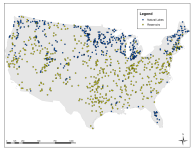
Maryland has zero, zip, nada, no natural lakes. Texas has only one large natural lake. Delaware has at most two. Other than in the formerly glaciated northern tier of states and Florida, the vast majority of lakes in every state are manmade. DAM CREATIONS! Here is the EPA's distribution map of natural vs. manmade lakes in the USA's Lower 48:
For lentic water paddlers who like to travel by bush plane, Alaska has about 3 million natural lakes. Hawaii has only five.
Virtually all the lakes and ponds I paddle in Connecticut are dammed.
For the dam busters among us (with all due respect to the RAF's Operation Chastise), remember that busting dams en masse will bust U.S. canoeing en masse.
Maybe that's why god invented Canada.
Without dams, both the lentic and lotic canoeing waters of the USA would be impoverished.
Let's start with extreme lotic waters: whitewater rivers. Without dams, whitewater runs for normal paddlers would be limited to a narrow window between the gullywashing torrents of peak runoffs of spring and the bony rock gardens of summer and fall. Dam releases provide predictable and safe levels for whitewater canoeing throughout the year, all over the country.
The importance of dams for lake/lentic canoeing is even more dramatic. The only places in the USA that have a high percentage of natural lakes are the northern states that were glaciated during the last Ice Age and Florida. The rest of the USA's lentic canoeing waters rely on dams—from picturesque mill ponds, to swamps like Sparkleberry, to large lakes. In a 2012 assessment of 111,119 lakes in the USA, the U.S. Environmental Protection Agency estimated that 52% are natural and 48% are manmade.
Maryland has zero, zip, nada, no natural lakes. Texas has only one large natural lake. Delaware has at most two. Other than in the formerly glaciated northern tier of states and Florida, the vast majority of lakes in every state are manmade. DAM CREATIONS! Here is the EPA's distribution map of natural vs. manmade lakes in the USA's Lower 48:
For lentic water paddlers who like to travel by bush plane, Alaska has about 3 million natural lakes. Hawaii has only five.
Virtually all the lakes and ponds I paddle in Connecticut are dammed.
For the dam busters among us (with all due respect to the RAF's Operation Chastise), remember that busting dams en masse will bust U.S. canoeing en masse.
Maybe that's why god invented Canada.