• Happy Golden Retriever Day! 🐕‍🦺👅💛

Hogging and interior cracks in OT Discovery 169

Joined
Jan 27, 2026
Messages
1
Reaction score
0
Location
NW California
A 1989 Old Town Discovery 169 has come into my life and I'm wondering if it is worth putting time and money into trying to prolong its existence.
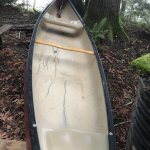
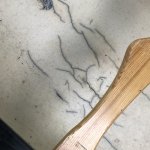
The hull is significantly hogged between both seats and the yoke - this alone is probably not a huge issue for the mellow class I river use that might be in its' future, but the hogging seems to be exacerbating the cracking of the interior, as can be seen in the photos below.

To fix the hogging, my impression is that options include some combo of shortening and re-attaching the yoke, and adding thwarts on either side of the yoke with some sort of vertical piece to push the floor of the boat out.

I think that without addressing the hogging, there is probably no point in trying to repair the cracks in the interior poly, as the flexing of the hull will continue to cause more cracking. Perhaps the cracks could be fixed with g/flex and fiberglass(and flame pre-treatment since it is poly)?

The outer hull is in remarkably good shape, with no signs of significant gashes - otherwise I wouldn't even be considering putting time into it. But maybe the best approach is to just gorilla tape the interior cracks to keep from soaking the foam core, and enjoy the boat on low-stakes water where when if it fails catastrophically it won't be a major disaster?

Any advice welcome, thanks!
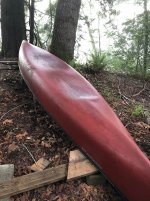

IMG_3482.JPGIMG_3483.JPGIMG_3484.JPG
 
GravelBar, welcome to site membership! Feel free to ask any questions and to post messages, photos and videos, and to start threads, in our many forums. Please read Welcome to CanoeTripping and Site Rules! Also, because canoeing is a geographic sport, please add your location to the Account Details page in your profile, which will cause it to show under your avatar as a clickable map link. Many of the site's technical features are explained in Features: Help and How-To Running Thread. We look forward to your participation in our canoe community.

Sorry no one has replied. Perhaps because this situation is rather odd and unusual. Were some sort of heavy weights resting on the bottom on each side of the center thwart?

To fix the hogging, my impression is that options include some combo of shortening and re-attaching the yoke, and adding thwarts on either side of the yoke with some sort of vertical piece to push the floor of the boat out.

I think two extra thwarts with vertical supports make sense, and would be relatively inexpensive, if you want to use the canoe and have it perform reasonably well. I'm not sure that shortening the center thwart will reduce the hogging, but you can test that theory by removing the central thwart and compressing the sides to see what happens.

If you do add central supports, epoxying the cracks could stop leaking but, by itself, I doubt epoxy would add structural rigidity to the bottom of the hull. Epoxying on big fiberglass patches should do so, at least to some degree.

So . . . if you want to salvage the canoe, have the hull perform as designed, and stop any further cracking and hogging, I suppose I would advocate fiberglassing big patches over the cracks and installing the vertical supports.
 
Welcome. I don't know much about repairing hogged boats but I'd wondered the same about the cause. I have to doubt that the center thwart would have kept that part of the floor from caving in so it seems likely that the canoe had been stored upside down with some heavy weights fore & aft. (especially since it seems to have had a pretty defined keel at one time)

A layer of glass on the inside might be helpful in correcting the condition and preventing further cracking but I'm not sure how to get good adhesion to the plastic (You may be on the right track with the flame treatment).

Hopefully, someone with a higher level of expertise (or cognitive function) will be along shortly.
 
I have that type of interior cracking in both my Mohawk XL14's, the one where it is the worst has a small bit of hogging. For the cracks I used thickened Gflex and then covered with pieces of s-glass. Some would recommend turning the cracks into a v-shape, all I did was give a twirl of a knife point to prevent the cracks from getting longer. Over time the old cracks have been stable but new ones appear here and there.

Depending on the intended use some would would just ignore it, after all nobody can see it when you are paddling!
 
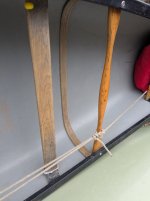
My sons disco has a similar hog problem. Solved for the time with am ash rib forced in and wedged up under the gunnels. Before that solution we tried all sorts of weight and heat combinations but as soon as the sun shone, the hogging came back. To be honest, on flat water I think it's an aesthetic problem rather than a performance problem.
Sam
 
Solved for the time with am ash rib forced in and wedged up under the gunnels.

Samb, ribs sound like a potentially better solution than vertical supports descending from two extra thwarts. Did you have to steam or soak the ash rib before insertion to make it more bendable?
 
The local nature center has a number of OT Discovery canoes with the hogging issue but no interior cracks. A few years ago we got several new boats that soon developed hogged hulls. We assume it is because they are stored outdoors year around. For rental use it doesn’t make any difference to the public who use the boats.
 
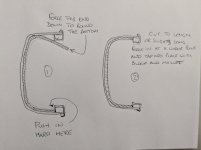
To put a rib in, I machine and sand the rib. Next I steam it, bend the first corner then force the end up under the gunnels and then continue the bend, forcing the rib into the chines and pushing hard to round the bottom, then clamping it. I let it cool for a couple of hours so the rib is beginning to set but is still wanting to relax. I then mark the rib, cut it to length and force it back in place, tightening the fit by using a mallet and block to force it towards the narrower direction.
I've also got a Winonah Aurora which I bought from an outdoor centre with a very floppy bottom. To be honest, I don't think it made any noticeable difference to performance but watching waves travelling through the royalex is not a good look and must make a fractional difference to speed so that boat now has a couple of ribs. I originally glued them in place but the glue gave up after a couple of years so now I just kick the ribs into place when I spot they have moved
PXL_20260203_110207707.jpgPXL_20260203_110430831.jpg
Sam
 
Back
Top Bottom