• First fundraiser in 3 years begins Nov. 1. Watch for thread. Please contribute.

Post your training paddles

Alan, what's an AGX?? Looks like a really cool canoe.

Back in the day I had a couple J-boats I didn't trust myself to keep upright and I also had a great little dog that loved to paddle and I felt guilty every time I took the j-boats out for training paddles. I wanted something in between a fast tripper and a USCA C1 and couldn't find anything that fit the bill so I set out to design and built one. Worked out quite well and is a nice boat to paddle. I gave it some rocker so it would be more friendly on the river and flared the gunwales forward of the paddling position to give me dog room to sit. I think it would make a great MR340 hull as it's quite fast but much more relaxing to paddle. I was out of racing before I could put that to the test though.

Alan
 
I would love to see the AGX sometime. I like light fast solos.
Here is the build thread, if you want some more background.

 
Went out for a harder effort with a faster boat tonight. Another beautiful evening and not another boat on the lake. Time after work is getting really short though. It was pretty much dark by the time I got off the water.

6 mile paddle
5.5 mph average speed
6.5 mph max
121 average heart rate
132 max heart rate
68 strokes/minute average
592 calories burned

I feel like my atrophied paddling muscles are holding me back. They quickly fatigue and don't allow me to get the heart rate up higher. We'll see if I can get them built up at all before the cold weather and darkness puts a halt to the paddling season.

View attachment 157872
That's a pretty boat Alan. It looks like it was made to move swiftly by a swift-moving maker.
 
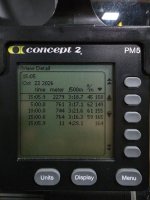
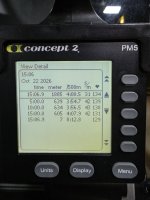
Did two 15 minute intervals today. (Plus a little max-effort sprint at the end, not recorded)

The goal was to hold 60spm for 15min and hold 40spm for 15min

Potentially interesting bio-efficiency correlation. I need to get my fitness way up before I start drawing conclusions, but at my current level, it cost me 360 heartbeats to go 394 meters. I understand that it is way deeper than that, but I was surprised at the narrowness of the HR gap compared to perceived cardiopulmonary exertion.

11565.jpg

11566.jpg
 
The goal was to hold 60spm for 15min and hold 40spm for 15min

Potentially interesting bio-efficiency correlation. I need to get my fitness way up before I start drawing conclusions, but at my current level, it cost me 360 heartbeats to go 394 meters. I understand that it is way deeper than that, but I was surprised at the narrowness of the HR gap compared to perceived cardiopulmonary exertion.

Interesting results. You were certainly 'faster' at 160 spm but the increased heart rate indicates you were working harder too. I would be curious to know the results if you increased the cadence but kept the heart rate consistent with your low cadence efforts.

I mentioned my running cadence in an earlier post and another issue I had with that was that I found it difficult to increase cadence without running harder/faster at the same time. Watching my cadence and pace helped me dial it in and although it felt unnatural at first it soon became normal.

Don't overlook lower effort training as well. I was young and enthusiastic when I first got into paddlesport training/racing and thought I had to kill myself every time I went out. As I've gotten older (and less fond of killing myself during workouts) I've learned more and spend a lot more time training in zone 2. I find the training more enjoyable, I can train more often (don't need much recovery), it's easier on my joints, and even though most of my workouts are zone 2 I'm still getting more fit and faster in my quick runs/bike rides.

A big eye opener for me was that when I started running I just followed the daily running suggestions of my Garmin watch figuring it probably new more about running and training than I did. I was surprised how many of the runs were low effort. I was also a little frustrated because this was my fun new hobby and I wanted to run hard. But the watch kept me running slow with short bits of harder running mixed in every few days (something like a 10 minute warmup, 15 minute harder effort, and a 15 minute easy cool down).

As my fitness improved it would raise the pace for my "easy" runs and it started programming more hard effort and sprint work. Early this summer I ran an all out 5k and my time was 24:20.

Then some of my joints began hurting during the hard runs and it got really hot and humid so I backed off to almost exclusively zone 2 running for a little over a month. When the temp and humidity dropped again I did another all out 5k and my time had dropped by over a minute to 23:10. This despite doing virtually nothing but easy training runs.

I think I would have built much better fitness during my racing days if I had given more attention to more zone 2 paddling to build base endurance rather than doing 60 minute max efforts on most training paddles.

Alan

 
The biggest variable right now is my underlying cardiopulmonary "fitness". I *know* that it is not good, and I won't have a real baseline for at least another month.

Because of my lack of fitness, lower-effort training is difficult on the erg. It's not like being on the water where you can "lily-dip" down your exertion to a literal standstill. Even setting the damper on the lowest setting allows the paddle wheel to decelerate to the point of making every catch a "starting" catch. As I slow down on the erg, the stroke effort "line" on the imaginary exertion level graph rises to meet the turnover effort line and they intersect somewhere around 32spm. This will no doubt increase with fitness. Not sure if I will ever get to the point where 60spm keeps me in zone 2 indefinitely, but that would be a worthy goal. In the meantime, I do a bit of rucking, which does keep me in the 120-130bpm range pretty easily.

Immediate paddling goal: Improve baseline fitness to the point I can hold 40-45spm @ <130bpm for 1 hour.
December goal: Improve stroke rate to 60spm for 60 minutes, regardless of heart rate.
February goal: Have completed at least one 4+hour erg session, any stroke rate.
March goal: Pick up new canoe
April goal: Analyze training data to-date and establish realistic long-distance heart rate, caloric output, and stroke rate thresholds.
May goal: Complete a dawn-to-dusk and a dusk-to-dawn paddle within threshold parameters
June goal: TBD
July goal: Complete the MR340 within time parameters; and tentatively in <60hours.
 
lower-effort training is difficult on the erg. It's not like being on the water where you can "lily-dip" down your exertion to a literal standstill. Even setting the damper on the lowest setting allows the paddle wheel to decelerate to the point of making every catch a "starting" catch.

I've never paddled on an erg but I can see that being the case. Sounds like you have zone 2 covered with rucking though so that's good. With the amount of time you're planning to put in on the erg I hope paddling an actual canoe will feel easy in comparison. Sounds like you've got a good plan laid out!

Alan
 
Back
Top Bottom