• Happy National Banana Bread Day! 🍌🍞

What's changed for better or worse over your canoeing lifetime?

My new old Royalex canoe sure weighs less than the old 1960s fiberglass canoe that trashed my shoulder last fall!

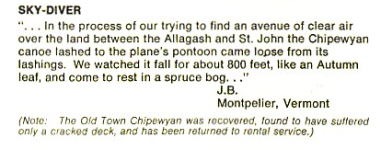
Re throwing canoes from roofs, there was a story some years back about a canoe that came loose from a seaplane and fell a thousand feet or so. When they finally found and retrieved it, it was intact.
 
Cost of equipment - bad

From some quick research, which certainly wasn't exhaustive, it looks like you could expect to pay $1200 or more for a nice Kevlar canoe in 1985. In today's money that would equal $3600, which which appears to be right in line with the cost of a new Kevlar canoe today. And I would guess that today's Kevlar canoe would weigh less with overall better construction.

Alan
 
From some quick research, which certainly wasn't exhaustive, it looks like you could expect to pay $1200 or more for a nice Kevlar canoe in 1985. In today's money that would equal $3600, which which appears to be right in line with the cost of a new Kevlar canoe today. And I would guess that today's Kevlar canoe would weigh less with overall better construction.

Alan

Let's see. An original kevlar Curtis Dragonfly weighed 39 pounds and my (slightly larger) SRT weighed 42. Original Nomad might weigh slightly more than a comparable new Peregrine. Curtis would sell you a 22 pound Ladybug in the 1970's. Which are the new boats with better overall construction than Curtis boats? Whenever I come across a decades-old Curtis or Blackhawk all the screws are still tight.

There have been some nice developments like integrated carbon gunwales but overall I think the tradeoffs have changed more than the technology.

And as DutchLiennert mentioned, you cannot buy a carbon paddle of the same quality as you could 2-3 decades ago. Many of the passionate creators of paddles and boats that stand up well to anything on today's market have retired or passed away.
 
Last edited:
How many here had $1200 for a canoe in 1975? I think the question is probably meant to be about the “state of the art” differences. However, the individual cannot be dismissed from the equation because a “lifetime” is a personal metric.

In retrospect, I started with horrible gear, and I was oblivious. Even backpacking, I used army surplus. My friends had better equipment, but I made do. I wasn’t even aware of state of art canoes, the aluminum ones I rented with friends were way too expensive to own. Eventually, I bought a fiberglass canoe for $100, which was a fortune for me bussing tables and shoveling horse stalls. Honestly, I didn’t know carbon fiber or even Kevlar existed. I have no idea what was state of art in 1957, which was the beginning of my lifetime.

I’d give up my Kevlar canoe and carbon fiber paddle in a NY minute for half the pig-headed energy I had in 1975.
 
I occasionally feel the need to remind my kids that time has flown by at mind blowing speed, and then qualify that statement with examples dredged up from my fading flickering memory. Like
33&1/3 and 45 vinyl records, stereo, complete with life altering art! Wow! Cool! Colour television! In a legless cabinet that looks like furniture! Crazy. Yer regular wall mount telephone but with push buttons, and no party line!? What's the world coming to!? Cars with tail fins, and with automatic tranny! (Dad still won't let us borrow the car. So it looks like we're still hitch hiking.) And the new family up the road have an in-ground swimming pool (no, not a pond, an actual swimming pool, like in the movies). They also have a brand new birch bark canoe. Except, it isn't bark. Wait for it.
It's made of aluminum! That's just nuts! (Can we borrow it?)
There've been lots of good and bad in the intervening years between once upon a time and the here and now, so we all just have to suck it up and set aside hubris, thank whomever/whatever/wherever, and fly by the seat of our pants into the great unknown. I know my ride has been bumpy and spectacular, and so I have no intention of letting the kids take any of this life-trip for granted.
You know when i was your age...

 
I have no idea what was state of art in 1957

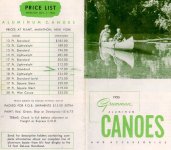
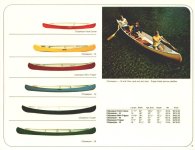
Most people would probably have considered an aluminum Grumman to be a 'state of the art' canoe in the mid-1950s. These were priced in the $100 to $300 range as shown in the first image below. The ABS plastic canoes in the 1970s were priced in $300 to $400 range as shown in the second image below from the 1975 Old Town catalog. The most expensive Old Town canoe that year was a wooden Molitor model for $1025. Fiberglass canoes in that catalog were priced in the $200 to $400 range with Kevlar available for $75 extra.

Benson


Grumman-1955.jpg


PAGE-07.JPG
 
Last edited:
i got my first canoe when I was stationed in the Air Force in Columbus OH, 1975. I bought the lightweight Grumman, which made me very happy. Did not much like paddling in OH, the rivers were too small and flowed thorugh green mine polluted watrer on their way south. Unlike my home in the Adirondacks, where I could camp on any state land area, that was not a possibility iin OH. Only at commerial pay campgrounds was allowed. Larger waterways were clogged with motorboats who cared nothing about noise and wakes afffecting a canoe with young married couple with a kid and a dog. I still have that same canoe (and the wife). The kid is long gone from home on his own, and so is the dog.
 
Last edited:
I've got to go with the lightweight canoe. I like long trips and would have had to give it up by now.
At the time there were three weights. Two as listed above, standard and lightweight. Not shown is "camp weight" with thicker aluminum, as sold for rough use at youth camps and the like. I thiink most Boy Scout camps got the heavies. I really liked the lightweight, 10 pounds less than standard, with extra ribs to make it somewhat sturdy. Camp weight was 10 pounds more than standard, IIRC.
 
Last edited:
The ABS plastic canoes in the 1970s were priced in $300 to $400 range as shown in the second image below from the 1975 Old Town catalog.

Years ago, I was researching the first Royalex canoe on the market and one source said the Old Town Chipewyan (which may be wrong). The catalog page suggests that "Chipewyan" was more a family name of a group of different size canoes, such as Chestnut's "Prospector" was. Benson, is that correct or was there one first canoe model called the Chipewyan? And if Chipewyan was a family name, was that the family of Royalex (Oltonar) canoes?
 
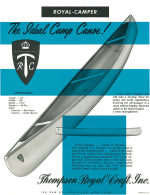
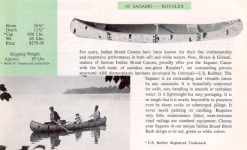
Chipewyan was Old Town's name for their ABS/Royalex/Oltonar series of canoes which came in various lengths. This was similar to their Carleton group of fiberglass canoes. I believe that Old Town built the second facility to make canoes from flat ABS sheets in the 1970s. The first one was made by U. S. Rubber / Uniroyal in the 1960s for a material known as Royalite. They also sold raw hulls to be finished by Thompson and others as shown below. Thompson first introduced a canoe like this in 1964 at the Chicago Boat Show.
1771895291110.png

These had no ultraviolet protection and broke down very quickly in bright sun. Bart Hauthaway used to joke that Royalite canoes were great if you were only planning to use them for night paddling. Uniroyal solved this issue by adding vinal exterior layers and called the new product Royalex. These were also sold to other builders as shown below.

1771895824157.png

Uniroyal's molding facility was in Warsaw, Indiana and the hulls were finished by a number of different canoe builders. They became known sarcastically as 'Warsaw Rockets' since their performance was not great. Old Town built their own molding facility because they wanted more control over the hull shape and layering. They decided to call their version of the material Oltonar since it was significantly different from Royalex. Mad River and others built their own molding facilities shortly thereafter.

Benson
 
Last edited:
Benson, your knowledge and research are greatly appreciated! I remember the term Warsaw Rocket but had no idea its origin, and was around Blue Hole and MR boats in the 70s (sorry, Old Town wasn't as popular in the southeastern rivers then. I did sell and own Old Town in the PNW in the early 80s though).
 
Back
Top Bottom