
• Happy Publication of "Star Spangled Banner" (1814)! 🚀💣🇺🇸

Which solo canoes are best for heeling?

I'll agree that the seat can make it easier (and more comfortable) to heel a hull. When I built my Raven, I contoured the seat all the way to the gunwales and heeling becomes automatic if you slide to the rail (probably would be anyway but this remains comfy).
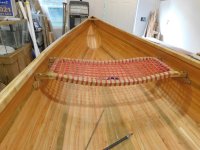
DSCN1896.JPG

It might require a new jig for every few hulls (the same jig worked for the Bloodvein but the spreaders are nearly under the gunwales) but I'll probably never use another seat contour.

It doesn't heel it all the way to the rail (you'd have to kneel in the knuckle for that) but, in a tripping situation, with full gear load, you don't need to do that anyway. All you're looking for (IMO) is enough to break the stems free & allow turning to become easier.
DSCN1962.JPG
 
It might require a new jig for every few hulls (the same jig worked for the Bloodvein but the spreaders are nearly under the gunwales) but I'll probably never use another seat contour.
You boat-builders have some serious skills! I can't picture the jig or spreaders, but that is one nice looking seat.
 
As a complete beginner, I’ve learned here that the most important thing is to have a good seat. Next comes positioning yourself in the boat so you can comfortably use both options (sitting or kneeling). This also includes whether the seat is mounted flat or at an angle in the boat.
 
Last edited:
I've had the Solitude for several years now. Its seat is adjustable to three heights. It came to me with the seat in its lowest setting. I immediately raised it to the middle, and left it there.
Seat hight also makes a difference. A low seat may make for a safer ride but it might not give you enough leverage to comfortably get the lean you want.
It took me until less than a week ago to figure that out. On the last morning in Bowron, I raised the seat to the top out of curiosity (finally!). Suddenly, it was easier to heel the boat to turn. I also noticed that I was using core muscles more than before in my forward strokes. To top that off, now I have room to kneel if I want - and with no significant stability penalty.

I need a forehead smack emoji.
 
Yeah, besides the extra leverage for leaning a higher seat gives you, it also lets you have a more powerful stroke because you can use more of your core muscles. This gives you the most powerful stroke you can get without using foot pegs or a bar. The minimum seat hight I like is about 11 inches. Most canoes built today have the seats way too low IMO.
 
I've had mixed results when it comes to heeling a canoe to the point that the gunwale is touching the water. In some canoes it seems that I can effortlessly tilt the rail all the way down to the water and maintain that position comfortably as I paddle, but in other canoes I am constantly fighting it and require lots of effort and energy.
My first thought when I read that you wanted to "maintain that position comfortably as I paddle" was: Do you want to paddle your canoe with the gunnel at water level while paddling stylistic Freestyle? Or are you asking about functional paddling, where having a bit of freeboard helps keep water from spilling into the canoe?

If you want to heel to the rail while paddling, then as discussed earlier, there are several sport canoes that should be on your list, especially the Savage River Illusion. If you're looking for a sport canoe that you can comfortably heel for paddling but leave some freeboard, then in addition to the canoes recommended, I suggest including a canoe like the Northstar Firebird, with shouldered flare. I can get the Firebird to heel to the rail when I'm "messing about in a boat" but I'm not comfortable keeping the gunnel at the waterline. I typically just heel it to the shoulder and call it good, where I can still do effective axles, wedges, and posts without having to think about water getting into the canoe.

Marc Ornstein described shouldered flare earlier in this thread:
Most of the so called shouldered boats are essentially flared to the shoulders, then tuck in. As such they stiffen, as you heel them, until you reach the shoulder. Pushing them past the shoulder, they "release" a bit, making them feel, to some, a bit unpredictable, but only if the paddler wants to push them to the gunwales. Most paddlers don't heel to the gunwales and like the fact that they stiffen a bit while still maintaining a bit of freeboard.
 
Back
Top Bottom