
• Happy Birthday, Louis Jolliet (1645-1700)! 🧭🗺️🛶

Which solo canoes are best for heeling?

I'll agree that the seat can make it easier (and more comfortable) to heel a hull. When I built my Raven, I contoured the seat all the way to the gunwales and heeling becomes automatic if you slide to the rail (probably would be anyway but this remains comfy).
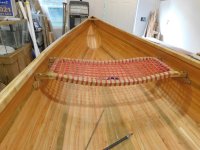
DSCN1896.JPG

It might require a new jig for every few hulls (the same jig worked for the Bloodvein but the spreaders are nearly under the gunwales) but I'll probably never use another seat contour.

It doesn't heel it all the way to the rail (you'd have to kneel in the knuckle for that) but, in a tripping situation, with full gear load, you don't need to do that anyway. All you're looking for (IMO) is enough to break the stems free & allow turning to become easier.
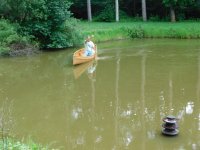
DSCN1962.JPG
 
It might require a new jig for every few hulls (the same jig worked for the Bloodvein but the spreaders are nearly under the gunwales) but I'll probably never use another seat contour.
You boat-builders have some serious skills! I can't picture the jig or spreaders, but that is one nice looking seat.
 
As a complete beginner, I’ve learned here that the most important thing is to have a good seat. Next comes positioning yourself in the boat so you can comfortably use both options (sitting or kneeling). This also includes whether the seat is mounted flat or at an angle in the boat.
 
Last edited:
I've had the Solitude for several years now. Its seat is adjustable to three heights. It came to me with the seat in its lowest setting. I immediately raised it to the middle, and left it there.
Seat hight also makes a difference. A low seat may make for a safer ride but it might not give you enough leverage to comfortably get the lean you want.
It took me until less than a week ago to figure that out. On the last morning in Bowron, I raised the seat to the top out of curiosity (finally!). Suddenly, it was easier to heel the boat to turn. I also noticed that I was using core muscles more than before in my forward strokes. To top that off, now I have room to kneel if I want - and with no significant stability penalty.

I need a forehead smack emoji.
 
Yeah, besides the extra leverage for leaning a higher seat gives you, it also lets you have a more powerful stroke because you can use more of your core muscles. This gives you the most powerful stroke you can get without using foot pegs or a bar. The minimum seat hight I like is about 11 inches. Most canoes built today have the seats way too low IMO.
 
I've had mixed results when it comes to heeling a canoe to the point that the gunwale is touching the water. In some canoes it seems that I can effortlessly tilt the rail all the way down to the water and maintain that position comfortably as I paddle, but in other canoes I am constantly fighting it and require lots of effort and energy.
My first thought when I read that you wanted to "maintain that position comfortably as I paddle" was: Do you want to paddle your canoe with the gunnel at water level while paddling stylistic Freestyle? Or are you asking about functional paddling, where having a bit of freeboard helps keep water from spilling into the canoe?

If you want to heel to the rail while paddling, then as discussed earlier, there are several sport canoes that should be on your list, especially the Savage River Illusion. If you're looking for a sport canoe that you can comfortably heel for paddling but leave some freeboard, then in addition to the canoes recommended, I suggest including a canoe like the Northstar Firebird, with shouldered flare. I can get the Firebird to heel to the rail when I'm "messing about in a boat" but I'm not comfortable keeping the gunnel at the waterline. I typically just heel it to the shoulder and call it good, where I can still do effective axles, wedges, and posts without having to think about water getting into the canoe.

Marc Ornstein described shouldered flare earlier in this thread:
Most of the so called shouldered boats are essentially flared to the shoulders, then tuck in. As such they stiffen, as you heel them, until you reach the shoulder. Pushing them past the shoulder, they "release" a bit, making them feel, to some, a bit unpredictable, but only if the paddler wants to push them to the gunwales. Most paddlers don't heel to the gunwales and like the fact that they stiffen a bit while still maintaining a bit of freeboard.
 
If you want to heel to the rail while paddling, then as discussed earlier, there are several sport canoes that should be on your list, especially the Savage River Illusion. If you're looking for a sport canoe that you can comfortably heel for paddling but leave some freeboard, then in addition to the canoes recommended, I suggest including a canoe like the Northstar Firebird, with shouldered flare. I can get the Firebird to heel to the rail when I'm "messing about in a boat" but I'm not comfortable keeping the gunnel at the waterline. I typically just heel it to the shoulder and call it good, where I can still do effective axles, wedges, and posts without having to think about water getting into the canoe.
Thanks for the reply. Regarding the Firebird, I get what you are saying about not being comfortable keeping the gunnel at the waterline. I can't do it at all past the shoulder. I'm watching the guy in this youtube video, and he makes it look easy:


But this guy moves both of his knees to the same side and demonstrates the freestlye turns, and I don't know if he could heel it that way with a knee in each chine, which is how I would normally be paddling unless I was trying to practice a freestyle maneuver. In any case I can't get the Firebird rail to the water with any stability at all. I haven't had a chance to paddle the Illusion yet. Based on your experience, how would you compare the Illusion to the Firebird?
 
Thanks for the reply. Regarding the Firebird, I get what you are saying about not being comfortable keeping the gunnel at the waterline. I can't do it at all past the shoulder. I'm watching the guy in this youtube video, and he makes it look easy:


But this guy moves both of his knees to the same side and demonstrates the freestlye turns, and I don't know if he could heel it that way with a knee in each chine, which is how I would normally be paddling unless I was trying to practice a freestyle maneuver. In any case I can't get the Firebird rail to the water with any stability at all. I haven't had a chance to paddle the Illusion yet. Based on your experience, how would you compare the Illusion to the Firebird?
Both boats are similar in size and capacity. The Firebird has shouldered tumblehome as has been discussed above, while the Illusion is more of a "bubble sided" canoe. What that means is that when heeling, the Firebird will likely stiffen as you approach the shoulder and then will "release" a bit as you push further, to the gunwale. The Illusion will heel more evenly, all the way to the gunwale. Significantly, the Firebird has approximately twice the rocker that the Illusion has. In theory, it should be "looser" (less natural tracking) even when level (not heeled) than the Illusion. I have not spent any significant time paddling the Firebird so I am speaking about what I would expect, based only upon the specs. I have several friends with Firebirds and they seem quite pleased with their boats.
I not only designed the Illusion, but I paddle it extensively. My experience is that for paddlers with a solid, refined, forward stroke, it tracks quite well. With a moderate heel, it turns very easily. When heeled to the gunwale, 270 degree turns or more are possible.
 
Now that we've discussed what canoes can be heeled to the rail more or less easily, and how to do it, I would ask whether heeling to the rail is a necessary trait for a canoe or skill for a paddler.

I'd answer myself with a "yes" for whitewater paddling at the intermediate or above skill level. Railing a canoe is the most effective and probably safest way to turn into and out of strong currents and to cross strong eddy lines.

Heeling is certainly very helpful to turn any canoe in quiet water, but heeling to the rail is not "necessary" in my opinion for recreational day paddling or canoe tripping in quiet water. It is, however, a good way to fully understand a hull's stability profile and limits, to learn boat control, to improve body balance, and to enhance confidence. That all helps translate into better overall paddling in your canoe(s).

P.S. on edit: I recall a national champion quiet water canoeist telling me he spent one entire summer paddling every stroke on a very radical heel so that heeling would become second nature to him. When I asked him whether he could do that ambidextrously, he accused me of being a kayaker.
 
Marc, could you describe what this looks like? Is this paddle assisted or are you getting up speed and then letting the hull carve the turn?

Canoedad, FWIW, I get more lean and more stability with both knees in one chine.
The answer is yes, on both accounts. If I get the hull running straight (minimal interfering winds or currents) and I heel the boat, on-side or off-side, then take the paddle out of the water, I can often get a 180 deg.+ turn.
If I initiate the turn, (sweep, J etc) place the paddle appropriately, and ride the placement, I can generally get 170 deg., or more with a solid conclusion. I've done similarly with a shouldered boat (Wildfire) but holding that heel to the rail, without bobbling is more difficult.
 
Now that we've discussed what canoes can be heeled to the rail more or less easily, and how to do it, I would ask whether heeling to the rail is a necessary trait for a canoe or skill for a paddler.

I'd answer myself with a "yes" for whitewater paddling at the intermediate or above skill level. Railing a canoe is the most effective and probably safest way to turn into and out of strong currents and to cross strong eddy lines.

Heeling is certainly very helpful to turn any canoe in quiet water, but heeling to the rail is not "necessary" in my opinion for recreational day paddling or canoe tripping in quiet water. It is, however, a good way to fully understand a hull's stability profile and limits, to learn boat control, to improve body balance, and to enhance confidence. That all helps translate into better overall paddling in your canoe(s).

P.S. on edit: I recall a national champion quiet water canoeist telling me he spent one entire summer paddling every stroke on a very radical heel so that heeling would become second nature to him. When I asked him whether he could do that ambidextrously, he accused me of being a kayaker.
I agree, that for most, recreational paddling, heeling to the rail is unnecessary, though it can be useful occasionally.
 
But this guy [that's Ethan Ebersold] moves both of his knees to the same side and demonstrates the freestlye turns, and I don't know if he could heel it that way with a knee in each chine, which is how I would normally be paddling unless I was trying to practice a freestyle maneuver. In any case I can't get the Firebird rail to the water with any stability at all.
I can't heel the gunwale to the waterline without placing both knees in the chine. To get even more of the stern out of the water I rise up off the seat into a two-point stance. I'm getting more comfortable doing that but I still wobble while doing a maneuver. If I back off the heel a bit, so I'm taking advantage of the shouldered flare and not trying to keep the rail to the water, I'm much more stable.

I haven't had a chance to paddle the Illusion yet. Based on your experience, how would you compare the Illusion to the Firebird?
Marc gave you a good comparison and I'll add that I rented Marc's Illusion when I first took Freestyle classes and it reminded me of my Curtis Ladybug so I was very comfortable paddling the canoe. Since then I've been taking classes with my Firebird and only taken an Illusion out for quick spins so I'm not as familiar with it. The Illusion tracks well for a performance sport canoe and feels more predictable and stable when heeled to the limits. The Firebird goes plenty straight if you pay attention and with the increased rocker profile it's easier to get the stems lifted to make crisp turns; it feels like I'm cheating. They both handle wind and waves well.

Now that we've discussed what canoes can be heeled to the rail more or less easily, and how to do it, I would ask whether heeling to the rail is a necessary trait for a canoe or skill for a paddler.
Not for the majority of my paddling. I used to paddle whitewater and it's a useful skill, especially when combined with a solid paddle plant. Heeling to the gunwale is now more about playing around in a canoe on a sunny day.
 
Back
Top Bottom